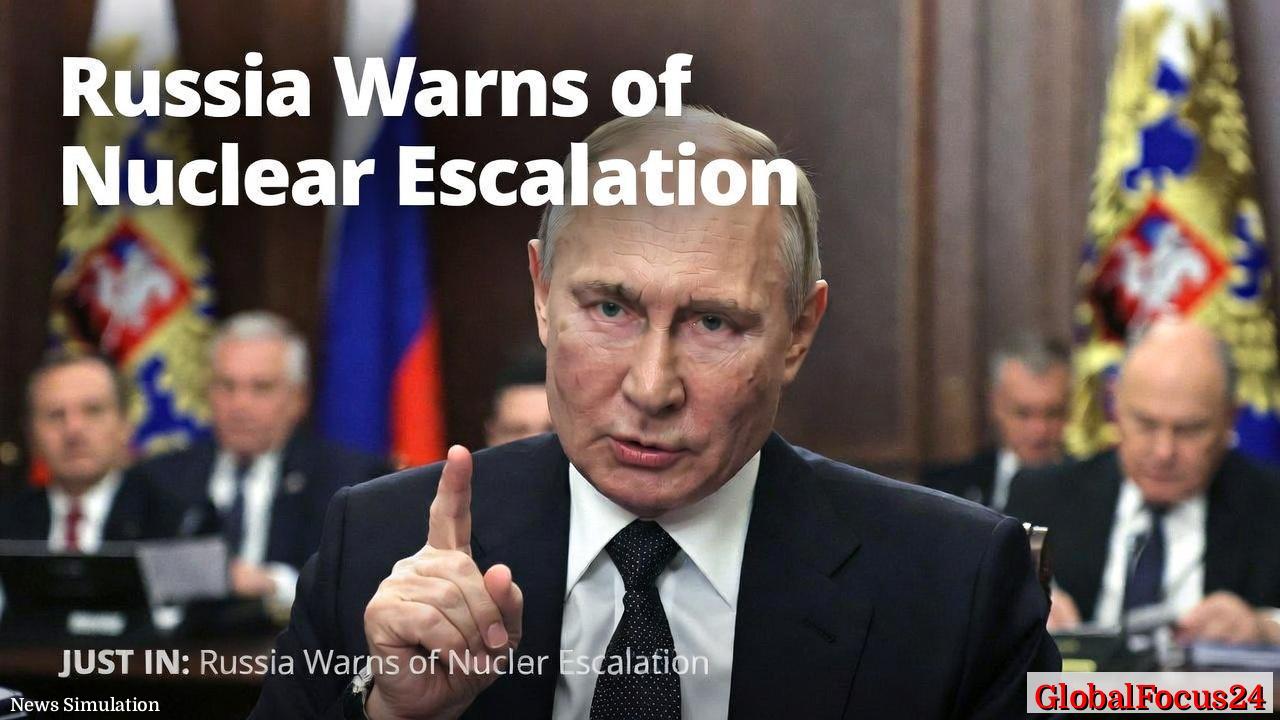
Russia Warns of “Severe Escalation” Over Alleged Western Plans to Arm Ukraine With Nuclear Capabilities
Rising Tensions in Europe’s Most Volatile Conflict Zone
Moscow has issued a stark warning, claiming that British and French elites are considering ways to provide Ukraine with nuclear or radiological weapons—raising the specter of one of the most dangerous escalations since the Cold War. President Vladimir Putin cautioned that such a move would represent a “severe escalation with catastrophic consequences,” amplifying alarm across Europe as the war in Ukraine nears its third year with no sign of resolution.
Russian officials said any transfer of nuclear or radiological technologies to Kyiv, whether for a functional nuclear bomb or a so-called “dirty bomb,” would constitute a direct violation of international law, including the Treaty on the Non-Proliferation of Nuclear Weapons (NPT). The statement, accompanied by warnings of potential “defensive measures,” represents one of Moscow’s most serious accusations against Western governments in recent months.
Moscow’s Claims and the Context Behind the Warning
The Russian Foreign Ministry alleged that conversations within Western defense and political circles, particularly in London and Paris, have included speculative ideas about enhancing Ukraine’s deterrence capabilities. While no verifiable evidence has been presented publicly, officials in Moscow argue that “even the discussion of such scenarios” signals a level of recklessness that endangers global stability.
Since the invasion of Ukraine in 2022, Russia has regularly accused Western countries of crossing “red lines” through military aid, including tanks, long-range missiles, and advanced air-defense systems. The alleged pursuit of nuclear or radiological weapons, if confirmed, would mark a new and unprecedented phase in the conflict.
A Legacy of Nuclear Restraint
The current tensions echo decades-old fears rooted in Europe’s nuclear history. Since the 1968 signing of the NPT, the global community has worked to limit both the spread and modernization of nuclear arsenals. Ukraine itself once held the world’s third-largest stockpile of nuclear weapons following the dissolution of the Soviet Union in 1991.
In 1994, under the Budapest Memorandum, Ukraine agreed to relinquish its inherited Soviet nuclear arsenal in exchange for security assurances from the United States, the United Kingdom, and Russia. The agreement has been frequently cited in debates about nuclear deterrence, especially following Russia’s 2014 annexation of Crimea and the 2022 full-scale invasion.
Analysts note that the recent Russian statements may partly reflect long-standing distrust over Western commitments and lingering resentment about NATO’s eastward expansion—issues that Moscow often ties to its security doctrine.
What Is a “Dirty Bomb”?
The phrase “dirty bomb” refers not to a nuclear device capable of a chain reaction, but to a conventional explosive that disperses radioactive material over an area, contaminating the environment and potentially causing mass panic. While the physical impact is far less catastrophic than a true nuclear detonation, the psychological and economic consequences can be profound.
Russia’s reference to British and French involvement in such projects has intensified debate in European capitals. Experts in nuclear security point out that Ukraine’s infrastructure includes medical and industrial sources of radioactive isotopes, which could, in theory, be repurposed for radiological weapons. However, there has been no public evidence of Ukrainian efforts to develop or deploy such capabilities.
Global Non-Proliferation Principles at Stake
The accusations have refocused international attention on the fragility of the global non-proliferation framework. Both France and the United Kingdom are recognized nuclear-weapon states under the NPT, with strict obligations to prevent the transfer of nuclear materials or technology to non-nuclear states. Any perceived violation of these commitments would severely undermine diplomatic credibility and could trigger a crisis not only in Europe but across the global security architecture.
The International Atomic Energy Agency (IAEA), which monitors nuclear activities worldwide, has not reported any detected diversion of nuclear materials in Ukraine. Still, Moscow’s assertions may increase pressure on the IAEA to verify and communicate the status of Ukraine’s civilian nuclear resources, especially as several of its nuclear power plants remain in war zones.
Historical Echoes and Strategic Fears
The current rhetoric recalls Cold War confrontations when both the United States and Soviet Union used nuclear signaling to assert dominance and deter perceived aggression. The 1962 Cuban Missile Crisis remains a key historical parallel, frequently cited by scholars warning of how misinformation, posturing, and rapid military escalation can spiral toward disaster.
In the modern context, the risk lies less in a deliberate nuclear launch and more in miscalculation. Experts argue that repeated threats, coupled with the fog of war and high-stakes rhetoric, increase the possibility that an unintended incident—such as a misinterpreted radar signal or a strike on a nuclear facility—could provoke an uncontrolled response.
Economic and Humanitarian Implications
Beyond the strategic dimensions, the fallout from renewed nuclear tensions could ripple through the global economy. Energy markets have already reacted nervously to past Russian warnings, and additional instability may push oil and gas prices higher. The European Union, still managing energy diversification after cutting dependence on Russian supplies, faces the prospect of renewed market volatility.
Financial analysts note that defense stocks across Europe and the United States often surge in response to heightened conflict rhetoric. However, broader sectors such as manufacturing and agriculture remain vulnerable to commodity price swings and supply-chain disruptions. For Ukraine, continued uncertainty over its security commitments may complicate reconstruction financing and access to global investment markets.
On a humanitarian level, the possibility of any radiological or nuclear incident poses grave risks for surrounding regions. The 1986 Chernobyl disaster, still vividly remembered in Ukraine and beyond, stands as a haunting reminder of the long-term damage radiation can inflict on ecosystems and human health. Any renewed contamination—accidental or deliberate—would compound the immense suffering already caused by the ongoing conflict.
Regional Reactions and Diplomatic Efforts
So far, official responses from London and Paris have not confirmed or addressed the Russian allegations directly. Western diplomats have consistently dismissed claims that Ukraine seeks nuclear capabilities, emphasizing that allied support remains confined to conventional defense systems. NATO has repeatedly declared that its assistance aims to help Ukraine defend itself against aggression, not to initiate new fronts of escalation.
Nevertheless, Moscow’s warnings have reignited fears among neighboring countries such as Poland, Hungary, and Slovakia—all NATO members bordering Ukraine. Regional observers note that even unfounded nuclear accusations can alter risk perceptions, prompting governments to reconsider defense postures and civil preparedness protocols.
China’s foreign ministry expressed concern over the growing rhetoric, urging “all relevant parties to refrain from actions that could intensify nuclear confrontation.” The United Nations Security Council is expected to review recent developments if tensions continue to escalate.
Strategic Significance and the Road Ahead
For Russia, framing the conflict in nuclear terms reinforces its message that the West is pushing the world toward a dangerous brink. For Western nations, the allegations may be viewed as an attempt to deter further arms deliveries to Kyiv by invoking global fears. The information war surrounding the conflict has become increasingly complex, with propaganda, misinformation, and strategic leaks shaping public opinion as much as battlefield developments.
While the veracity of Russia’s claims remains undetermined, their timing coincides with renewed Ukrainian appeals for advanced weaponry and continued Western funding. The narrative may therefore serve both military and diplomatic objectives—offering Moscow justification for future defensive actions while testing the cohesion of Western alliances.
A Precarious Balance
The latest exchange underscores how fragile the European security order has become. Nearly eight decades after the end of World War II, the continent once again faces the possibility of nuclear rhetoric turning into policy. Whether these warnings remain a matter of political signaling or presage a deeper crisis will depend on the responses of the United Kingdom, France, and NATO partners in the weeks ahead.
For now, the world watches carefully as familiar Cold War fears reemerge under new conditions—where a single misstep could ignite consequences far beyond Eastern Europe’s battlefields.