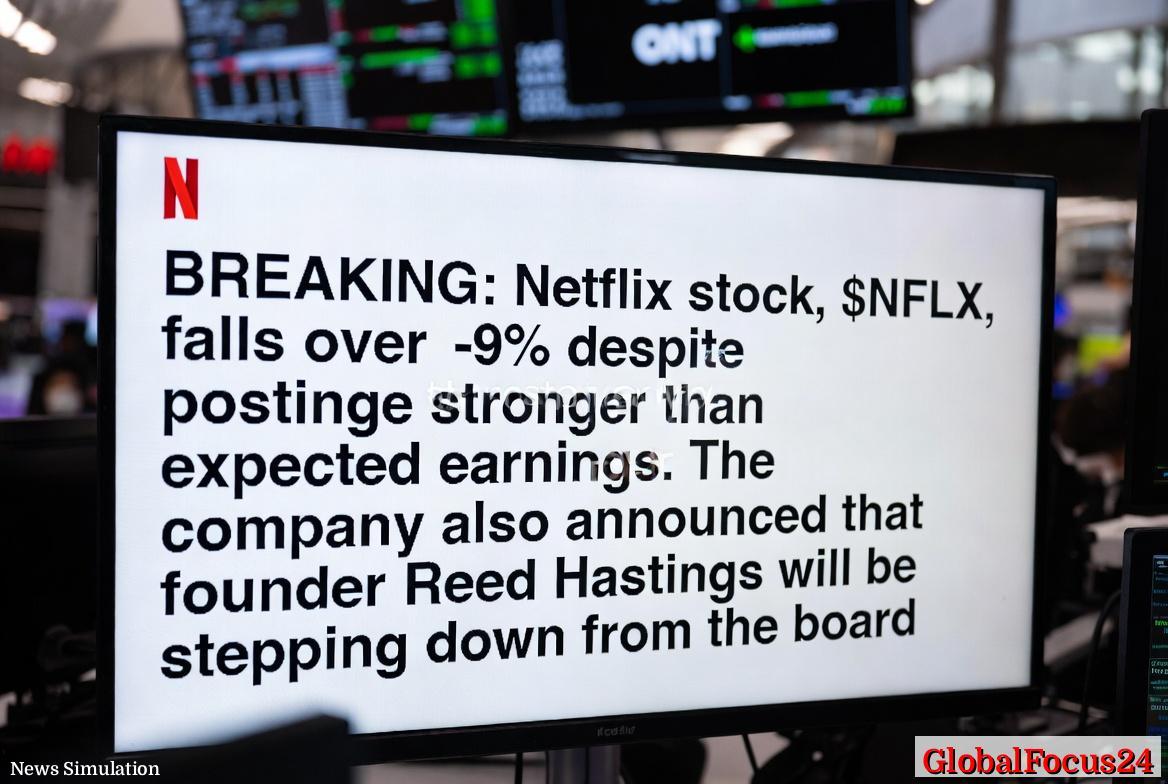
Netflix Stock Sinks Despite Strong Quarterly Earnings as Reed Hastings Announces Departure
Earnings Beat Expectations but Market Reacts Sharply
Netflix shares fell more than 9% in after-hours trading Thursday following the company’s first-quarter earnings release, despite results that surpassed Wall Street estimates. The streaming leader posted revenue of $12.25 billion, a 16% increase from a year earlier, while diluted earnings per share came in at $1.23. The quarter’s bottom line was influenced by a $2.8 billion one-time termination fee associated with the company’s deal with Warner Bros., which added a complex twist to the otherwise solid report.
Markets appeared unsettled by the sharp swing in post-market trading. While analysts had anticipated steady growth for the start of 2026, the magnitude of Netflix’s revenue jump could not offset investor concerns surrounding its forward guidance and leadership transition. The strongfigures were overshadowed by a cautious tone in Netflix’s second-quarter projections and news that co-founder and former CEO Reed Hastings would step down from the company’s board, signaling a new era for the company’s governance.
Revenue Growth Reflects Streaming Stability
Despite the stock drop, Netflix’s first-quarter results confirmed that demand for its streaming service remains resilient. The company’s 16% year-over-year revenue increase adds to a growing trend of recovery seen in the digital entertainment sector, which continues to rebuild momentum following the pandemic-era boom and subsequent normalization.
The streaming platform has successfully balanced subscriber retention with price increases, buoyed by sustained engagement in both domestic and international markets. Netflix’s diverse content catalog—ranging from high-budget original series and global co-productions to expanding live sports coverage—continues to draw audiences across key regions such as North America, Europe, and Asia-Pacific.
The company has faced increasing competition from Disney+, Max (Warner Bros. Discovery), Amazon Prime Video, and newer entrants like Apple TV+, all vying for subscriber growth as economic uncertainty tempers entertainment spending. With that backdrop, Netflix’s expansion of ad-supported tiers has become a critical strategy in reaching more budget-conscious consumers, driving incremental revenue even as subscription models evolve.
Strategic Shifts and the Warner Bros. Transaction
Central to the company’s recent financial narrative was the $2.8 billion termination fee linked to its Warner Bros. transaction. While Netflix did not disclose detailed terms of the agreement, analysts speculate that the fee marks the conclusion of a broader partnership discussion aimed at licensing and distribution rights. For shareholders, the transaction signals both an opportunity and a warning—Netflix’s bold approach to content acquisition can create short-term financial shockwaves even as it secures long-term flexibility in the streaming landscape.
This development underscores Netflix’s evolving role in the entertainment ecosystem. From its beginnings as a DVD-by-mail service in 1997, the company has transformed into one of the world’s most influential content platforms, reshaping global viewing habits and even production economics. That evolution has come at a cost—not only in financial outlays but in the immense pressure to sustain growth amid increasing market saturation.
By incorporating one-off items such as the Warner Bros. fee, Netflix maintains transparency while reminding investors of the volatility inherent to digital content licensing. Past examples, including similar negotiations with Universal and Paramount, reveal how strategic exits or renegotiations can create momentary turbulence while strengthening the company’s long-term autonomy.
Guidance Suggests Measured Growth Ahead
The streaming giant provided second-quarter revenue guidance of $12.57 billion, reflecting confidence in steady progress but a cautious stance given current market conditions. It reaffirmed its full-year 2026 revenue forecast between $50.7 billion and $51.7 billion, leaving investors with mixed feelings about how much growth remains before saturation forces slower expansion.
Recent months have seen Netflix integrate more non-traditional content formats—such as gaming, interactive storytelling, and live-streamed events—to diversify beyond its traditional binge-watching model. These initiatives may account for some optimism in the company’s guidance, though analysts remain watchful of how rising content costs and inflationary challenges globally could constrain profit margins.
In regional comparisons, North American subscriber growth continues to plateau, while Asia-Pacific and Latin American markets remain drivers of incremental expansion. Europe has steadied after currency fluctuations and regulatory shifts regarding digital content distribution. Netflix’s consistent international performance helps offset maturity in U.S. subscriptions but also requires ongoing investment in local-language productions and marketing to capture diverse audiences.
Reed Hastings Steps Away from the Board
A majoraccompanying Thursday’s earnings release was Reed Hastings’ decision not to stand for re-election to Netflix’s board at its annual meeting in June. Hastings, who co-founded the company nearly three decades ago, played a pivotal role in transitioning Netflix from mailbox DVDs to global streaming dominance. His departure marks a symbolic end to an era that defined how audiences consume entertainment.
In a statement, Hastings cited plans to pursue philanthropic and personal ventures, emphasizing confidence in Netflix’s leadership team under co-CEOs Ted Sarandos and Greg Peters. The company’s board, comprised of figures from technology, finance, and entertainment sectors, is expected to maintain its current composition with minor adjustments to fill Hastings’ vacancy later this year.
Industry reactions were largely reflective of Hastings’ enduring influence. Analysts noted that while he had gradually withdrawn from day-to-day operations since 2023, his presence on the board provided continuity and reassurance amid rapid change. Many credited his legacy for Netflix’s early adoption of streaming algorithms and its distinctive data-driven production strategies that continue to define modern media planning.
Historical Context: From Disruption to Domination
Netflix’s trajectory mirrors the broader shift in media consumption over the past two decades. When the platform began streaming video in 2007, few anticipated the massive upheaval it would cause across television, cinema, and advertising sectors. By 2013, the debut of original programming like “House of Cards” opened a new chapter in direct-to-consumer content creation, forever altering how audiences discover and discuss shows.
Throughout economic cycles—from the Great Recession to the pandemic aftermath—Netflix has been a bellwether for digital entertainment resilience. Its ability to pivot, whether by adjusting pricing, experimenting with release schedules, or introducing localized content, has allowed it to sustain engagement despite global challenges such as bandwidth constraints, inflation, and shifting licensing agreements.
Today, Netflix boasts one of the largest subscriber bases in the streaming industry, estimated at over 270 million worldwide. That scale grants immense leverage in negotiations and distribution but also raises expectations among shareholders for innovation and fiscal discipline.
Market Reaction and Analyst Commentary
Thursday’s after-hours decline in Netflix stock—down more than 9%—highlighted investor sensitivity to leadership changes and long-term profitability signals rather than short-term earnings strength. Analysts describe the reaction as “margin-driven,” meaning the one-time fee and modest guidance tempered enthusiasm about the underlying business momentum.
Several investment firms revised their near-term price targets but maintained generally positive outlooks on Netflix’s multi-year trajectory. Many expect the company to continue outperforming peers in global subscriber engagement, even as competition intensifies in ad-supported streaming and bundled media platforms.
Market volatility surrounding tech and media stocks this year has magnified investor responses to corporate transitions. Netflix’s drop mirrors similar patterns seen at other major entertainment firms—Disney after executive changes and Warner Bros. during its restructuring—reflecting how leadership announcements can influence investor sentiment as much as financial metrics.
Broader Implications for the Streaming Industry
Netflix’s mixed market reaction has implications that extend beyond its own stock performance. As the streaming sector matures, the company’s results serve as a barometer for broader consumer trends and economic pressures within digital entertainment.
Rising production costs, global copyright regulation, and competition from free ad-supported television (FAST) channels continue to reshape industry profitability. The first quarter’s strong subscriber stability, combined with Netflix’s commitment to diversified content structures, suggests the streaming ecosystem may be entering a more sustainable—though less explosive—phase of growth.
Regional comparisons show U.S. services focusing on consolidation, European platforms tightening compliance standards, and Asian providers expanding aggressively with localized content strategies. Netflix’s navigation of these trends positions it at the center of global entertainment economics, balancing creative risk with data-driven predictability.
The Road Ahead
As Netflix prepares for its second-quarter performance and Reed Hastings transitions away from formal leadership, the company faces both opportunity and uncertainty. Investor focus will likely turn toward how effectively management executes its diversified content and advertising strategies while maintaining cost efficiency in an increasingly competitive field.
If Netflix can sustain revenue growth through 2026 and uphold disciplined guidance amid economic fluctuations, its legacy as the dominant streaming platform will remain intact. However, Thursday’s stock reaction underscores the delicate balance between innovation and financial stability—a challenge that every major player in the digital entertainment age must now confront.
Netflix’s story has always been one of transformation. From red envelopes to global streaming supremacy, the company’s ability to reinvent itself continues to define modern entertainment. Whether its next evolution succeeds as resoundingly as its last may depend on how it navigates this moment—marked by record revenue, an iconic founder’s departure, and a market eager for its next chapter.