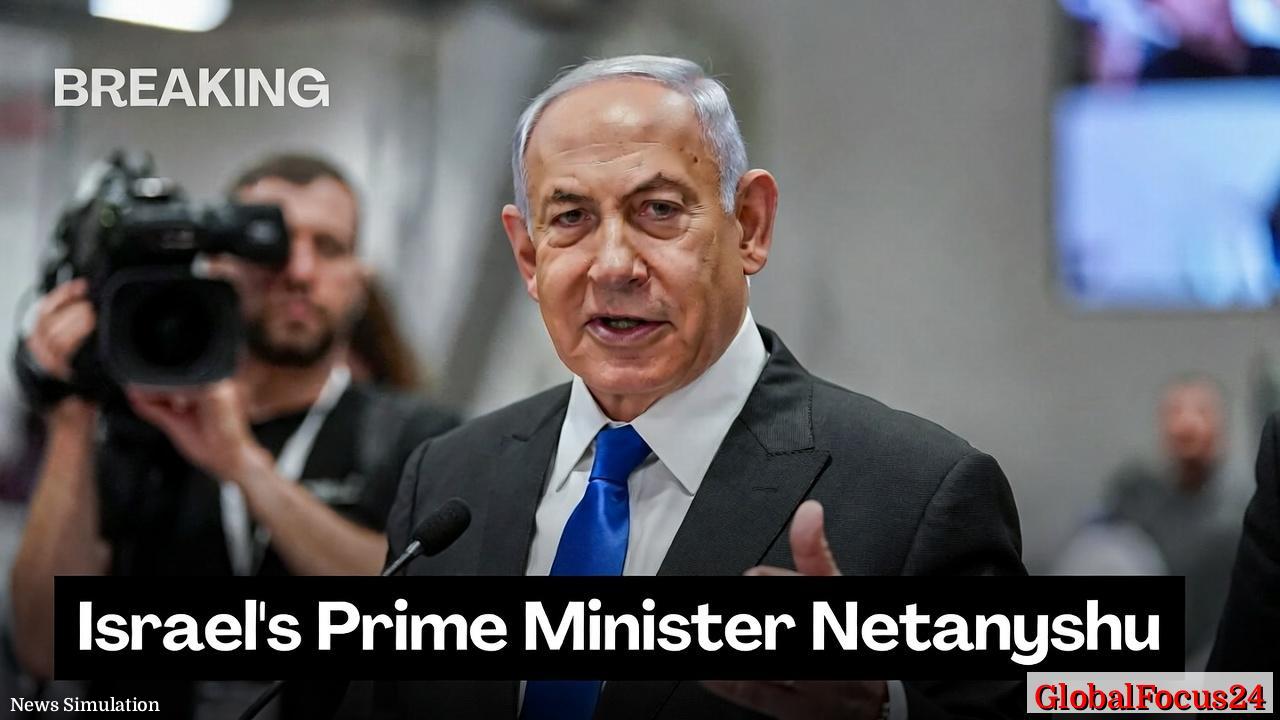
Netanyahu Suggests Iran’s Supreme Leader Khamenei May Be Dead After Joint U.S.-Israeli Strikes
Reports Stir Uncertainty Over Iran’s Leadership
Tensions across the Middle East surged late Friday after Israeli Prime Minister Benjamin Netanyahu suggested that Iran’s Supreme Leader, Ayatollah Ali Khamenei, may have been killed in recent joint U.S.-Israeli airstrikes on Tehran. In a televised address, Netanyahu claimed the coordinated attacks “eliminated the tyrant who terrorized the world for decades,” describing Khamenei as responsible for spreading aggression and repression inside Iran and beyond its borders.
According to Netanyahu, the strikes targeted Khamenei’s main residence and command center in northern Tehran, allegedly destroying parts of the compound. He said that several senior commanders of Iran’s Islamic Revolutionary Guard Corps (IRGC) and figures involved in the country’s nuclear program were also killed. The Israeli leader indicated that military operations would “continue as long as necessary” to assist Iranians seeking to overturn their current regime.
While Netanyahu’s remarks electrified global news cycles, the Iranian government swiftly denied the claims. Foreign Minister Hossein Amir-Abdollahian declared in televised comments that Khamenei was “alive and overseeing national defense operations.” Iran’s state-controlled outlets have maintained silence on the matter, prompting speculation and uncertainty across the country.
Conflicting Accounts and Information Blackout
Confusion deepened on Saturday as Iranian media offered only sporadic coverage of the missile barrages and failed to broadcast images or statements from Khamenei, who, at 86, has led the Islamic Republic since 1989. Independent reports from Tehran described widespread internet disruption and increased security patrols in major cities.
Unofficial channels circulated claims that parts of central Tehran had been sealed off following explosions late Thursday, though these accounts could not be verified. Residents reported hearing air raid sirens in several neighborhoods, with some shelters reportedly overflowing as missiles struck near military sites.
International intelligence agencies have so far declined to confirm whether Khamenei was present at the targeted location. Pentagon officials, speaking on condition of anonymity, interpreted Netanyahu’s statement cautiously, emphasizing that the operation’s objective was to neutralize Iran’s ongoing missile and nuclear capabilities rather than any specific individual.
U.S. and Israel Deepen Coordination
The joint operation marks one of the most aggressive military collaborations between the United States and Israel in recent years. Analysts say the airstrikes represented a clear message to Tehran after months of escalating proxies’ attacks in Iraq, Syria, and the Red Sea. Washington reportedly supplied real-time intelligence, while Israeli aircraft carried out precision strikes using stand-off munitions.
President Donald Trump, in separate remarks, told reporters the mission “removed one of the greatest threats to peace in the Middle East.” The statement added a new layer of uncertainty, suggesting U.S. leadership was aware of possible confirmation regarding Khamenei’s death. Officials from the National Security Council declined to elaborate on operational details, citing ongoing assessments.
The cooperation echoes earlier joint missions, including cyber operations against Iranian nuclear infrastructure during the early 2010s. However, observers note that this strike—if confirmed to have killed Iran’s supreme leader—would represent a historic escalation in direct action between the two nations.
A Turning Point in Iran’s Political History
Ayatollah Ali Khamenei rose to power in 1989 following the death of Ayatollah Ruhollah Khomeini, architect of Iran’s 1979 Islamic Revolution. Over the ensuing decades, Khamenei consolidated influence across the military, political, and religious spheres, effectively transforming the Supreme Leader’s post into the ultimate center of authority in Iran.
His rule was characterized by a blended ideology of religious conservatism and nationalist defiance, particularly toward Western powers. Khamenei’s support for proxy movements—from Hezbollah in Lebanon to the Houthis in Yemen—helped cement Iran’s regional clout while isolating it economically under layers of U.S. and European sanctions.
If confirmed, his death would create the most significant power vacuum since the revolution’s early years. The Assembly of Experts, responsible for choosing the next Supreme Leader, has not publicly met in months, and its leading members are aging clerics with varying loyalties. Potential successors include President Ebrahim Raisi and Khamenei’s son Mojtaba, though both face internal resistance. Political analysts warn that any succession crisis could trigger infighting among the Revolutionary Guards, clerical establishment, and reformist factions.
Economic Fallout and Energy Market Shock
News of the strikes sent immediate ripples through global oil markets. Brent crude surged above $105 per barrel as investors braced for potential retaliatory disruptions in the Strait of Hormuz, through which roughly one-fifth of global petroleum shipments pass. Energy experts fear that sustained instability could reverse recent declines in fuel prices and drive inflation higher across major economies.
Within Iran, economic activity was paralyzed as panic spread about possible further attacks. The Tehran Stock Exchange reportedly suspended trading amid sharp sell-offs, while the rial slipped further against the dollar in unofficial markets. Sanctions already weakened the country’s financial system; new uncertainty over leadership may further erode confidence in Iran’s ability to maintain trade or stabilize oil exports.
Regional economies are bracing for collateral impacts. Gulf states like the United Arab Emirates and Saudi Arabia temporarily heightened security at major ports and energy facilities. In Europe, governments convened emergency energy consultations amid fears of pipeline disruptions or retaliatory cyberattacks on infrastructure.
Regional and Global Reactions
Across the Middle East, reactions have ranged from celebration to alarm. In Tel Aviv and Jerusalem, spontaneous gatherings formed late Friday, with crowds waving Israeli flags and chanting slogans in support of the military operation. In contrast, public anger boiled over in Tehran and several Iranian provincial cities, where demonstrators blamed Israel and the United States for the attacks and called for retribution.
Neighboring Iraq and Lebanon, both deeply influenced by Iran-backed militias, reported heightened alert levels. Western embassies across the region issued new travel advisories urging citizens to avoid border areas and critical transit hubs.
European Union officials urged restraint, calling for “clarity and calm” amid unverified claims about Khamenei’s fate. Russia and China condemned the airstrikes as violations of international law and demanded a full investigation at the United Nations Security Council.
Retaliation and Escalation Risks
Iran’s military responded within hours of the reported strikes, launching a series of missile attacks targeting Israeli territory and U.S. installations in Iraq and Kuwait. Israel’s Iron Dome and Arrow defense systems intercepted many incoming projectiles, though several impacts were recorded in the Negev desert and near Beersheba. Casualty figures remain unclear.
U.S. military outposts across the region were placed on maximum readiness. Officials confirmed limited damage at one base in western Iraq but no major injuries. Analysts warn that Iran’s capacity for asymmetric warfare—including cyber operations, maritime disruption, and activation of allied militias—remains substantial even amid leadership uncertainty.
If Iran’s leadership transition collapses into internal chaos, regional actors including Turkey, Saudi Arabia, and the UAE may move to recalibrate diplomatic and security strategies. An internal power struggle could weaken Tehran’s support for proxy networks, potentially reshaping dynamics in Lebanon, Syria, and Yemen.
Historical Parallels and Strategic Consequences
This potential turning point recalls moments of sudden regime change that reshaped the Middle East, such as the fall of the Shah in 1979 or the death of Egyptian President Gamal Abdel Nasser in 1970. Both transitions unleashed waves of political reorganization and identity crises across the region.
For Iran, Khamenei’s possible death could redefine the ideological foundation of the Islamic Republic. Since its inception, the system has revolved around “Velayat-e Faqih,” or guardianship of the Islamic jurist—a doctrine that grants ultimate authority to a supreme religious scholar. Losing Khamenei could spark calls from younger Iranians, already disillusioned with clerical control, to push for democratic reforms.
At the same time, hardliners within the IRGC might attempt to preserve the old order through military dominance, potentially steering Iran toward a more overtly authoritarian, militarized model. Such a transformation would affect global negotiations over nuclear policy, sanctions, and the future of the Joint Comprehensive Plan of Action (JCPOA), which collapsed in the late 2010s.
Uncertain Future Amid Fragile Calm
As Sunday dawned, Tehran remained tense but mostly calm under heavy security presence. Pilgrims visiting mosques were searched, communication lines were restricted, and rumors continued to swirl online. For many Iranians, the situation fueled both dread and reluctant hope—dread over potential conflict, but hope that long-promised change might finally emerge.
Whether Ayatollah Khamenei is truly dead or merely in hiding, the coming days will determine not only the fate of Iran’s leadership but the trajectory of an entire region already exhausted by decades of confrontation. The next chapter will depend on whether pragmatism or vengeance prevails in Tehran—and on how far Washington and Jerusalem are prepared to go in reshaping the Middle East’s political map.