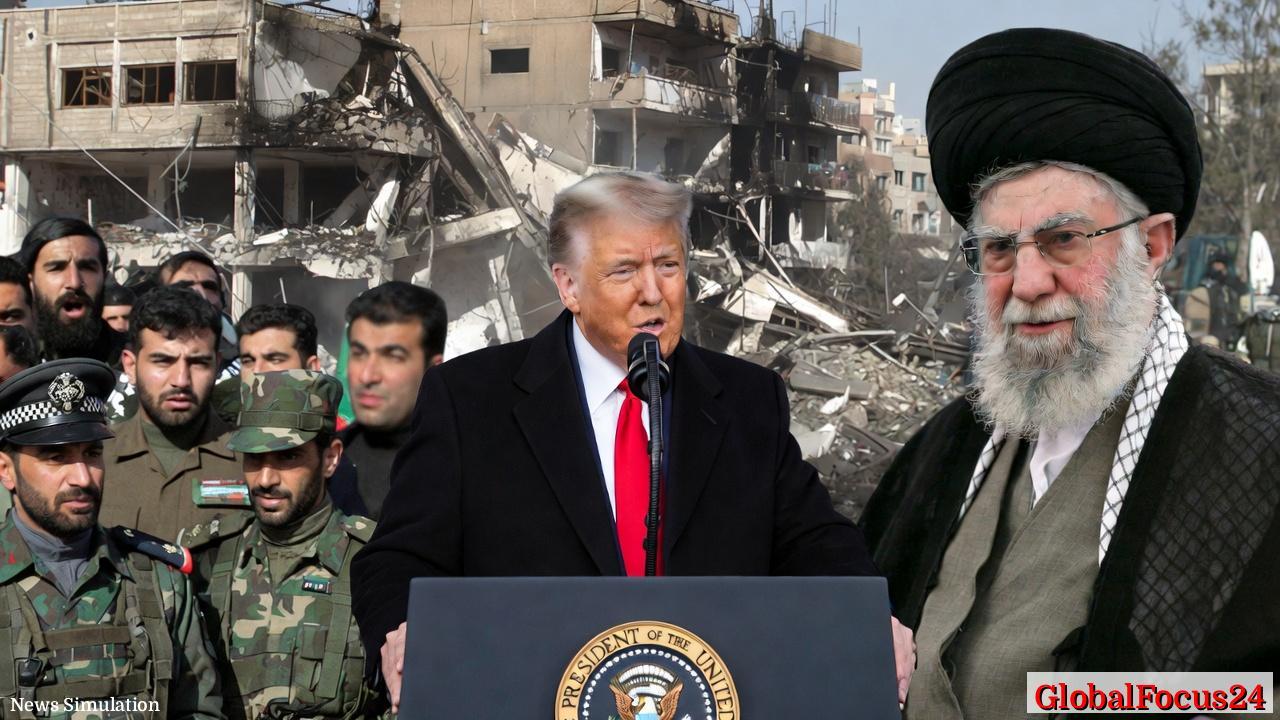
Ayatollah Ali Khamenei Killed in U.S.-Israeli Strikes: Middle East on Edge After Iran’s Supreme Leader’s Death
Historic Strike Targets Iran’s Leadership Core
TEHRAN, Iran — In a dramatic escalation that has sent shockwaves across the Middle East, Iran’s Supreme Leader Ayatollah Ali Khamenei was killed early Saturday in a coordinated U.S.-Israeli airstrike on Tehran, according to Iranian state media. The attack, described as one of the most significant military operations in the region since the 2003 invasion of Iraq, targeted multiple high-value locations linked to Iran's leadership, including Khamenei’s official compound and the offices of the Islamic Revolutionary Guard Corps (IRGC).
The Pentagon confirmed that precision-guided munitions were used in the pre-dawn assault, which reportedly destroyed command centers tied to Iran’s military and intelligence networks. U.S. officials described the operation as a decisive step against “ongoing threats to global stability.”
Images and footage emerging from Tehran showed plumes of smoke rising over the capital, with emergency vehicles swarming through the heavily fortified neighborhoods surrounding Khamenei’s residence. Iranian officials declared a state of emergency, imposing curfews in several provinces as communication networks went down intermittently throughout the day.
A Leader Who Defined Post-Revolution Iran
Ayatollah Ali Khamenei, who assumed the role of Supreme Leader in 1989 following the death of Ayatollah Ruhollah Khomeini, presided over Iran for 37 years — a tenure marked by deep ideological rigidity, political repression, and persistent confrontation with the West.
Born in Mashhad in 1939, Khamenei rose from a relatively obscure clerical background to become one of the most influential religious and political figures in modern Iranian history. As a former president before succeeding Khomeini, he consolidated power across all branches of government, maintaining tight control over Iran’s armed forces, the judiciary, and the state-run media.
Under his leadership, Iran expanded its regional influence through proxies and militias, supporting groups such as Hezbollah in Lebanon, the Houthis in Yemen, and various Shiite factions in Syria and Iraq. His anti-Western rhetoric and unwavering stance against Israel defined Iran’s foreign policy for decades.
Khamenei’s death thus represents not only a political turning point but also the collapse of a symbolic pillar of Iran’s revolutionary identity — a moment that analysts believe could reshape the regional balance of power for years to come.
Global Reactions and Immediate Fallout
In Washington, President Donald J. Trump confirmed Khamenei’s death during a televised address, calling him “one of the most evil people in history.” The President said the operation was part of an ongoing effort to “eliminate state sponsors of terrorism and restore hope to the Iranian people.” He credited U.S. intelligence agencies and close cooperation with Israel for the success of the mission.
Trump added that U.S. forces would continue operations “until peace is achieved in the Middle East and beyond,” hinting at a sustained military campaign targeting Iran’s remaining command structures.
Israel’s Prime Minister echoed similar sentiments, describing the strike as a “watershed moment” for regional security. Israeli Defense Forces remain on high alert, anticipating potential retaliatory strikes from Hezbollah and Iranian-backed militias in Syria.
Iran immediately vowed retaliation. Within hours of the strike, Iranian missiles were launched toward U.S. bases in Iraq and Kuwait, with explosions reported near Erbil and Basra. The extent of casualties remains unclear, but military analysts warn that a wider escalation may be imminent.
Streets of Tehran: Shock and Mourning
The mood in Tehran on Saturday night was one of disbelief and grief. Thousands of Iranians poured into the streets despite heavy security presence, many chanting religious hymns and carrying posters of Khamenei draped in black.
State television announced a 40-day mourning period and suspended regular programming, replacing it with funerary music and archival footage of the Supreme Leader’s speeches. In a televised statement, interim officials praised Khamenei as a “martyr of resistance” and called on citizens to remain united “against aggression.”
Local reports indicate that the government has declared a week of public holidays, with schools, businesses, and government offices closed nationwide. However, signs of anxiety are palpable, particularly as the identity of Khamenei’s successor remains uncertain.
Succession Crisis and Political Uncertainty
The death of Ayatollah Khamenei leaves Iran without a clearly designated successor. The Assembly of Experts, the clerical body constitutionally tasked with selecting the next Supreme Leader, is expected to convene in emergency session over the coming days.
Multiple factions within the regime are reportedly maneuvering to fill the power vacuum. Among the potential contenders are Ebrahim Raisi, Iran’s late president who perished in 2024, and Mojtaba Khamenei, the Supreme Leader’s son, though his political future remains ambiguous.
If Mojtaba were to ascend to leadership, it would mark the first hereditary transfer of power in the Islamic Republic, potentially igniting fierce internal debate. Conversely, a leadership struggle among more moderate clerics or military elements could fracture the elite establishment, setting off a new phase of instability within Iran.
Historical Context: From Revolution to Retaliation
Iran has experienced moments of leadership crisis before, but none on this scale since the 1979 Islamic Revolution. At that time, Ayatollah Khomeini’s overthrow of the Shah ushered in a theocratic regime built around clerical authority and anti-Western ideology — a model perpetuated by Khamenei for nearly four decades.
The U.S.-Iran relationship has been defined by cycles of confrontation since 1979, from the hostage crisis to the Iran-Iraq War and later nuclear tensions. The killing of Khamenei marks a historic rupture in those relations, likely to be remembered alongside the assassinations of figures like Qassem Soleimani in 2020 as milestones in the long shadow war between Tehran and Washington.
Unlike past confrontations, however, this strike targeted the very heart of Iran’s political structure rather than its military leadership alone — a shift that analysts describe as “regime-level engagement.”
Regional and Economic Repercussions
The immediate market response to the strike was swift and severe. Global oil prices surged more than 20 percent within hours of the news, crossing the $130-per-barrel mark for the first time since 2022. Traders feared disruptions to key shipping lanes through the Strait of Hormuz, where nearly one-fifth of the world’s crude oil passes daily.
Neighboring countries, including Saudi Arabia, the United Arab Emirates, and Iraq, have heightened border security amid intelligence warnings of potential proxy attacks. Financial analysts predict volatility across global energy markets, with ripple effects likely to hit European and Asian economies dependent on Gulf oil.
In the long term, the destabilization of Iran — OPEC’s third-largest producer — could significantly alter production dynamics, giving Saudi Arabia and other Gulf producers expanded influence over pricing and supply agreements.
Meanwhile, Iran’s internal economy, already weakened by years of sanctions and inflation exceeding 45 percent, faces near paralysis. With much of the country’s leadership incapacitated and communication lines severed, the rial plunged against the U.S. dollar in early unofficial trading.
Public Sentiment and the Prospect of Change
While mourning dominates official broadcasts, evidence of public unrest is emerging. Social media clips circulating through encrypted channels show small groups celebrating the end of Khamenei’s rule, interpreting the strike as a potential path toward freedom.
Exiled Iranian activists have called on citizens to seize the moment, with online campaigns urging unity among the military, police, and civilians. Reports indicate that some IRGC soldiers have abandoned posts in northern and western provinces, while others appealed for clemency through unofficial diplomatic channels.
Observers in Tehran suggest that if opposition groups manage to organize amid the current chaos, Iran could face a political transition unprecedented since the fall of the Shah. However, the specter of violent repression remains, especially if the regime’s surviving commanders rally around hardline continuity.
The Uncertain Road Ahead
International diplomats have begun emergency consultations to prevent the conflict from engulfing the wider region. The United Nations Security Council is expected to convene an emergency session to discuss potential ceasefire frameworks and humanitarian measures.
For now, the skies over Iran remain tense. U.S. and Israeli aircraft continue to patrol, and satellite imagery indicates further strikes against IRGC infrastructure in western Iran. As funerary banners go up across Tehran, the world watches anxiously to see how Iran — and its more than 85 million citizens — will navigate a future without the man who defined its modern identity.
Whether Khamenei’s death will usher in a new beginning for Iran or unleash deeper turmoil across the Middle East remains to be seen. But for the first time in nearly four decades, the Islamic Republic stands at a crossroads, its destiny uncertain, its leadership decapitated, and its people suspended between mourning and the faint possibility of change.