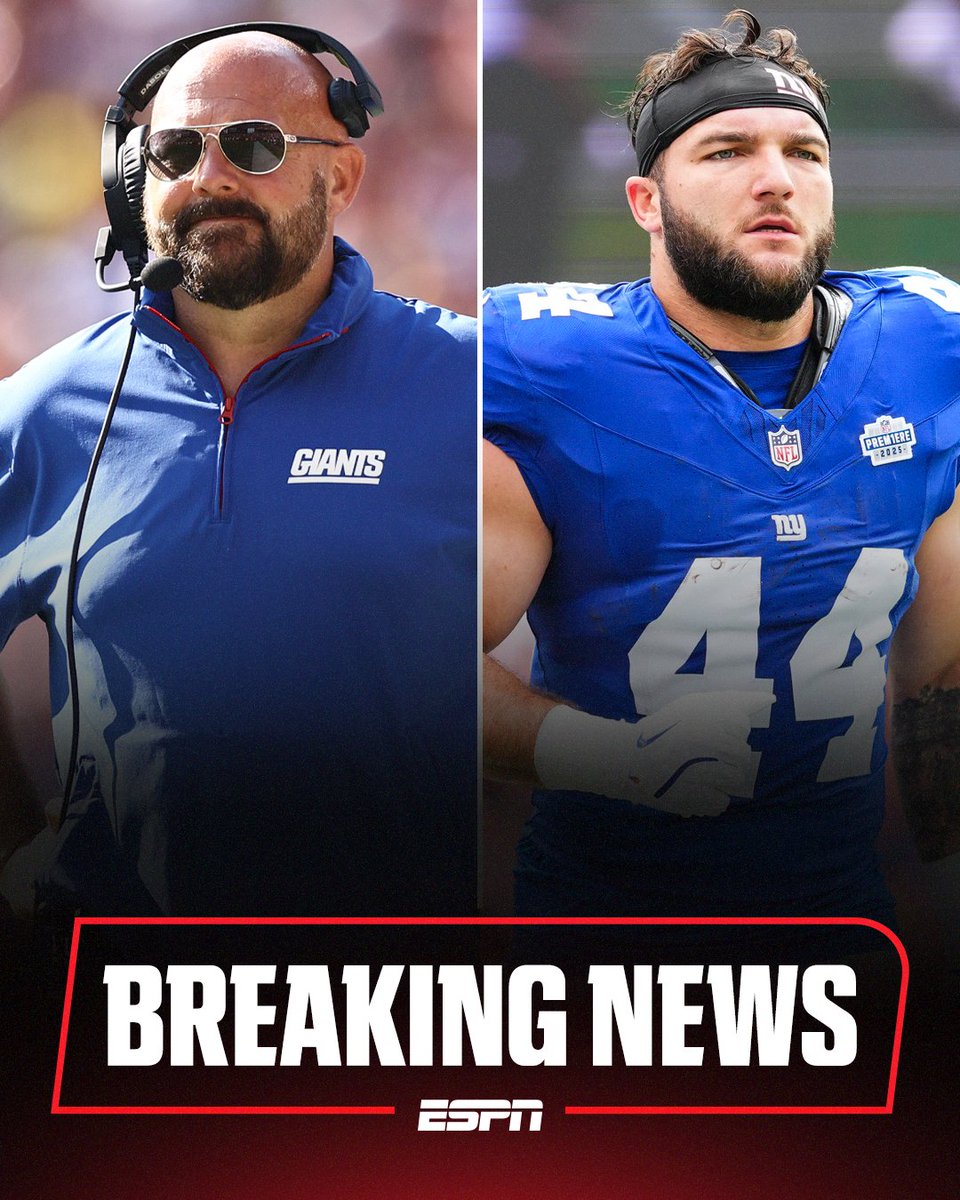
NFL Fines Giants, Coach Daboll and RB Skattebo for Concussion Protocol Violation
New York, NY — The NFL has levied a total of $315,000 in fines against the New York Giants, head coach Brian Daboll, and running back Cam Skattebo after determining that the team violated league concussion protocols during a recent practice incident involving quarterback Jaxson Dart. The decision underscores the league’s increasingly uncompromising stance on player safety amid heightened awareness of head injury risks across professional football.
The Giants organization was fined $200,000, Daboll was personally fined $100,000, and Skattebo was penalized $15,000 for his role in interfering with the concussion assessment process. According to the league’s report, Skattebo, who is certified in concussion awareness but not licensed to perform in-game evaluations, entered the team’s medical tent during Dart’s evaluation and disrupted the independent medical team’s work.
This marks the second violation of concussion safety standards by the Giants in under a year, a pattern that has drawn the attention of league officials and raised questions about internal compliance procedures. The NFL, which has faced mounting pressure from players’ unions, health experts, and fans, stated that it will continue to monitor the Giants closely for further infractions.
Concussion Protocols and the Giants’ Repeat Offense
Under current NFL policy, every concussion evaluation must be conducted by both team medical personnel and an independent neurological consultant. The presence of unauthorized individuals — even players — in the examination area is strictly prohibited to maintain medical independence and avoid influence over the process. The blue medical tent, a fixture on every NFL sideline and at practices, is a confidential area meant exclusively for medical evaluation and diagnosis.
In this latest incident, sources indicate that Dart sustained a potential head injury during a midweek practice drill involving multiple linemen and defensive backs. After the quarterback appeared disoriented, medical staff directed him to the sideline for mandatory testing. Witnesses reported that Skattebo entered the tent shortly after Dart was brought in, engaging with both team doctors and the player. League investigators concluded that this presence “compromised the neutrality of the assessment,” a key requirement of the concussion protocol.
The Giants were cited for organizational failure to enforce boundaries between on-field personnel and medical evaluators. The violation mirrors an episode from the 2024 preseason, when a team trainer reportedly rushed a player back onto the field without completing a full neurologic exam. That earlier incident led to a smaller fine and a formal warning but stopped short of triggering probationary oversight. This second breach, however, may prompt the league to increase compliance monitoring of the franchise.
Jaxson Dart’s Status and Team Response
Quarterback Jaxson Dart, considered one of the Giants’ most promising young talents, was cleared after the incident but was held out of Thursday’s practice as a precaution. According to the team’s injury report, Dart is listed as day-to-day ahead of Sunday’s game, with evaluations continuing under standard return-to-play protocols. Team insiders describe his symptoms as “mild and resolving,” but the franchise declined to provide further specifics.
Giants officials said in a brief statement that they had received notice of the fines and would not comment further until their internal review concludes. The organization reiterated its “full commitment to upholding player safety and NFL health standards.” Coach Brian Daboll did not directly address the penalties in his media availability but expressed support for the league’s overall safety initiatives, emphasizing a need for “communication and clarity” in medical protocols.
Skattebo, reached by reporters Friday morning, stated simply that he “regrets the misunderstanding” and supports the medical staff’s decisions. Though the league’s report characterized his actions as interference, those close to the team have suggested he entered the tent out of concern for Dart’s wellbeing rather than to influence medical findings.
The NFL’s Broader Commitment to Player Safety
The NFL has made concussion protocol compliance a defining element of its modern player safety strategy. Following years of public criticism and litigation over inadequate responses to brain injuries, the league has adopted increasingly strict rules on medical independence and oversight. Infractions now carry not only financial penalties but also the potential for personnel suspensions and loss of draft assets if deemed egregious or repeated.
Since 2016, the number of verified concussion protocol violations has decreased, reflecting the league’s efforts to train coaches, players, and staff on proper procedures. However, the Giants’ repeated infractions represent a setback in the broader compliance effort. League officials believe continued enforcement is vital to maintaining credibility with players and the public.
NFL medical consultant Dr. Henry Lawson stated in a press briefing that the league cannot compromise on protocol enforcement: “The integrity of the concussion evaluation process depends on it. Even well-intentioned interference undermines both the player’s safety and the league’s reputation for medical independence.”
Historical Challenges with Concussion Policy
The NFL’s journey toward improved concussion management has been shaped by a history of controversy. In the early 2000s, studies linking repeated head trauma to chronic traumatic encephalopathy (CTE) led to lawsuits and a fundamental reevaluation of league practices. The introduction of the independent neurological consultant model in 2013 marked a turning point, creating stricter boundaries between team interests and medical judgment.
In several high-profile cases — including those involving players from Miami, Pittsburgh, and Kansas City — protocol violations led to hefty sanctions and, in rare cases, temporary staff suspensions. Each incident reinforced the league’s message that player safety must transcend competitive pressures.
Against this backdrop, the Giants find themselves navigating not only the financial repercussions of fines but the reputational challenges associated with recurring noncompliance. While $315,000 is a manageable financial penalty for an NFL franchise, the optics of repeat violations could amplify scrutiny from both the Players Association and NFL fans.
Economic and Reputational Impact for the Giants
The immediate financial cost will be split across organizational and personal accounts: $200,000 from the team’s operational funds, deducted from its salary cap allowance, and $115,000 cumulatively from Daboll and Skattebo. Beyond the numbers, the fine carries broader implications for the Giants’ internal structure and medical trust framework.
In the modern NFL, a team’s reputation for medical diligence often influences its standing in free agent markets. Players and agents prioritize franchises with strong safety cultures, particularly after years of head injury debate. The Giants’ recent pattern may complicate future negotiations with players wary of insufficient medical autonomy.
Moreover, the incident could prompt changes in internal policy. Analysts expect the franchise to implement stricter access control for medical areas and designate a new compliance officer responsible for regular training sessions on league requirements. These measures would mirror steps taken by teams like the Los Angeles Rams and New England Patriots after past health-related infractions.
Regional Comparisons and League Trends
Across the league, enforcement of health and safety measures has become more uniform thanks to revised oversight protocols introduced in 2022. Many franchises — notably those in California and Texas — have invested heavily in expanded medical facilities and independent consultant partnerships to meet compliance standards and avoid financial or reputational setbacks.
The Giants’ latest fine stands out as an anomaly within the NFC East, where other franchises have avoided major penalties since the reforms took effect. By contrast, the NFC North and AFC South have each recorded multiple fines for procedural lapses over the past two seasons, underscoring that while the system has improved, inconsistencies persist among teams adapting to ever-evolving medical demands.
Analysts note that New York’s large media market amplifies both scrutiny and consequence. In a region where sports coverage dominatess and fan expectations remain high, missteps in player safety protocols can quickly transcend sports pages and feed into broader debates about athlete welfare and leadership responsibility.
Looking Ahead: Reinforcing a Culture of Accountability
The NFL’s decision to fine the Giants reinforces its determination to uphold integrity in concussion management, a principle at the heart of recent reforms. For the Giants, the path forward will depend on their willingness to correct systemic lapses and rebuild confidence among players, fans, and regulators.
League insiders expect Commissioner Roger Goodell’s office to require formal retraining sessions for all coaching and medical personnel within the organization. These sessions, designed both as penalty and preventive measure, aim to ensure no further ambiguity regarding who may access medical evaluation zones.
Brian Daboll, known for his disciplined coaching style and player rapport, now faces the challenge of turning this moment into a learning opportunity for his staff. As the Giants prepare for a pivotal stretch in their season, the balance between competitive urgency and safety compliance will define the team’s ability to move past the controversy.
Conclusion
The $315,000 fine levied against the New York Giants, Coach Brian Daboll, and Cam Skattebo represents more than just a financial penalty — it underscores the NFL’s ongoing campaign to enforce the strictest standards of player safety and medical independence. As the league continues refining its concussion protocols and punishing breaches with increasing severity, the Giants’ experience serves as a cautionary example for all franchises navigating the delicate intersection between competition, care, and compliance.
The coming weeks will reveal whether the organization can reinforce its internal systems and regain the league’s confidence. For now, the message from the NFL is clear: in today’s game, no team — regardless of history, market size, or intent — stands above the rules designed to protect the minds and futures of its players.