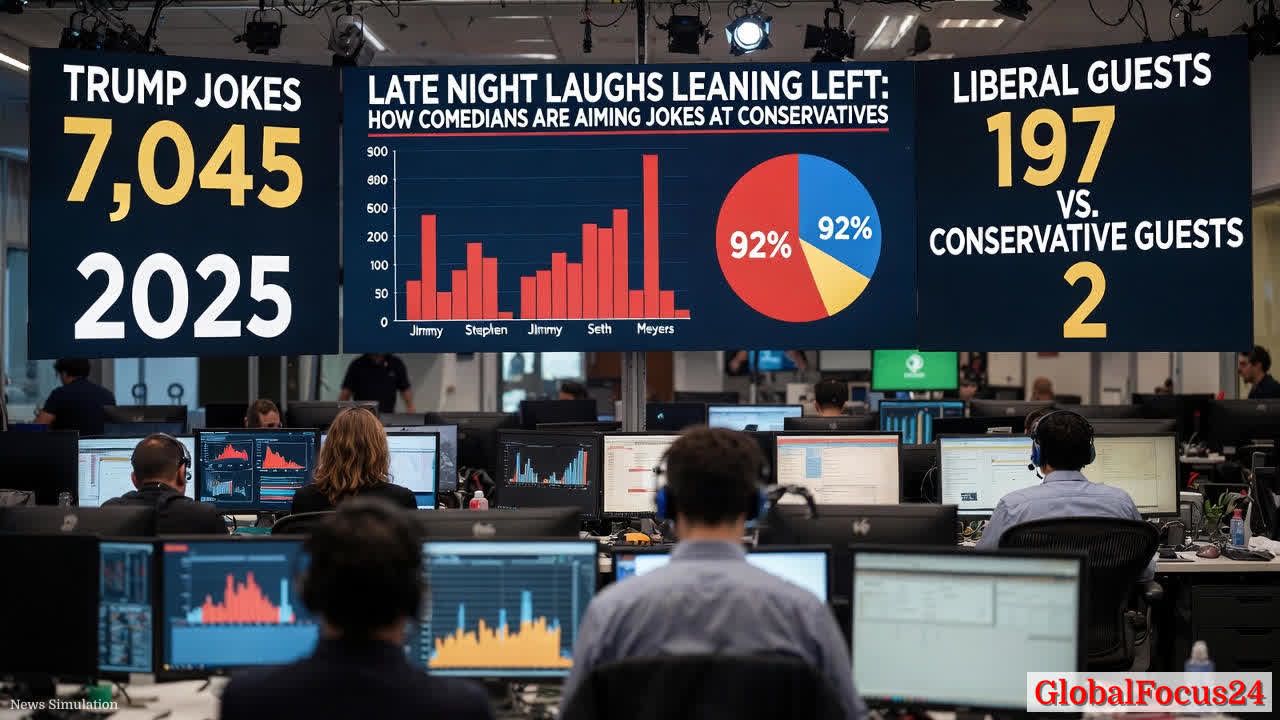
Late-Night Comedy Shifts Left: A Comprehensive Look at 2025's Keyboarded Narrative
Across the late-night television landscape, a discernible shift has intensified in 2025: monologues and sketches lean more heavily toward left-leaning content, with a pronounced focus on conservatives and right-leaning figures. An extensive analysis of 818 episodes from prominent programs reveals that liberal guests appeared more than three times as often as conservative guests, underscoring a broader cultural conversation about politics, media, and the role of comedy in public discourse. This article places the 2025 findings in historical context, examines the economic and regional dynamics at play, and compares current patterns with those from prior years to illuminate how late-night formats are evolving in a polarized information environment.
Historical context: late-night as a cultural barometer
Late-night talk shows have long functioned as a mirror and amplifier of contemporary politics. Since their television dawn, hosts have balanced entertainment with topical commentary, often shaping public perception of political figures and policies. The 1990s and early 2000s showcased a relatively more bipartisan mix of guests and topics, even as humor frequently targeted political leadership. Over the past decade, however, the editorial alignment of late-night hosts has shifted in notable ways. Increasingly, shows have leaned on a combination of political satire and advocacy-flavored humor that resonates with a specific segment of the audience. The 2025 dataset reflects a continuation of that trend, with a measurable tilt toward criticizing conservatives and right-leaning public figures across multiple programs.
Economic impact: what the shift means for networks and the advertising ecosystem
The revenue model for late-night programs hinges on a delicate balance of ratings, sponsorships, and brand safety. When content edges toward partisan framing, it can influence audience retention, advertiser alignment, and ratings volatility. The 2025 patterns—where left-leaning content and liberal guests appear with greater frequency—may reflect strategic programming decisions aimed at stabilizing viewership within a core demographic. Higher engagement with viewers who prioritize progressive perspectives can translate into longer tuning times, more social media interaction, and increased clip circulation, all of which drive ad impressions and potential sponsorship value.
From a budgeting perspective, a season characterized by a heavy liberal guest roster and a relative scarcity of conservative guests could impact guest procurement costs, the allocation of production resources, and the negotiation dynamics with network executives. If a show experiences sustained audience growth within certain market segments, it could also influence regional advertising strategies and the prioritization of content themes that align with local cultural conversations.
Regional comparisons: how different markets respond to late-night discourse
Regional media ecosystems exhibit varying receptivity to late-night political humor, and the 2025 landscape highlights several contrasts:
- Urban hubs with historically high engagement in social and political discourse often show stronger tolerance for sharp partisan humor, accompanied by broader exposure to liberal policy debates. In these markets, audiences may respond positively to programming that foregrounds progressive issues or critiques of conservative leadership.
- Suburban and rural regions, where political divides are sometimes more pronounced, can exhibit mixed responses to heightened partisan punchlines. Live audience reactions, local sentiment, and national news cycles collectively shape how viewers interpret and react to jokes targeting conservatives.
- Regions with robust media diversity—where multiple outlets emphasize investigative reporting and viewpoint plurality—may offer audiences a counterbalance to late-night framing. In such markets, viewers might seek out alternative sources for conservative perspectives, potentially dampening the perceived omnipresence of a singular journalistic stance in late-night comedy.
Audience reaction: public sentiment and discourse
Public response to the 2025 late-night pattern has blended critique with appreciation in various quarters. Supporters of the left-leaning framing often cite the role of humor in highlighting policy shortcomings, mocking hypocrisy, and providing a counter-narrative to conservative rhetoric. Critics argue that intensified partisanship in humor can contribute to ideological echo chambers, reduce cross-partisan dialogue, and perpetuate skewed perceptions of political figures. In response, some fans emphasize the importance of satire as a cultural safety valve, while others call for more balanced treatment of political topics.
Programmatic examples and notable moments
The 2025 analysis identifies several recurring themes and moments that illustrate the broader trend:
- Targeted satire of conservatives: A substantial portion of jokes centers on conservative policymakers, commentators, and political figures. The humor often leverages quick-fire punchlines, visual gags, and satirical characterizations to critique policy decisions, leadership styles, or public statements.
- Prominent liberal guests: Liberal guests appear frequently across programs, contributing to a conversational cadence that foregrounds progressive policy topics, social issues, and critiques of conservative governance.
- Focus on presidential material: The 2025 data shows a notable volume of jokes about the sitting or recent presidents, reflecting how national politics continually filters into late-night panel discussions and monologues.
- Anomalous conservative appearances: While less frequent, conservative voices still surface in notable interviews or segments, occasionally provoking heated audience reactions or memorable moments that become talking points in broader media coverage.
Contextualizing the results within program history
The observed skew toward liberal content aligns with broader patterns seen in other media sectors during periods of heightened political polarization. Late-night formats—traditionally built on spontaneity, topical relevance, and responsiveness to audience energy—tend to reflect and amplify prevailing cultural conversations. In periods of partisan tension, writers and hosts often lean into provocative material that sparks engagement and sharing across social platforms. The 2025 data set captures the culmination of these dynamics, offering a snapshot of a genre negotiating its role in a polarized information ecosystem.
Methodology and scope: how the study arrived at its conclusions
The analysis examined 818 episodes from programs hosted by leading figures in late-night television, focusing on the tonal balance of jokes, guest composition, and topic coverage. The categorization of jokes by political orientation—liberal versus conservative—was conducted by a team applying predefined criteria to punchlines, segments, and monologue content. The study also tracked guest appearances, noting the frequency of liberal versus conservative guests and highlighting notable exceptions. While the dataset provides a robust view of the 2025 season's comedic focus, it exists within the broader context of evolving media formats, viewer engagement strategies, and shifting cultural conversations.
The broader media landscape: how late-night fits into a changing information environment
Late-night television operates alongside digital platforms, streaming services, and social media that accelerate the dissemination of political content. Clips from late-night monologues frequently become viral, influencing public discourse beyond the television screen. This dynamic can intensify the visibility of partisan messaging and shape how audiences perceive political figures and policy debates. The 2025 patterns thus reflect not only a television programming choice but also a broader media ecosystem in which satire, commentary, and audience feedback loops reinforce certain narrative arcs.
Economic resilience and adaptation: navigating audience fragmentation
With traditional broadcast models facing competition from on-demand streaming and digital-first content, late-night programs are increasingly optimizing formats for engagement across platforms. The 2025 findings may encourage producers to diversify monetization strategies, such as collaborating with digital-first segments, extending clips for social distribution, and exploring branded content opportunities that align with audience interests while maintaining editorial boundaries. By leveraging audience preferences and analyzing engagement data, programs can experiment with segment length, guest rosters, and thematic diversity to sustain relevance in a fragmented viewer landscape.
Regional translations: from national narratives to local conversations
While late-night humor often centers on national politicians ands, its impact on regional conversations matters. Localized topics—education funding, healthcare debates, regional economic concerns—can be woven into national political humor without sacrificing entertainment value. In practice, this means writers may incorporate region-specific context to enhance accessibility and resonance, ensuring audiences across different communities find relevance in the broader political discourse.
Closing thoughts: what this means for viewers and future seasons
For viewers, the 2025 data set offers a window into how late-night comedy is engaging with the political moment. The trend toward left-leaning framing and more frequent liberal guest appearances reflects a particular editorial stance and audience expectation, while still leaving room for occasional conservative voices and counterpoints. As networks navigate the tension between humor, accountability, and entertainment, future seasons may experiment with balancing guest diversity, tightening focus on policy issues, or exploring alternative formats that encourage cross-partisan dialogue through satire.
Public policy and cultural implications
The interplay between late-night satire and public discourse can influence civic engagement and media literacy. Humor that foregrounds policy critique can sharpen awareness of policy trade-offs and governance challenges, while also risking oversimplification if not paired with nuanced explanations. Educators, researchers, and media analysts may study these patterns to understand how humor shapes opinions, informs debates, and contributes to the public’s comprehension of complex political issues.
In sum, the 2025 late-night landscape reveals a pronounced leftward tilt in comedic framing, a notable disparity in guest composition, and a continuing evolution of how humor intersects with politics in the modern media ecosystem. As audiences navigate a crowded information space, late-night programs remain a barometer of cultural mood, a platform for political satire, and a catalyst for ongoing conversations about governance, policy, and the testing ground for public perception.