Iran Weighs New Taxes on Strait of Hormuz Shipping Amid Oil Price Surge
Rising Tensions in a Global Energy Artery
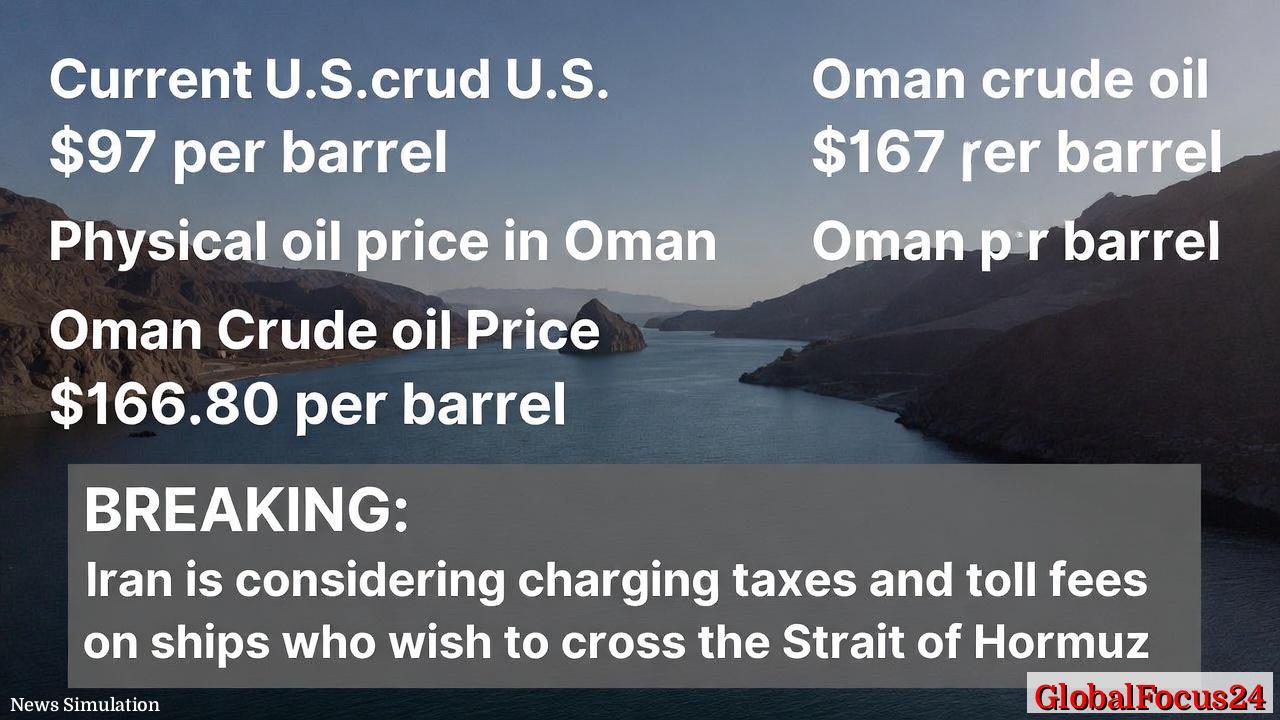
Iran is considering imposing new taxes and toll fees on vessels transiting the Strait of Hormuz, the world's most critical maritime chokepoint for crude oil exports. The proposal, disclosed by officials familiar with ongoing internal discussions, would mark a dramatic escalation in Iran’s attempts to assert economic control over the strategic corridor. The move comes as regional tensions deepen and global energy markets reel from the renewed conflict entering its third week.
If enacted, the toll system would apply to all foreign commercial ships crossing the 21-mile-wide strait, which lies between Iran to the north and Oman to the south. The Strait of Hormuz is the only sea passage from the Persian Gulf to open waters, carrying an estimated 20% of the world's daily oil consumption. For decades, it has remained a flashpoint of geopolitical competition — and now, with energy prices soaring to multi-year highs, any disruption could amplify global economic volatility.
Oil Prices Surge to Multi-Year Highs
Global crude oil markets responded immediately to whispers of the Iranian plan. U.S. benchmark crude rose to $97 a barrel on Thursday, marking a staggering 76% increase since December. Meanwhile, in Oman, physical crude oil prices have skyrocketed to $166.80 per barrel for monthly FOB (free on board) partial cargoes — a record-setting 163% surge from recent lows. These levels have not been seen since early 2022, when Russia’s invasion of Ukraine upended global supply chains.
Traders and energy analysts warn that the psychological impact of Iran introducing shipping tolls may further inflate prices. “The market is hypersensitive to any sign of tightening in Hormuz,” said one commodities risk manager at a European energy firm. “Even the suggestion of new transit costs sends shockwaves through pricing models.”
With Oman crude already trading at a 72% premium over established benchmarks, shipping companies and refiners are bracing for higher transport costs and thinner margins. The surging differentials could ripple across refining hubs in Asia, Europe, and North America, translating into higher gasoline and diesel prices for end consumers.
The Strait of Hormuz: A Vital Maritime Bottleneck
The Strait of Hormuz has long stood as one of the world’s most strategically significant waterways. Roughly 21 million barrels of crude and refined petroleum products pass through it every day, primarily destined for energy-thirsty markets in East Asia, Europe, and the United States. Major exporters including Saudi Arabia, Iraq, Kuwait, and the United Arab Emirates depend on this narrow passage to move most of their output.
Historically, Iran has leveraged the strait’s vulnerability to influence regional and international negotiations. During past conflicts — notably the “Tanker War” of the 1980s and subsequent U.S. sanctions decades later — Tehran used threats of closure to assert diplomatic pressure. However, the idea of instituting systematic taxation or toll collection on passing vessels represents a new dimension of economic leverage, blending traditional territorial control with fiscal policy.
Maritime law experts note that Iran has previously claimed a right to regulate traffic in what it considers its territorial waters under the 1982 United Nations Convention on the Law of the Sea. Yet, the legal foundation for imposing transit fees remains unclear — particularly since the strait functions as an international shipping route under long-standing global conventions guaranteeing free passage.
Economic Context Behind the Proposal
Behind Tehran’s consideration of this policy lies a web of economic imperatives. Iran’s economy, still burdened by years of international sanctions, has faced intensified fiscal pressure amid renewed military expenditures and constrained oil exports. Introducing maritime tolls could generate a new and stable revenue stream while projecting sovereign authority.
Analysts estimate that if Iran were to impose even a modest fee — for instance, $1 per barrel equivalent moved through the strait — annual revenues could reach several billion dollars. However, such a policy could provoke strong retaliation from regional neighbors and global powers that depend heavily on stable energy transit.
“This is not just a matter of revenue generation,” said Dr. Layla Mansouri, a Gulf economic analyst based in Doha. “It’s also a statement of control. Iran wants to remind the world that every barrel flowing out of the Gulf does so under its watch.”
Regional Comparisons and Strategic Reactions
Iran would not be the first nation to levy shipping fees through a major maritime chokepoint. Egypt collects tolls on vessels transiting the Suez Canal, generating more than $9 billion in annual revenue. Similarly, Panama’s canal tolls serve as one of its largest sources of national income. Both nations justify their fees as part of infrastructure maintenance and security costs.
However, the situation in the Strait of Hormuz is vastly different. Unlike the Suez or Panama Canals—human-made waterways fully within national borders—Hormuz is a natural strait bordered by multiple sovereign states and governed by international navigation rights. Imposing unilateral tariffs on foreign ships could be viewed as a violation of maritime law, potentially triggering legal disputes or naval responses.
Neighboring Oman, which shares the other coastline of the strait, has remained largely silent on Iran’s proposal. Muscat traditionally acts as a diplomatic intermediary in regional crises and may find itself balancing delicate interests if the policy advances. Saudi Arabia and the United Arab Emirates, both major oil exporters whose tankers rely on the corridor, are expected to oppose any new fees, viewing them as an unnecessary escalation.
Ripple Effects on Global Trade and Inflation
An Iranian toll system could have severe downstream effects across global trade networks. Beyond crude oil, the Strait of Hormuz also handles shipments of liquefied natural gas (LNG), petrochemicals, and dry goods essential to regional economies. Any additional costs or administrative hurdles could slow transportation and heighten insurance premiums for shipping lines operating in the Gulf.
Financial markets have already reacted to the ongoing uncertainty. Shipping insurance rates for voyages through the Gulf have climbed 18% over the past two weeks, according to maritime reinsurance data. Freight companies are beginning to factor in potential delays and rerouting costs, though alternative routes are limited. Pipelines bypassing the strait through Saudi Arabia and the UAE offer partial relief, but their combined capacity covers only a fraction of total exports.
For consumers, the immediate consequence may come in the form of higher fuel prices and rising inflation. Economists warn that sustained oil prices above $95 per barrel could slow global growth in the second quarter of 2026, especially in energy-importing nations like India, Japan, and much of Western Europe. The surge has already triggered domestic price adjustments in gasoline and heating oil across North America.
Historical Precedent and Strategic Significance
Throughout modern history, the Strait of Hormuz has tested the limits of global energy security. During the Iran-Iraq War in the 1980s, the passage became the center of the so-called “Tanker War,” when both sides targeted oil shipments to undermine each other’s revenues. In 2019, a series of attacks on commercial tankers reignited fears of a potential blockade, prompting U.S. and European naval patrols to escort ships through the narrow channel.
Iran’s current considerations echo that legacy, albeit through economic instruments rather than direct military confrontation. The toll proposal reflects how statecraft can blend economic pressure and territorial control — an alternative means of achieving leverage without outright conflict. Yet, the mere possibility of fees has already reinforced the perception of the strait as a geopolitical fault line where small actions can ripple into global consequences.
Prospects and Uncertainty
For now, Iran’s proposal remains under discussion. Officials have not disclosed specific timelines or rates, and international observers are watching closely for signs of implementation. Energy ministries worldwide are adjusting contingency plans, revisiting strategic petroleum reserves, and exploring expanded pipeline routes to limit exposure to Strait of Hormuz disruptions.
The implications extend beyond oil markets. A prolonged price rally could influence central bank decisions on interest rates, currency stability, and inflation control across major economies. The United States, the European Union, China, and India — each heavily invested in Gulf energy flows — are expected to engage diplomatically to prevent logistical or legal escalation.
A Precarious Balancing Act
As the conflict drags deeper into its third week, the global energy system faces a familiar crossroads. Whether Iran proceeds with toll collection or uses the threat as a bargaining chip, the stakes could not be higher. The Strait of Hormuz remains both a corridor of commerce and a chessboard of power — one where barrels, ships, and nations converge in a fragile equilibrium.
With oil near record highs, inflation mounting, and global growth forecasts tightening, the world once again finds itself reminded that a single narrow waterway between Iran and Oman can sway the course of the global economy.