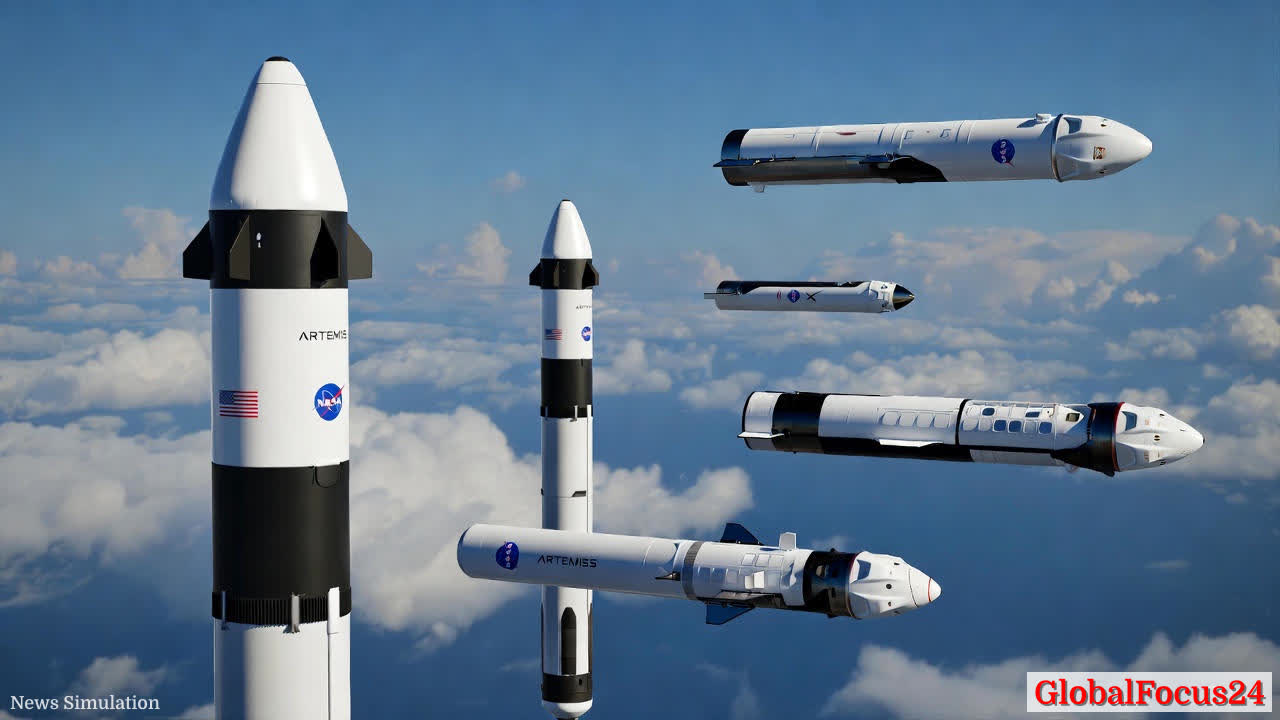
Moon Mission Momentum: Humans Return to the Lunar Surface Amid a Broader Deep-Space Push
In what promises to be a watershed year for space exploration, plans are accelerating for humans to set foot again on the Moon, while ambitious missions target Mars and the lunar south pole. A wave of new rockets, advanced spacecraft, and international collaboration is reshaping the roadmap for human spaceflight, offering not only scientific breakthroughs but also economic ripple effects across launch industries, technology sectors, and regional space economies.
Historical context and the trajectory of return The modern era of human lunar exploration began with the Apollo program, which completed its final manned Moon landing in 1972. For decades, the Moon remained a distant milestone rather than a near-future destination, as geopolitical priorities, budgetary constraints, and technological challenges redirected attention to low-Earth orbit operations and robotic exploration. The renewed push in the 21st century has re-entered the public imagination, driven by a combination of national space agencies and private sector players collaborating on a sustainable, reusable, and commercially viable path to cislunar space.
Key elements of the current plan build on two pillars: sustainability in lunar operations and the development of deep-space capabilities that can serve multiple destinations, including the Moon, Mars, and orbital outposts beyond Earth’s gravity well. Prolonged surface presence on the Moon hinges on reliable landers, life-support systems that can operate autonomously for extended periods, and the ability to harness local resources for in-situ utilization. The broader context includes international partnerships that leverage shared costs and expertise, as well as a growing commercial ecosystem surrounding launch vehicles, propulsion, and space infrastructure.
Technological drivers and mission Architecture Advances in propulsion, robotics, and habitat design are at the heart of the current mission architecture. Next-generation launch systems, including reusable rocket stages and higher-throughput upper stages, are enabling more frequent missions with reduced per-mayload cost. In-space propulsion developments—ranging from electric and solar-electric propulsion for cargo to more powerful chemical propulsion for crewed legs—aim to shorten transit times and increase mission resilience.
On the surface, modular habitats and autonomous rovers are being designed to operate in the extreme lunar environment, where temperature swings and regolith dust pose unique challenges. Redundant life-support loops, radiation shielding strategies, and advanced habitat redundancy are central to mission safety. The plan also emphasizes robotic precursors that scout landing corridors, assess resource availability, and set up early infrastructure such as power generation and communication networks.
In addition to hardware, data analytics, ground testing, and digital twins are becoming integral to mission planning. Simulated mission scenarios enable operators to anticipate contingencies ranging from communication blackout periods to solar flare events, helping to reduce risk while expanding the cadence of surface operations. These capabilities are critical as space agencies and commercial partners seek to establish a sustainable presence on the Moon rather than episodic visits.
Economic impact and industry ripple effects The return to the lunar surface is expected to generate a broad economic impact that extends beyond science and exploration. A renewed focus on space infrastructure catalyzes growth across multiple sectors, including propulsion suppliers, manufacturing, and data services. Job creation spans engineering, systems integration, mission operations, and ground support, with regions hosting launch facilities and research centers likely to experience a notable uptick in high-skilled employment and associated economic activity.
A robust lunar initiative can fuel regional clusters that specialize in specific capabilities. For example, nations and regions with established aerospace bases may deepen their capabilities in hydrogen and oxygen propellant production, cryogenic storage, and materials research. The demand for precision manufacturing and small-batch production of specialized components is expected to rise, driving investments in both established suppliers and new entrants in the space supply chain.
Public-private collaboration remains a central feature of the space economy. Government agencies provide the regulatory framework, safety standards, and mission oversight, while private firms contribute innovation, rapid prototyping, and scalable production capabilities. This collaboration has historically accelerated the pace of technology transfer—from autonomous navigation systems to advanced composites—that can have spillover benefits for terrestrial industries, including energy, transportation, and national security sectors.
Global regional comparisons and strategic considerations Different regions bring distinct strengths to the current lunar push. In North America, where dense aerospace ecosystems exist, a combination of government funding and private capital supports high-volume launch activity and rapid iteration of space hardware. Europe, with its strong track record in space science and collaboration through the European Space Agency, emphasizes scientific payloads, lunar orbiters, and international partnerships that distribute risk and expertise. Asia-Pacific regions, including major space programs and growing commercial entrants, focus on propulsion technology, satellite servicing concepts, and broader off-Earth infrastructure development.
The Moon also serves as a proving ground for technologies that will later be used for Mars missions. Lessons learned about habitat life support, energy generation in harsh radiation environments, and surface operations will inform mission design for deeper space exploration. In this sense, the lunar return acts as a stepping-stone toward a sustainable presence beyond Earth, with potential spillover benefits in robotics, AI for autonomous operations, and materials science.
Regional economic comparisons reflect not only direct space investments but also ancillary benefits to STEM education, supplier ecosystems, and regional innovation pipelines. Economies that cultivate a pipeline of engineering talent, technology startups, and robust supply chains are better positioned to convert space investments into long-term productivity gains. Conversely, regions with limited aerospace capacity may rely more on international partnerships and shared missions to access lunar and deep-space infrastructure.
Public reaction and policy context Public interest in renewed lunar exploration remains high, often propelled by dramatic mission previews, vivid surface imagery from landers and rovers, and the prospect of scientific discoveries about lunar geology, ice deposits, and the history of the solar system. Communities near launch sites and research campuses frequently engage in outreach programs, science communication initiatives, and academic partnerships that help sustain support for ambitious programs.
Policy considerations continue to shape the pace and scope of lunar missions. Debates over funding allocations, export controls, and international collaboration agreements influence scheduling and mission design. Governments weigh the strategic value of space infrastructure against budgetary constraints, while space agencies work to balance exploration goals with risk management and public accountability. The net effect is a carefully calibrated trajectory that seeks to maximize scientific returns, technology development, and national capacity without sacrificing safety or economic prudence.
Environmental and sustainability considerations As with any high-stakes aerospace endeavor, the lunar initiative includes environmental considerations. The extraction and use of lunar resources, the handling of regolith dust, and the potential for surface contamination require rigorous stewardship. Mission planners emphasize clean operations, debris mitigation, and responsible utilization of resources that minimize environmental footprints both on the Moon and in near-Earth space. These considerations influence mission planning, hazard analyses, and the selection of propulsion and power systems that align with long-term sustainability goals.
Public-private partnerships are also expected to emphasize responsible innovation. Investment in reusable launch capability, recyclable spacecraft components, and on-site resource utilization technologies aligns with broader sustainability objectives. In this context, the lunar return is framed not only as a scientific and exploratory milestone but also as a test bed for sustainable, responsible off-world activity.
Long-term outlook and the path forward Looking ahead, the lunar return is unlikely to be a one-off event. Instead, it is envisioned as part of a continuous cadence of surface operations that gradually build up a sustained presence. This includes establishing fallback infrastructure, such as surface habitats, power generation capabilities, and communication relays, to support longer-duration missions and eventual crew rotations. The ability to regularly deploy cargo missions, scientific experiments, and habitat modules will be a deciding factor in how quickly humanity transitions from episodic visits to a truly permanent off-world presence.
Mars missions, while still years away in many planning documents, are already informing the design choices for Lunar Gateway architectures, surface habitats, and long-duration life support. The synergy between Moon-based operations and interplanetary missions could yield efficiencies in logistics, mission planning, and technology maturation. In parallel, efforts to explore the lunar south pole—home to permanently shadowed regions that may harbor water ice—offer scientific and strategic incentives, including life-support resource potential and new frontiers for robotic and human exploration.
Conclusion The coming year is poised to mark a turning point in space exploration, as the Moon returns to the forefront of human ambition and the broader solar system becomes more navigable. The combination of groundbreaking propulsion, autonomous systems, and international collaboration is driving a new era of space activity with the potential to catalyze economic growth, inspire educational initiatives, and broaden our understanding of the solar system. While challenges remain—from technical hurdles to budgetary considerations—the momentum behind these missions signals a resolute commitment to expanding human presence beyond Earth, pushing the boundaries of science, engineering, and exploration.
Keywords woven into the narrative: lunar return, deep-space missions, Moon, Mars, lunar south pole, propulsion technology, habitat design, in-situ resource utilization, cislunar economy, space infrastructure, international collaboration, public-private partnerships, space sustainability, robotic precursors, life-support systems, regional space economies, launch systems, mission cadence, debris mitigation, off-world presence, science payloads, exploration milestones.
Follow-up question Would you like me to tailor this article to a specific region or audience, or adjust the emphasis toward technical details, policy implications, or economic analysis for stakeholders?