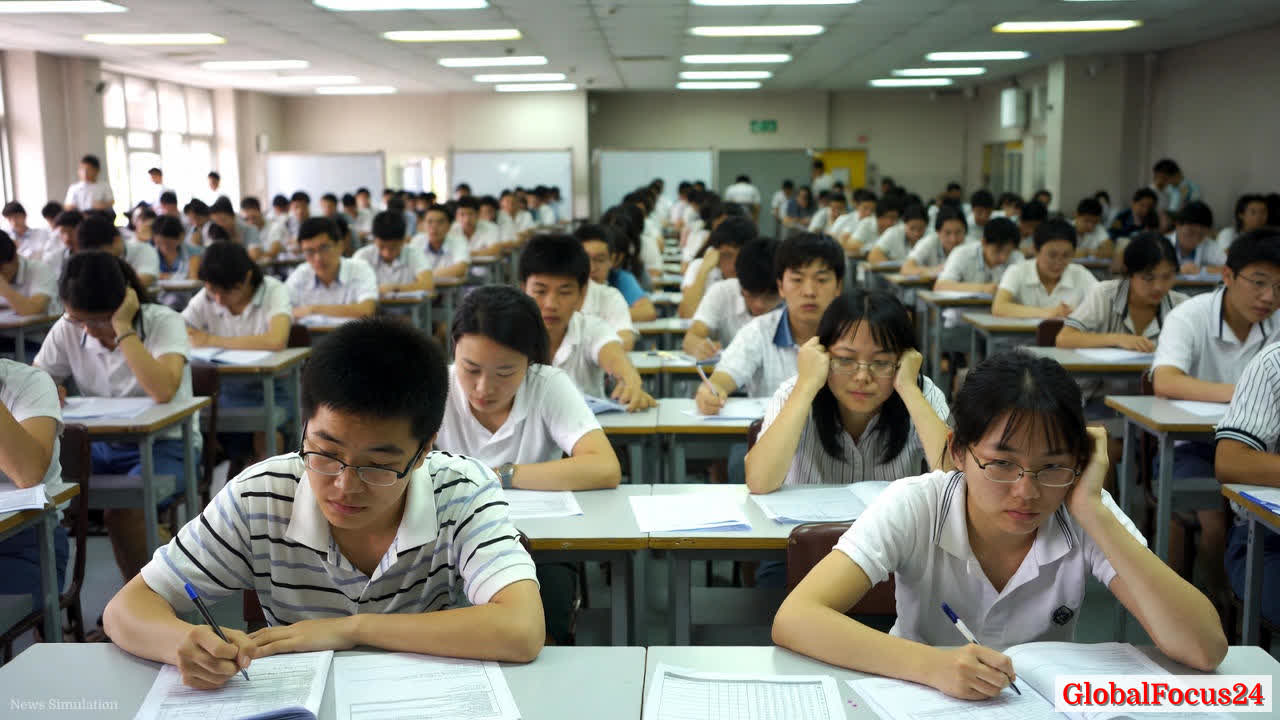
China and India's Civil Service Exams Rank Among World's Most Challenging
In a pair of vast, bustling economies where bureaucratic efficiency and social mobility are closely watched, the national civil service examinations in China and India stand out as some of the most demanding and competitive pathways to government careers. Each year, millions of aspirants around the two nations chase a slim handful of coveted posts, a process steeped in centuries of tradition and modern performance metrics. The resulting stories touch on ambition, pressure, and the broader implications for governance, economy, and society.
Historical context and roots of meritocracy
The roots of standardized civil service exams stretch deep into Asia’s history. China’s keju, or imperial examination system, emerged as a formal mechanism to recruit scholars based on knowledge of Confucian texts and policy principles. Tracing back to 587, the keju shaped the elite through a rigorous testing regime designed to identify talent beyond hereditary privilege. While the imperial system formally ended in the early 20th century, its legacy persisted in modern civil service assessments that continue to emphasize policy understanding, analytical writing, and aptitude for governance.
In the Indian subcontinent, the modern Civil Services Examination (CSE) has its own layered lineage. It evolved under British rule and then evolved into a comprehensive, multi-stage process designed to assess administrative potential across a diverse population. The current exam framework—comprising a preliminary test, a main examination, and an interview—has been refined over decades to balance knowledge breadth with the need for managerial skills in a federal, multilingual democracy.
Scale of competition and selection outcomes
China’s national civil service examination, or guokao, is among the globe’s most fiercely contested hiring processes. Last year, the exam drew 3.41 million registrations, signaling the sheer scale of ambition across urban centers and rural provinces alike. Of those who registered, roughly 2.6 million sat the written portion, which blends multiple-choice aptitude testing with essays on policy, governance, writing, and ideological orientation. The process narrows to interviews for a much smaller pool: about 120,000 advance to interviews, and 39,700 ultimately win roles, equating to a success rate of roughly 1.5 percent.
India’s Civil Services Examination process also operates at industrial scale, with 1.1 million applications in a recent cycle. Approximately 583,000 candidates appeared for the preliminary stage, with around 14,600 qualifying for the mains and 2,845 moving on to interviews. Final selections hovered around 1,000, translating to a roughly 0.2 percent overall success rate. These figures underscore the extraordinary selectivity behind government service posts in both countries.
Preparation culture and its social implications
The sheer depth and breadth of material covered in guokao and the Indian CSE drive a distinctive preparation culture. In both nations, ambitious candidates invest years in preparation, often quitting full-time employment to join intensive coaching centers or study retreats. These centers offer structured practice, mentorship on essay writing, policy analysis, and interview technique, frequently accompanied by psychological coaching to manage the stress of high-stakes testing. For many families, the exam is not merely a career gateway but a defining life milestone, shaping decisions on education, housing, and social status.
The social consequences of such a protracted and high-stakes process can be complex. While success can confer lifelong security—housing assistance, pensions, and elevated social standing—the path is also associated with anxiety, delayed life milestones such as marriage and child-rearing, and, in some cases, tragic outcomes. Reports from across both nations show that the pressure to excel can lead to mental health challenges, including depression and anxiety, particularly among younger aspirants who see national service as the ultimate form of proof of merit.
Economic context and opportunity costs
The economics of the process are notable. In China, the guokao represents not only public service prestige but a bridge to stability within a rapidly changing economy. Civil service roles are valued for their predictable salaries, formal job security, and the potential for career progression within a highly structured bureaucracy. The investment in study time, coaching fees, and living costs during preparation are substantial, but the long-term return—steady income, pension benefits, and social capital—can far exceed that of many private-sector options for similarly educated individuals.
In India, the CSE is similarly anchored in the promise of a stable, influential career within the All India Services and central and state administrations. Given India’s sizable and diverse economy, civil service roles offer an attractive counterpoint to the volatility of private sector employment, with opportunities to influence policy, administer large programs, and contribute to development initiatives. Yet the opportunity costs remain steep: time spent studying for the exam often translates into deferred access to certain professional tracks, networks, and earnings.
Regional comparisons and governance implications
When viewed through a regional lens, China and India’s civil service landscapes reveal both similarities and differences in governance models and bureaucratic culture. China’s system emphasizes centralized coordination, policy implementation, and a standardized approach to public administration across provincial boundaries. The guokao is a gatekeeping mechanism that helps maintain a unified administrative vision, with candidates selected for their alignment with national priorities and capacity to execute complex policy agendas.
India’s civil service structure reflects its constitutional framework, with a federal system that distributes authority across central and state governments. The CSE functions as a gateway to a broad constellation of services, including the Indian Administrative Service, Indian Police Service, and Indian Revenue Service, among others. This framework fosters a degree of regional diversity, allowing officers to operate within culturally varied contexts. It also poses ongoing challenges for uniformity in governance, given state-specific variations in policy emphasis, resources, and implementation capacity.
Global ranking and effectiveness metrics
World Bank governance indicators provide a framework for assessing government effectiveness. In comparative terms, both nations face challenges. Recent metrics indicate that China and India rank in the lower half of global comparisons on government effectiveness, reflecting complexities in bureaucratic processes, implementation efficiency, and public service delivery. Reforms in both nations have aimed to address these limitations, with initiatives that broaden lateral entry for experienced specialists, emphasize professional development, and encourage more dynamic recruitment practices beyond traditional exam-based pathways.
Reform efforts and future directions
Both countries have begun experimenting with reforms intended to balance merit-based selection with practical needs for agility and specialized expertise. In China, reforms have included limited lateral entry for specialists with substantial professional experience, designed to inject practical knowledge into the civil service and reduce over-reliance on rote knowledge. In India, reforms have sought to diversify pathways into civil service, emphasizing competency-based assessments, aptitude tests, and age-appropriate entry strategies to expand access while maintaining rigorous selection standards.
Crucially, the debate around reforms also centers on the skills most needed in contemporary governance. Critics argue that heavy emphasis on memorization, policy trivia, and broad knowledge pools may not develop essential skills such as strategic management, teamwork, data-driven decision-making, and collaborative leadership. Proponents of reform contend that a robust foundation in governance principles remains valuable, but that the examination process should evolve to measure problem-solving abilities, adaptability, and practical administrative aptitude.
Public response and societal impact
Public reaction to these exams varies by context but often reflects a mix of reverence for the prestige of public service and concern about the social costs of the preparation race. In China, parents and communities frequently view civil service success as a transformative achievement that can alter family trajectories for generations. In India, the promise of social mobility and the opportunity to serve a diverse population generate broad interest, even as discussions about stress, mental health, and the equity of access to coaching resources continue.
Meanwhile, the broader labor market and private sector dynamics influence aspirants’ choices. In both countries, a robust private sector with high educational attainment presents an alternative to public service, offering competitive salaries and faster career progression in some sectors. Yet, for many, the public sector remains uniquely appealing due to stability, pensions, and the prospect of contributing to long-term national development goals.
The human stories behind the numbers
Beyond the statistics lie intimate narratives of dedication, sacrifice, and resilience. A candidate who spent years juggling family responsibilities while attending evening classes, a former government employee who left a secure job to pursue public service, or a student from a rural area who traveled long distances to attend coaching sessions—all illustrate the personal dimensions of this national pursuit. These stories highlight the human capacity to invest time, energy, and hope into the dream of shaping public policy and delivering services that reach millions of people.
Implications for future policy and public administration
The enduring popularity of the guokao and the Indian CSE signals a deep-seated belief in meritocratic pathways as a source of national strength. As both countries confront rapid demographic shifts, technological change, and evolving governance expectations, the role of civil servants becomes increasingly strategic. Future policy discussions are likely to center on how to balance merit with broader inclusivity, how to cultivate adaptable skills in an era of digital transformation, and how to ensure that the most capable leaders emerge from diverse backgrounds.
In practical terms, this may involve expanding access to high-quality preparatory resources, reducing barriers to entry for underrepresented groups, and integrating more experiential assessments into the selection process. It could also mean strengthening ongoing professional development within the civil service, enabling officers to apply policy expertise to complex, real-world challenges—from urban planning and healthcare delivery to climate resilience and disaster response.
Conclusion
The civil service examinations of China and India epitomize a long-standing commitment to merit, discipline, and public service. They are not only gatekeepers to prestigious careers but also reflections of each nation’s values, ambitions, and challenges. As the world watches, these examinations will continue to evolve—balancing tradition with innovation, maintaining rigorous standards while embracing new capabilities, and shaping a generation of officials entrusted with steering some of the most populous, dynamic, and consequential democracies on the planet. The outcome of this enduring contest remains a lens through which to understand how societies cultivate leadership, trust, and the capacity to govern large, diverse, and rapidly changing populations.