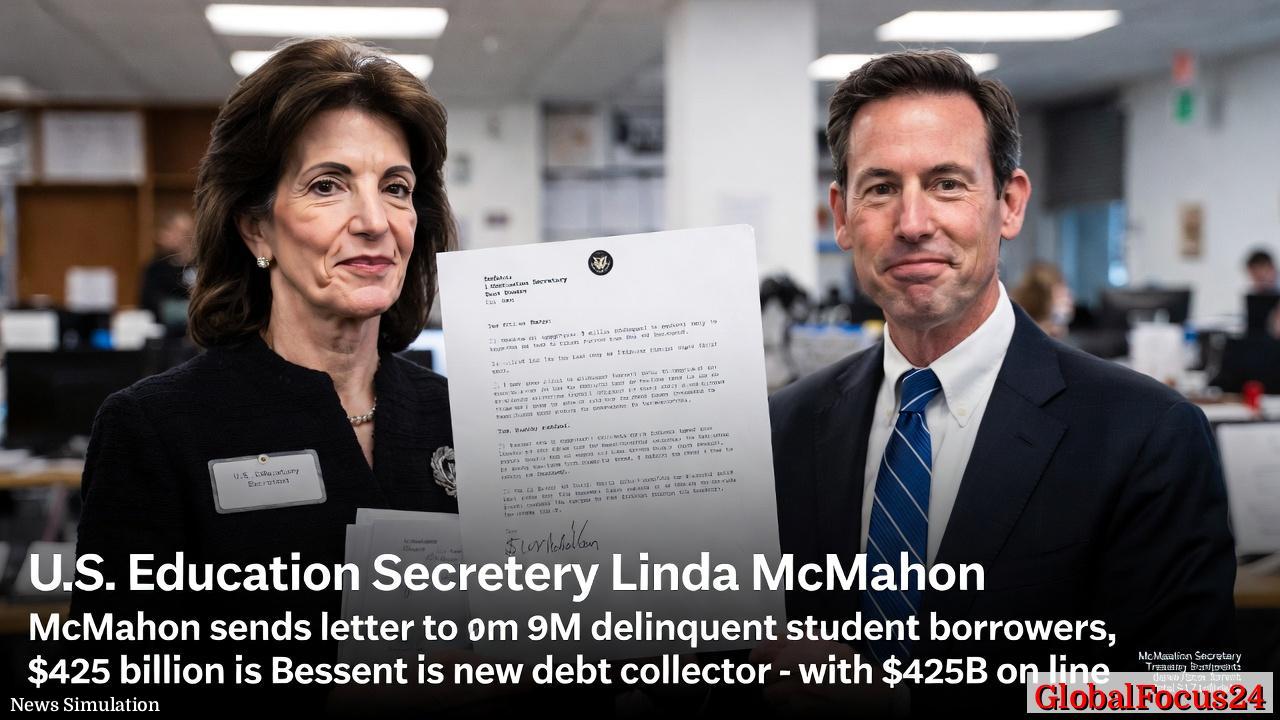
McMahon Transfers $425 Billion in Defaulted Student Loans to Treasury Amid Sweeping Debt Collection Shift
WASHINGTON — In one of the most sweeping administrative changes to federal student lending in decades, Education Secretary Linda McMahon has announced that the U.S. Treasury Department will assume full responsibility for collecting defaulted federal student loans. The decision affects more than 43 million American borrowers, including approximately 9 million who are currently delinquent, with an estimated $425 billion in defaulted debt on the line.
The change marks a turning point in how the federal government manages its $1.7 trillion student loan portfolio — a system plagued by decades of rising costs, confusing repayment options, and mounting public frustration.
A Historic Shift in Federal Debt Management
McMahon’s formal letter to borrowers, delivered electronically and by mail this week, cited the need for “integrity and accountability” in the loan repayment process. Centralizing collections within the Treasury Department, she wrote, would better safeguard taxpayer interests while helping borrowers navigate repayment after years of administrative disruption and overlapping responsibilities between agencies.
“For too long, Americans have shouldered the consequences of poor leadership and persistent mismanagement of our federal student aid portfolio,” McMahon wrote. “Today’s actions reclaim integrity and accountability for you, the American people.”
Treasury Secretary Scott Bessent, who will now oversee recovery efforts through the Bureau of the Fiscal Service, emphasized that his department is prepared to manage the transition smoothly. “Treasury has the operational capability and expertise to bring long overdue financial discipline to the program,” Bessent said in a statement.
Under federal law, the Treasury may garnish up to 15 percent of delinquent borrowers’ wages. However, officials confirmed that repayment assistance and income-driven plans — which can lower monthly payments to 10 percent of discretionary income — will remain available.
The End of a Complicated Era
The Education Department has long struggled to balance its dual roles as a policymaker and loan servicer. Borrowers have contended with inconsistent communication, changing repayment terms, and limited accountability from third-party collection agencies. Critics have argued that the federal system, with its multiple contractors and outdated technology platforms, placed administrative burdens on both borrowers and taxpayers.
McMahon described the handoff to Treasury as an overdue structural correction. “The previous administration created a web of confusion, leaving borrowers uncertain about their repayment obligations and lacking the tools and support to get back on track,” she said. “It’s time for an entity with deep experience in finance and banking to support this major fiscal responsibility.”
The current move follows years of suspended payments and collection activities. During the pandemic, federal student loan repayments were paused to provide financial relief. That freeze, extended multiple times by previous administrations, shielded millions from default — but also delayed efforts to recover federal funds.
When the moratorium finally expired in September 2024, default rates began rising sharply, prompting what officials described as “unsustainable pressure” on the system.
Scope of the Challenge: $1.7 Trillion in Student Debt
As of 2025, Americans owed roughly $1.7 trillion in federal student debt — more than the nation’s total credit card balance. The amount in default, estimated at $425 billion, represents nearly one-quarter of the portfolio and poses a major fiscal challenge for the government.
Treasury’s Bureau of the Fiscal Service, which already manages federal collections for delinquent taxes and other debts, will now be responsible for recovering these funds. Its track record in automated repayment programs and wage garnishments gives it a significant advantage in efficiency and scale, according to former federal finance officials.
Economists say the transfer could improve recovery rates by reducing administrative overlap and leveraging Treasury’s centralized data systems. However, they caution that aggressive collection tactics could place financial strain on low-income borrowers if not accompanied by strong outreach and repayment support options.
“The Treasury has powerful tools — wage garnishment, tax refund offsets, Social Security intercepts — but used carelessly, these can undermine borrowers’ financial stability,” said one higher education analyst. “The challenge will be balancing fiscal responsibility with compassion and rehabilitation.”
Borrower Concerns and System Continuity
In her letter, McMahon assured current borrowers that their repayment processes will not change immediately. Those already making regular payments should continue through their existing servicers. Financial aid application processes, including the Free Application for Federal Student Aid (FAFSA), will remain unchanged.
“Treasury will assume operational responsibility for collecting on defaulted student loan debt and provide support to help return borrowers to repayment,” McMahon wrote.
For many borrowers, however, the announcement came as a surprise — and with lingering anxiety. Online forums quickly filled with questions about how the transition will affect ongoing payment plans, credit reports, and eligibility for forgiveness programs.
“I’ve been trying to rehabilitate my loan for months,” said one borrower from Ohio. “Now I don’t even know if the person I’ve been talking to still works for the right agency.”
The Department of Education has pledged to communicate directly with affected borrowers over the coming months, outlining new procedures for those in default. Treasury officials also said they are developing an updated online portal to manage borrower accounts more effectively and consolidate contact points for assistance.
Historical Context: From Servicers to Centralization
The federal student loan system originated in the mid-20th century as a limited partnership between the government and private banks. Over the decades, successive reforms expanded access and reduced private involvement, culminating in full federalization of new lending in 2010. That change centralized disbursement but left servicing responsibilities in the hands of private contractors.
The transition to Treasury marks the first significant shift in that model since 2010. Historically, changes in loan servicing have often followed crises — such as the financial meltdown of 2008 or the pandemic-driven repayment suspension — highlighting vulnerabilities in the government’s lending infrastructure.
Experts note that the current realignment mirrors trends in other developed economies. In the United Kingdom, for instance, the Student Loans Company operates more like a revenue agency than a subsidized lending institution, integrating collection and income tracking functions. By comparison, the U.S. system has long been fragmented across multiple agencies and contractors.
“Bringing Treasury into the fold could move the U.S. closer to an integrated fiscal model seen in other countries,” said an education finance researcher. “It enhances accountability but also concentrates authority — which makes transparency even more important.”
Economic Stakes and Potential Fiscal Impact
The economic implications are profound. Student loan repayments represent a major cash flow for the federal budget, with tens of billions collected annually under normal conditions. Persistent defaults erode that revenue, while forgiveness or administrative delays increase long-term costs.
By consolidating collection under Treasury, the administration is signaling a shift toward long-term fiscal recovery. Economists estimate that even a modest improvement in collection efficiency — regaining five to ten cents per dollar of defaulted debt — could bring tens of billions back to federal coffers over the next decade.
However, critics caution that the broader issue remains affordability. Tuition costs have continued to outpace inflation, and institutional accountability has declined. McMahon herself criticized universities for raising prices while relying heavily on federal lending. “Twenty-three percent of bachelor’s programs and 43 percent of master’s degree programs leave students financially worse off than if they had never enrolled,” she noted.
That dynamic, experts argue, feeds a vicious cycle: loans fund rising tuition, rising tuition increases debt burdens, and growing debt perpetuates defaults.
Regional and Social Dynamics
Default rates vary widely across states and institutions. Borrowers in the South and Midwest — particularly those who attended for-profit or nonselective institutions — face some of the highest risks. In Mississippi, Alabama, and Oklahoma, more than one in four federal borrowers are in default. Coastal states fare somewhat better, but the national impact remains broad.
Communities with lower average incomes or limited access to public universities are disproportionately affected. Local economies in these areas may experience cascading effects when residents face wage garnishments or damaged credit scores, reducing disposable income and stalling small business growth.
Federal officials have hinted that the Treasury’s expanded role could also strengthen oversight of colleges with poor repayment outcomes. Data integration between agencies could make it easier to identify schools with persistently high default rates and evaluate their eligibility for federal aid programs.
A Precedent for Administrative Reform
Analysts describe the handoff as part of a broader reorganization of federal financial operations under the current administration. The move may test how effectively cross-agency management can address long-standing inefficiencies without disrupting services for millions of Americans.
While some lawmakers have expressed concern about the concentration of power within the Treasury Department, others view the reform as a necessary modernization of an outdated and fragmented system. It could also serve as a blueprint for integrating other federal financial functions, from housing assistance to veteran benefits, under more centralized management.
Outlook and Next Steps
Implementation will occur in phases over the next year. The Education Department is expected to transfer data and servicing files to Treasury systems by late 2026. In the meantime, joint task forces from both agencies are overseeing continuity to prevent disruptions in borrower communications.
For borrowers, the immediate advice is patience and vigilance. Officials emphasize that repayment options, forgiveness programs, and borrower protections remain in place. Treasury has also committed to expanding financial education resources to help delinquent borrowers understand their rights and responsibilities.
As McMahon wrote in closing her letter, the transition marks “a new era of accountability for both borrowers and institutions.” Whether that promise translates into smoother repayment experiences and a smaller default portfolio will depend on how effectively the two departments align policy ambitions with real-world results.
For now, $425 billion in frozen debt — and the financial wellbeing of millions of Americans — rests on that alignment.