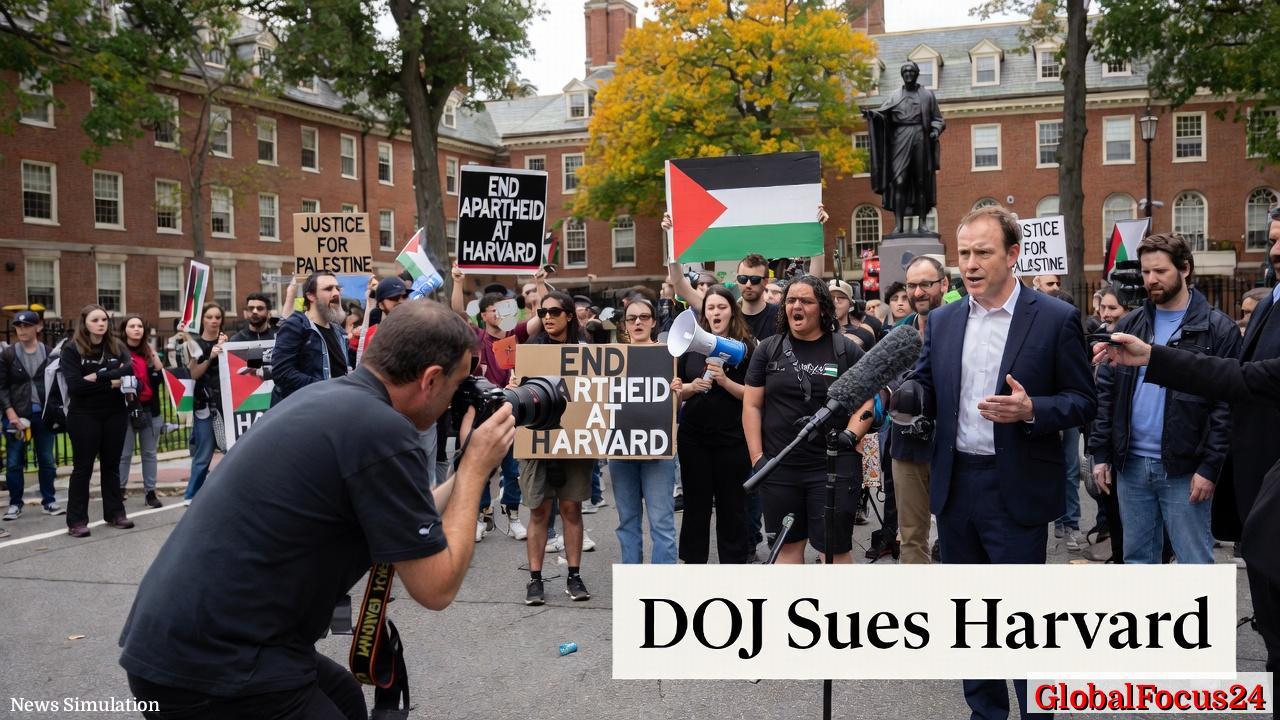
Justice Department Sues Harvard Over Alleged Antisemitism and Civil Rights Violations
Federal Lawsuit Alleges “Deliberate Indifference” to Antisemitic Harassment on Campus
WASHINGTON — The U.S. Department of Justice filed a sweeping civil rights lawsuit against Harvard University on Friday, accusing the Ivy League institution of violating federal law by failing to protect Jewish and Israeli students, faculty, and staff from harassment and discrimination. The complaint—lodged in Boston federal court—charges that Harvard showed “deliberate indifference” to antisemitic conduct, allowing a hostile environment to persist on campus despite repeated warnings and internal reports.
Assistant Attorney General for Civil Rights Harmeet Dhillon, who announced the filing, stated that Harvard’s alleged conduct amounted to “brazen violations of federal law” and that the government had “no tolerance for institutional neglect in the face of hate.” The 44-page complaint marks one of the most significant civil rights actions against a university in decades, signaling increasing federal scrutiny of elite academic institutions over how they handle antisemitism and discrimination.
Core Allegations: Failure to Protect Jewish and Israeli Students
The lawsuit outlines numerous examples of antisemitic incidents that escalated after Hamas’ October 7, 2023, attack on Israel, which killed roughly 1,200 people and ignited widespread protests at universities nationwide. At Harvard, anti-Israel demonstrators established a 20-day encampment in Harvard Yard during spring 2024, prompting criticism from the university president—but little tangible enforcement, according to the Justice Department’s filing.
The complaint cites instances in which Jewish and Israeli students were excluded from social and academic settings, harassed in public spaces, or physically intimidated during protests. It claims that faculty members and administrators “failed to respond meaningfully,” even after receiving repeated reports of abuse. The university’s Presidential Task Force on Combating Antisemitism and Anti-Israeli Bias allegedly documented these issues, but its recommendations were not implemented in a timely or effective manner.
The Justice Department asserts that this pattern created a chilling effect on students’ ability to participate fully in campus life, violating Title VI of the Civil Rights Act of 1964, which prohibits discrimination based on race, color, or national origin in institutions receiving federal funding.
Harvard’s Response: Defense and Commitment to Inclusion
In a statement issued Friday evening, a Harvard spokesperson expressed the university’s commitment to respect and inclusion for all students, including members of the Jewish and Israeli communities. The spokesperson outlined several measures Harvard claims to have taken since late 2023, including updated anti-harassment training, enhanced reporting systems, and facilitated workshops promoting dialogue across divided student groups.
“We will continue to prioritize this important work and will defend the University against this lawsuit,” the spokesperson said. “We reject the false narrative that Harvard has tolerated discrimination. Any suggestion that we have done so is inconsistent with our values and actions.”
However, Harvard’s statement also struck a defiant tone toward the federal government, characterizing the lawsuit as “a pretextual and retaliatory action intended to undermine the University’s independence.” This framing suggests a brewing legal and political standoff between the world’s oldest university and one of the federal government’s most powerful agencies.
The Stakes: Billions in Federal Grants on the Line
At the heart of the Justice Department’s action lies not only reputational damage but also a potentially massive financial penalty. The complaint seeks to bar Harvard from continuing discriminatory practices, compel enforcement of its own discipline policies, and require an independent monitor to perform regular civil rights audits. Most notably, the filing seeks to claw back nearly $953 million in federal grants received since October 2023, arguing that taxpayer money was awarded under the false premise of compliance with federal nondiscrimination laws.
The plaintiff’s brief also references the possibility of broader financial implications, noting that Harvard has received more than $2.6 billion in federal research and health-related grants through the Department of Health and Human Services. Should the court determine that civil rights violations merit revocation or suspension of federal funding, Harvard’s research operations—long regarded as among the most productive in the world—could face significant disruption.
Legal and Historical Context of Federal Oversight
This lawsuit marks one of the rare moments when federal authorities have moved aggressively against an elite private university for alleged civil rights breaches. Historically, enforcement under Title VI has targeted public universities or K–12 school districts, not private institutions with extensive resources and autonomy. The case therefore echoes previous government interventions that reshaped higher education’s compliance frameworks, such as desegregation cases of the mid-20th century and gender equity battles fought under Title IX in the 1970s.
Legal scholars note that the Department of Justice’s argument—centered on “deliberate indifference”—invokes precedent from Supreme Court rulings that hold educational institutions liable when they fail to act upon known harassment. If successful, the government’s action could establish a powerful precedent for federal involvement in campus discrimination related to religious or ethnic identity, especially amid rising incidents of antisemitism and Islamophobia nationwide.
National Surge in Campus Tensions Since 2023
The conflict at Harvard reflects a broader, nationwide escalation of campus unrest following the Hamas–Israel war. Universities from California to New York have witnessed intense protests, encampments, and sometimes physical confrontations surrounding the conflict. While many student groups have characterized their demonstrations as expressions of solidarity or political dissent, others—particularly Jewish and Israeli students—have described feeling unsafe or alienated.
Several universities, including Columbia, Stanford, and the University of Pennsylvania, have faced formal complaints or federal investigations over their handling of antisemitism. The Department of Education’s Office for Civil Rights has launched multiple probes during the past two years, though the Harvard lawsuit represents the first direct federal civil action under the current administration targeting a major higher-education institution for such violations.
Economic and Academic Implications
The financial stakes of a federal injunction extend beyond Harvard’s immediate budget. A successful lawsuit could send shockwaves through the broader network of U.S. universities reliant on government research funding. Federal grants account for a significant share of income for major institutions, particularly in fields such as biomedical research, climate science, and technology development. With economic pressures already rising due to inflation and declining graduate enrollments, universities could face increased federal compliance costs and heightened scrutiny of internal policies.
Harvard’s endowment, currently valued at over $50 billion, provides a cushion against immediate fiscal distress. Yet even for a university of its wealth, the potential loss of federal partnerships and reputational damage could have long-term repercussions. Donor confidence, faculty recruitment, and global academic collaborations may all be influenced by how Harvard navigates the pending litigation.
Economists also note the intangible consequences: diminished trust in higher education’s ability to self-regulate and a possible rethinking of the relationship between public funding and institutional accountability. In essence, the Harvard case could redefine what it means for private universities to uphold civic obligations tied to taxpayer dollars.
Regional Context: New England’s Educational Identity at Stake
Harvard’s status as a cornerstone of New England’s identity in education magnifies the regional significance of the lawsuit. For centuries, the Boston–Cambridge academic corridor has symbolized intellectual excellence and liberal inquiry. The Justice Department’s suit now places that legacy under scrutiny, raising questions about whether the nation’s oldest university has lived up to its moral and civic responsibilities.
Neighboring institutions such as MIT, Boston University, and Yale have also faced criticism over their handling of protests related to the Israel–Gaza war but have so far avoided the level of federal escalation now confronting Harvard. Academic observers in Massachusetts warn that the confrontation could ripple outward, prompting peer institutions to accelerate reforms in bias-response procedures, faculty training, and campus security.
Public Reaction and the Road Ahead
Reactions to the lawsuit have been polarized across academic and community circles. Jewish advocacy groups largely welcomed the federal action, describing it as overdue recognition of a hostile environment for Jewish and Israeli students. Civil liberties organizations have expressed concern that the case could chill free expression on campus if universities feel compelled to suppress certain political viewpoints to avoid liability.
Harvard faculty members, meanwhile, have voiced frustration that the university’s leadership failed to de-escalate tensions over the past two years, allowing disputes to harden into legal confrontation. Others view the lawsuit as an opportunity for transparency and reform, pushing the institution to reconsider how it balances academic freedom with student safety.
The legal process is expected to unfold over many months, with Harvard likely to mount a vigorous defense emphasizing its commitment to equal treatment and academic independence. Experts predict that the court’s eventual decision—whether in favor of the government or the university—will shape the contours of civil rights enforcement in higher education for years to come.
A Defining Moment for American Higher Education
The Justice Department’s case against Harvard represents more than a dispute over one university’s policies. It marks a defining moment in the evolving relationship between federal authority and academia. As universities grapple with increasingly polarized student bodies and complex global conflicts, the question of how far public institutions—and the government—should go to enforce coexistence has gained new urgency.
If the Department of Justice prevails, the ruling could expand the federal government’s ability to intervene when universities fail to safeguard minority students from discrimination. If Harvard mounts a successful defense, it may reaffirm the principle that academic institutions retain broad discretion in managing campus expression, even amid controversy.
Either way, the lawsuit underscores a shifting reality: American universities are no longer insulated cultural islands but deeply enmeshed in the nation’s ongoing struggle to define the boundaries of free speech, equality, and accountability.