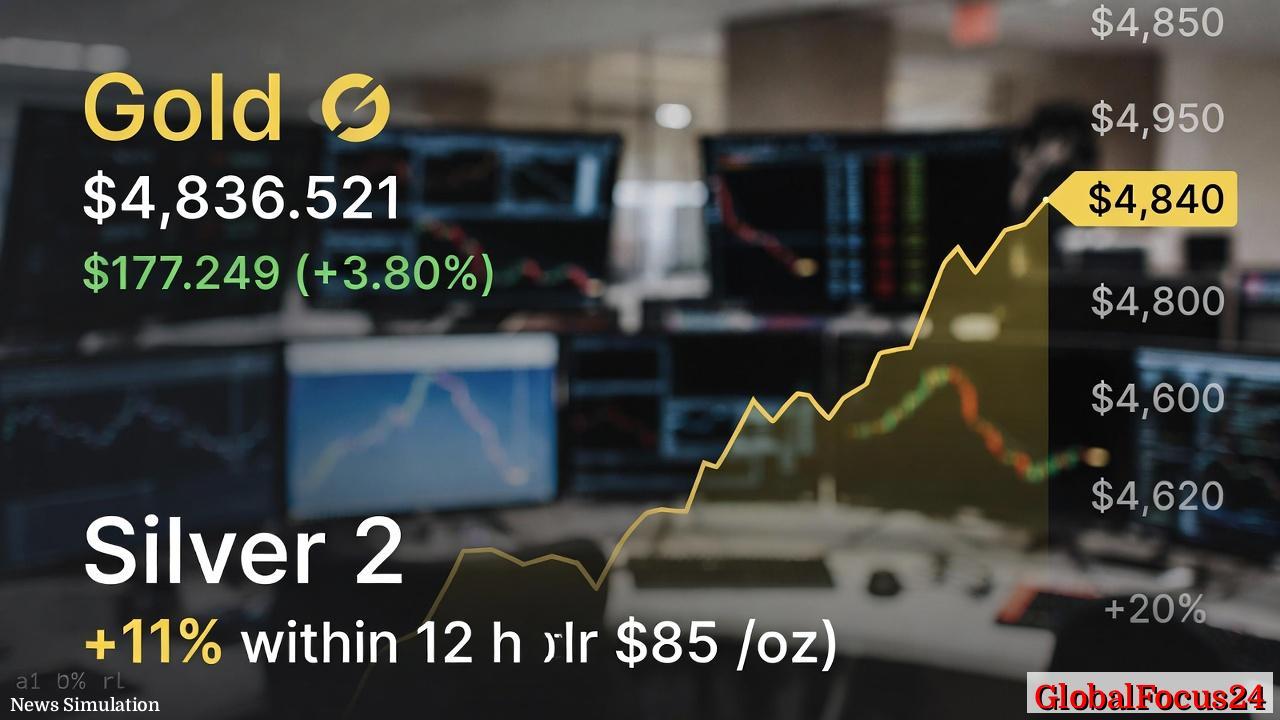
Gold Prices Surge to Record High Above $4,836 as Investors Flock to Safe Havens
Gold prices soared to an all-time high on Tuesday, with the metal trading at $4,836.521 per ounce, up $177.249 or 3.80% in contracts for difference (CFDs). The precious metal broke through the key $4,840 resistance level during an unusually volatile session, marking its strongest single-day performance in months as global investors rushed toward safe-haven assets amid mounting economic uncertainty and renewed fears of inflation persistence.
Global Uncertainty Propels Bullion to New Heights
The sudden rally reflects a confluence of global economic pressures that have accelerated demand for gold in early 2026. Investors have flocked to bullion as central banks signal slower-than-expected progress in curbing inflation, while ongoing geopolitical tensions continue to cast long shadows over global trade and energy markets.
Market analysts describe the move as both technically and sentiment-driven. The visible price momentum — climbing from around $4,620 earlier in the trading period to the session high of nearly $4,840 — underscores a decisive breakout in the long-term uptrend that began in late 2023. Traders had anticipated resistance near $4,800, but once that threshold was breached, automated buy orders and renewed institutional interest helped fuel the sharp leg upward.
Historically, gold has thrived in periods of macroeconomic instability. This latest surge mirrors past moments of investor anxiety, similar to the debt-ceiling and credit-rating episodes of the early 2010s or the inflation shocks during the 1970s, when gold prices quadrupled amid currency depreciation fears.
Inflation and Currency Pressures Reinforce the Rally
Underlying economic indicators continue to suggest that inflationary pressures remain embedded in major economies, particularly in the United States and the eurozone. Recent producer and consumer price data have shown month-over-month gains that exceed central bank targets, prompting speculation that policy rates may remain higher for longer — an outcome that historically boosts gold's appeal as a hedge against eroding purchasing power.
At the same time, the U.S. dollar index, after months of relative stability, has shown signs of weakening against other major currencies, further amplifying gold’s rise. Traditionally, gold prices move inversely to the dollar; a weaker greenback makes bullion cheaper for holders of other currencies, stimulating additional buying in international markets.
Currency depreciation fears have also strengthened physical demand from Asia, where gold jewelry and investment purchases remain culturally and economically significant. China and India — the world’s two largest consumers of gold — have seen surging domestic demand as investors seek protection against volatile equity markets and uneven manufacturing recoveries.
Central Banks Extend Record-Breaking Purchases
Behind the surge lies another critical factor: sustained central bank accumulation. Over the past two years, sovereign gold reserves have expanded at a pace not seen since the late 1960s. Central banks in emerging markets, led by China, Turkey, and several Gulf states, have accelerated their diversification away from the U.S. dollar amid evolving geopolitical alignments and trade fragmentation.
The World Gold Council recently reported that global official sector purchases topped more than 1,000 metric tons in 2025, marking the highest aggregate figure in modern records. Analysts note that these institutions appear undeterred by high prices, viewing gold not merely as a commodity but as a strategic reserve asset independent of foreign currency liabilities.
This central bank behavior has underpinned a structural floor for gold prices, dampening downside volatility even during brief periods of profit-taking. With private investment now rejoining the rally, the upward trajectory appears self-reinforcing — at least in the near term.
Comparing Regional Market Dynamics
Regional dynamics reveal distinct motivations behind the surge. In North America, retail investors and exchange-traded fund (ETF) participants have re-entered bullion markets amid concerns about slowing economic growth and continued fiscal deficits. In contrast, Europe’s investment community has been influenced by rising energy costs and renewed attention to deglobalization, factors that push long-term inflation expectations higher.
Meanwhile, in Asia, sustained currency weakness — particularly in Japan and parts of Southeast Asia — has made physical gold an increasingly attractive store of value. Physical dealers in Singapore, Hong Kong, and Dubai reported brisk trading throughout the week, with demand for bars and coins outpacing available inventory in some regions.
South American markets, traditionally less influential in global bullion flows, have also seen renewed participation. Investors in Brazil and Argentina, facing renewed currency instability, are diversifying into gold to hedge against local inflation and fiscal uncertainty.
A Historical Perspective: Echoes of Past Bull Runs
Gold’s current price trajectory evokes comparisons to earlier supercycles. The 1979–1980 rally saw gold surge to what was then a record high amid spiraling inflation, oil shocks, and tight monetary conditions. Likewise, the post-financial crisis run of 2011, when prices passed $1,900 per ounce, was driven by similar fears of systemic fragility and excessive liquidity.
However, the modern context differs in scale and structure. Global debt levels are now at record highs, real interest rates remain historically low when adjusted for inflation, and technological changes have dramatically increased the accessibility of investment instruments tied to gold. Digital trading platforms and tokenized gold products have opened the market to a broader investor base than at any prior moment in history.
Experts say this democratization of access has magnified volatility but also deepened market liquidity. It has allowed gold to serve simultaneously as a speculative asset, an inflation hedge, and a strategic reserve, blurring traditional lines between retail and institutional investor behavior.
Short-Term Momentum and Technical Factors
Technically, gold’s breakthrough above the $4,800 level is viewed by analysts as a bullish confirmation pattern. Chart indicators show strong upward momentum, with a series of higher daily closes and no immediate sign of exhaustion. The next major resistance level is expected near $4,900, though traders caution that profit-taking could prompt short-term retracements before any sustained push toward new milestones.
Volume figures also point to robust interest. Futures and CFD markets both registered record transaction counts during the latest session, suggesting active participation from both long-term holders and short-term momentum traders. Some analysts foresee consolidation within the $4,750 to $4,850 range before the next directional breakout.
Despite the enthusiastic sentiment, technical strategists warn that steep vertical climbs often precede periods of correction. If inflation expectations stabilize or the U.S. dollar rebounds, traders could see a moderation in gold’s ascent, though such a pullback may prove temporary given the underlying macroeconomic backdrop.
Broader Economic and Market Implications
The bullion rally carries broad implications for commodities, equities, and fixed-income markets. Rising gold prices often signal waning investor confidence in financial assets denominated in fiat currencies. This shift can tighten liquidity across other markets, as capital migrates toward tangible assets perceived as stable stores of value.
In equity markets, mining stocks — particularly those specializing in gold exploration and production — are experiencing renewed investor attention. The surge in metal prices has lifted profit margins for major producers, many of which had reduced exploration budgets during the leaner years of 2021–2023. Some exploration firms have already announced plans to increase drilling programs in Australia, Canada, and West Africa in response to improved price forecasts.
However, for broader industrial commodities, gold’s role as a safe haven can have the opposite effect, diverting capital from cyclical sectors like copper, nickel, and crude oil. Some economists worry that an extended gold bull run could coincide with weakening global manufacturing output, further signaling caution among investors about global growth prospects.
Regional Governments and Monetary Policy Outlook
Policymakers now face renewed pressure to manage inflation expectations. If gold continues to climb, it may reinforce public perceptions that currencies are losing purchasing power, complicating efforts by central banks to maintain confidence in monetary policy frameworks.
In the United States, Federal Reserve officials are expected to monitor the gold rally closely, viewing it as an indirect gauge of inflation expectations. While the Fed has emphasized data dependency in determining its rate path, persistent gold strength could challenge its messaging about disinflation progress. Similarly, the European Central Bank and Bank of Japan face parallel challenges, balancing fragile recoveries with commitments to price stability.
Emerging-market central banks may benefit more directly from higher gold prices, as many hold substantial reserves. For commodity-exporting nations, elevated bullion values can improve trade terms and strengthen fiscal positions, particularly in economies that mine and export gold as part of their resource mix.
Investor Sentiment and Outlook for 2026
As 2026 unfolds, investor sentiment toward gold remains overwhelmingly positive, though opinions differ on sustainability. Optimists argue that structural inflation, geopolitical realignment, and persistent fiscal deficits provide a strong foundation for further gains. Skeptics counter that once interest rates adjust and economic confidence improves, gold could revert to lower levels as risk appetite recovers.
For now, however, the technical and fundamental forces appear aligned in favor of the bulls. The record price above $4,836 per ounce represents not just a market milestone but also a reflection of global uncertainty, signaling that investors continue to view gold as the ultimate measure of safety in turbulent times.