Global Investors Reach Record $64.1 Trillion in U.S. Financial Assets
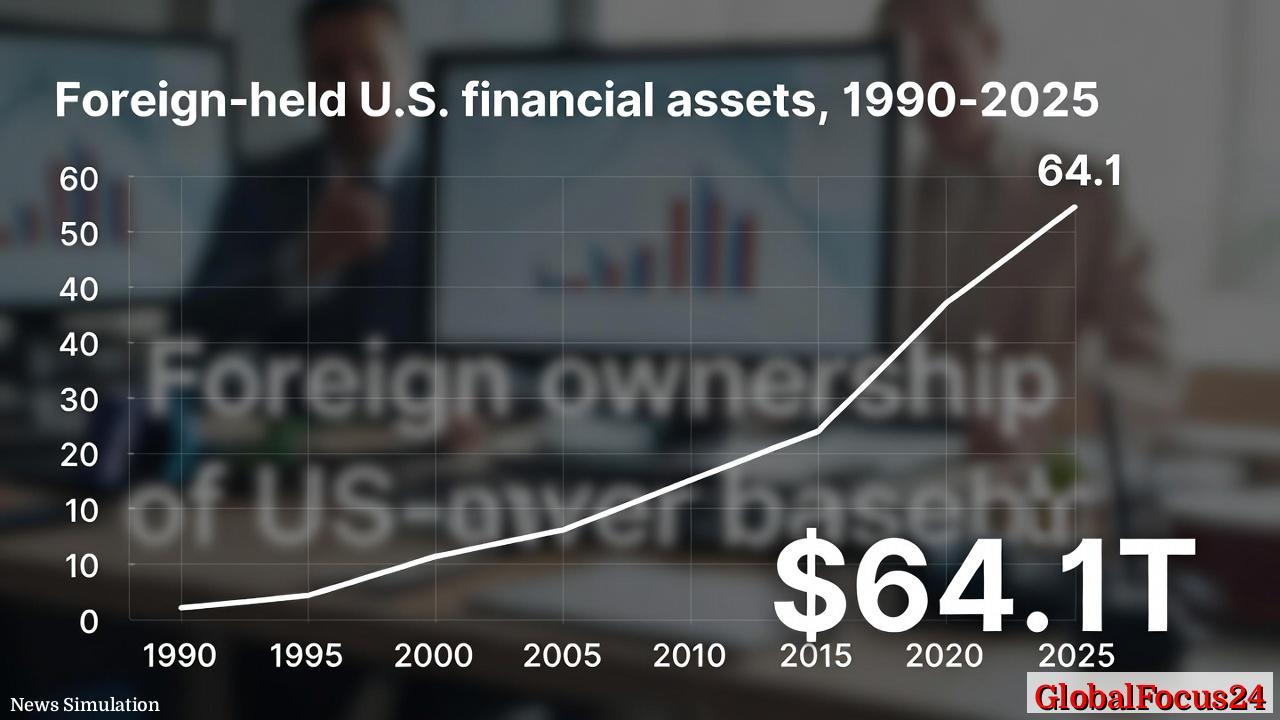
Foreign investment in U.S. financial markets surged to unprecedented levels in 2025, as global investors held a record $64.1 trillion in American assets by the third quarter, reflecting a 13.6% increase from the previous year. The milestone not only underscores the enduring appeal of the U.S. as the world’s leading destination for global capital but also marks a doubling of foreign-held assets since 2018—a sign of growing confidence in the resilience and depth of U.S. financial markets.
A Decade of Accelerated Growth
From 2015 to 2025, foreign holdings of U.S. financial assets expanded at a compound annual growth rate of 9.3%. While that pace was already impressive, the acceleration in recent years has been striking. The aftermath of the COVID-19 pandemic triggered a new wave of capital flows into the U.S., as investors worldwide sought safety, liquidity, and returns that were difficult to find elsewhere.
By the early 2020s, the U.S. had not only recovered from pandemic disruptions but had become the centerpiece of a global investment rotation out of emerging markets and into stable, high-value assets such as U.S. equities, bonds, and real estate investment trusts. As a result, the total value of foreign-held U.S. assets grew swiftly, reflecting both capital inflows and rising market valuations.
Historical Foundations: From Volatility to Strength
The current record level represents the culmination of a long historical trend. Foreign investment in the United States has expanded almost continuously since the 1990s, with only brief interruptions during global crises. In the wake of the 2000 dot-com bubble, foreign holdings dipped as markets recalibrated to new technology sector realities. A similar contraction took place during the 2008 global financial crisis, when risk aversion briefly curtailed capital flows and led to widespread deleveraging.
However, both downturns were followed by robust rebounds. The early 2010s witnessed a steady climb in foreign-held assets as central bank policies in advanced economies kept interest rates low and global investors sought yield and stability in U.S. markets. The resilience of American corporate earnings, coupled with innovation-driven growth in technology and healthcare sectors, reinforced the country’s status as a preferred haven for global capital.
The Post-Pandemic Acceleration
The economic volatility surrounding 2020 proved to be an inflection point. As the pandemic disrupted global supply chains and tested monetary frameworks, investors once again turned to U.S. assets for security. Landmark fiscal stimulus measures, aggressive monetary support from the Federal Reserve, and the swift recovery of corporate profits made American markets an attractive proposition.
Between 2020 and 2025, foreign-held U.S. financial assets soared, reflecting both inbound capital and rising valuations in equities and long-term bonds. The growth was strongest in U.S. corporate securities and government debt, signaling global trust in the country’s fiscal credibility. At the same time, renewed interest from sovereign wealth funds and institutional investors reinforced the perception of the U.S. as the anchor of the global financial system.
Comparative Perspective: U.S. Dominance in Global Portfolios
When viewed against other advanced economies, the scale of foreign-held assets in the United States remains unparalleled. The $64.1 trillion figure outpaces comparable metrics in the Eurozone, Japan, and China combined. European markets, while large, are more fragmented and face currency risk for dollar-based investors. Japan, once a magnet for international capital, has seen its role diminish due to sustained low yields and demographic headwinds. China’s capital markets continue to develop, but regulatory constraints and geopolitical considerations limit their ability to attract long-term foreign holdings on the same scale.
In regional comparisons, North America’s stability has made it the foremost hub for global investors, attracting funds not only from Europe and Asia but increasingly from the Middle East, Africa, and Latin America. The combination of transparent regulation, deep capital markets, and policy consistency has created a structure of confidence that remains durable even in volatile times.
Economic Impact: Strengthening the U.S. Dollar and Financial Markets
The influx of foreign capital has significant implications for the broader U.S. economy. Increased demand for U.S. securities has supported a strong dollar, moderating inflationary pressures and keeping financing costs relatively low. In the bond market, foreign participation helps stabilize yields, providing liquidity and reinforcing the Treasury market’s role as the global benchmark for risk-free pricing.
In equities, sustained inflows have contributed to higher valuations, aiding U.S. corporations in raising capital and supporting innovation-led sectors such as technology, pharmaceuticals, and renewables. For investors abroad, these returns have often exceeded those available in domestic markets, even after accounting for currency fluctuations.
Institutional Drivers and Shifting Allocations
The rise in foreign-held U.S. assets is not purely a result of market performance—it reflects strategic decisions by major global financial institutions. Central banks, sovereign wealth funds, and pension funds have all adjusted their portfolios to include greater exposure to U.S. instruments. This ongoing reallocation aligns with policy considerations such as diversification, liquidity management, and yield optimization.
In particular, sovereign investors from Asia and the Middle East have increased their stakes in U.S. Treasury securities, viewing them as essential reserve assets. Meanwhile, private institutional investors, including hedge funds and mutual funds, have expanded their holdings of U.S. equities and corporate debt, drawn by innovation-led growth and deep secondary market infrastructure.
Technological and Structural Factors
Another contributor to rising foreign holdings has been the evolution of digital trading platforms and regulatory harmonization. Financial technology has lowered barriers to cross-border investment, enabling greater participation by smaller institutions and high-net-worth individuals. At the same time, U.S. financial regulations have maintained an environment conducive to foreign investment while ensuring market integrity.
Advances in financial analytics and global payment systems have further facilitated the integration of international portfolios. These structural shifts mean that foreign investors now have unprecedented access, visibility, and control over their U.S. asset exposures, accelerating the long-term trend toward globalization of capital flows.
Risks and Emerging Challenges
Despite the optimism reflected in the record $64.1 trillion figure, some analysts warn of emerging vulnerabilities. A concentration of foreign capital in U.S. markets could heighten exposure to sudden reversals if global interest rates shift significantly or geopolitical tensions rise. The growing interdependence also implies that shocks in U.S. markets could transmit rapidly across borders.
Furthermore, currency fluctuations pose ongoing risks. A strengthening U.S. dollar benefits investors holding assets in local currency terms but can also compress returns once adjusted back to foreign currencies. Regulatory changes or adjustments in Federal Reserve policy, particularly regarding interest rate normalization or fiscal constraints, could also influence the pace of future inflows.
Long-Term Outlook: Enduring Global Confidence
Looking ahead, most economists anticipate that the long-term trajectory of foreign-held U.S. financial assets will remain upward, albeit at a potentially slower pace as global interest rates stabilize. The structural underpinnings of U.S. financial leadership—market transparency, institutional strength, and economic scale—continue to make it a magnet for global wealth.
As new challenges emerge, from technological disruptions to evolving global monetary frameworks, the U.S. is likely to retain its pivotal role in international finance. The $64.1 trillion milestone demonstrates not only the country’s economic gravity but also the deep trust placed in it by the world’s investors—a trust built over decades of policy stability, innovation, and financial integrity.
In an interconnected global economy, that trust remains one of America’s most valuable assets.