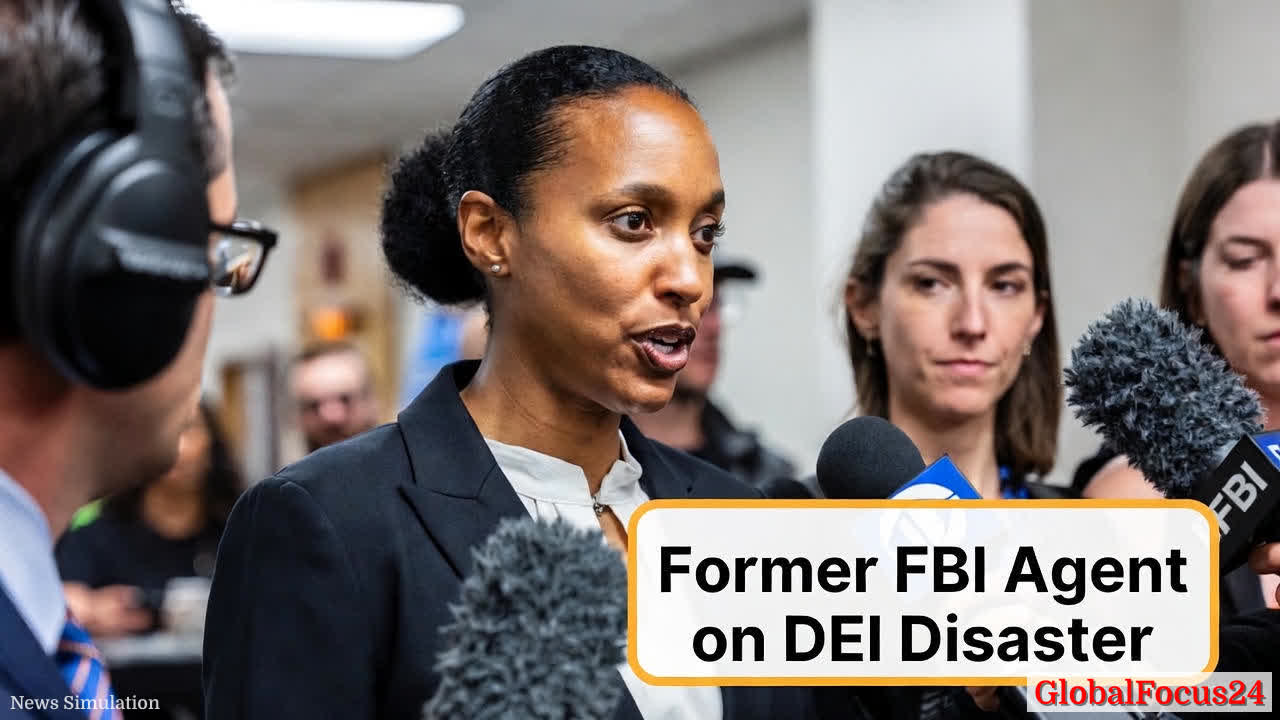
Former FBI Agent Details How DEI Initiatives Fractured the Bureau and Compromised Operations
A former FBI special agent has alleged that the bureau’s growing emphasis on diversity, equity, and inclusion (DEI) initiatives fractured its internal culture, weakened performance standards, and compromised operational effectiveness. Nicole Parker, who served with the Federal Bureau of Investigation for more than a decade, claims the institution’s devotion to political and social agendas was allowed to overshadow its critical law enforcement mission.
A Veteran Agent’s Alarming Account
Nicole Parker’s 12-year career at the FBI began in 2010, after an early professional life in finance and a transformative experience during the September 11 attacks, which she witnessed from New York City. Driven by what she described as a “sense of patriotic duty,” Parker entered the bureau during an era of renewed focus on counterterrorism and public safety.
Over the years, she specialized in investigating violent crimes, human trafficking networks, and active shooter cases. Among her notable roles was her involvement in the aftermath of the 2018 Parkland, Florida, school shooting—a tragedy that claimed 17 lives and sparked renewed scrutiny of federal and local law enforcement coordination.
In a candid retrospective, Parker asserts that by the mid-2010s, the FBI’s internal priorities began shifting from performance-based metrics toward ideological representation. What began as an effort to broaden inclusivity and diversity, she argues, morphed into an environment where identity and politics began influencing hiring, promotions, and field operations.
The Rise of DEI Within Federal Institutions
According to Parker, the transformation began around 2013, when the FBI created formal offices to oversee and advocate for DEI principles. By 2015, diversity had been adopted as a core institutional value, featuring prominently in public communications, training programs, and recruitment campaigns.
The FBI was not alone in this movement. Across the federal government, agencies during this period undertook similar initiatives aimed at improving representation. These programs were rooted in decades of civil service reforms dating back to the 1970s, when equal employment opportunity standards were first introduced. In the wake of the 2020 racial justice protests, however, DEI efforts accelerated in nearly every sector, including education, defense, and intelligence.
Parker contends that what had started as an attempt to ensure fair access to careers metastasized into an internal bureaucracy that consumed significant resources. “We were celebrating the wrong metrics,” she said, implying that performance excellence had been subordinated to demographic goals.
Claims of Lowered Standards and Operational Gaps
The former agent alleges that recruitment benchmarks were lowered to fulfill diversity quotas, leading to a decline in applicant quality. “They were hiring incompetence for optics,” she stated, arguing that this shift diluted the bureau’s traditional meritocracy.
According to Parker, some of these personnel decisions had real-world implications. She highlighted that a DEI recruitment event was held in South Florida only days before the Parkland tragedy—an event she believes reflected misplaced organizational priorities. While no evidence directly connects the two, Parker contends that resources might have been better spent addressing actionable threat tips that were reportedly ignored.
She further claimed that specialized divisions, such as those dealing with child exploitation or violent crime, saw diminished support while other politically sensitive investigations received disproportionate attention. Parker cited the 2021 death of FBI Special Agent Laura Schwartzenberger, who was killed during a search warrant operation involving crimes against children, pointing to what she described as under-resourced field operations.
“Some of the most dangerous assignments were staffed with minimal backup,” Parker lamented. “We were stretched too thin because the attention was elsewhere.”
The Parkland Case and Broader Implications
The 2018 shooting at Marjory Stoneman Douglas High School remains a defining moment in modern law enforcement accountability. In subsequent reviews, both the FBI and local authorities faced scrutiny for failing to act on multiple warnings about the shooter’s potential for violence.
While Parker does not attribute those failures solely to DEI, she suggests that political and internal distractions contributed to a diminished state of preparedness. Her critique echoes concerns periodically raised by law enforcement veterans who warn that non-operational agendas—however well-intentioned—can consume time and attention that should be directed toward threat mitigation.
Such sentiments reflect a broader debate within government institutions about how to balance social responsibility initiatives with mission-critical performance goals. Departments nationwide, from intelligence to education, have struggled to reconcile these often-competing priorities.
Internal Division and Employee Morale
Parker describes an internal culture increasingly split into two camps: one emphasizing professionalism and mission performance, the other committed to advancing identity-based representation and ideological goals. According to her account, disagreements over these priorities created resentment among field personnel.
“The divide wasn’t about politics as much as philosophy,” she explained. “There were those who believed in protecting equality of opportunity, and others who pushed for outcomes tailored by category.”
She alleges that dissenters who questioned DEI’s scope or implementation sometimes faced retaliation or professional ostracism. That pressure, she said, grew more intense during the pandemic when vaccine mandates and telework policies further polarized staff. Parker ultimately resigned in October 2022, joining what she described as a wave of disillusioned colleagues who no longer recognized the bureau’s founding ethos.
Political Neutrality and Public Trust
One of the most contentious aspects of Parker’s testimony involves the claim of politically motivated operations. She cited the FBI’s extensive involvement in investigations related to the January 6, 2021, Capitol breach and the 2022 search of a former president’s residence as evidence of unequal resource allocation.
While such operations fall within the bureau’s legal mandate, critics across the political spectrum have argued that the FBI’s objectivity is being questioned more than ever before. Polling data in recent years has shown a notable decline in public trust in federal law enforcement amid overlapping allegations—from both sides of the aisle—regarding bias, corruption, and selective transparency.
Historically, the FBI has weathered similar storms. From the Hoover era’s domestic surveillance controversies to the early 2000s counterterrorism missteps, the agency has repeatedly been pressured to reform its internal practices without eroding its independence. Parker’s remarks tap into that historical tension, suggesting the modern DEI era may be another chapter in a long cycle of bureaucratic overreach and recalibration.
Comparing Reforms Across Agencies
The debates surrounding the FBI’s DEI approach mirror similar challenges seen in other federal and corporate environments. The Department of Defense, for instance, has wrestled with how to maintain combat readiness while promoting diversity in service ranks. Corporate America has faced its own reckoning, with some firms scaling back or restructuring DEI programs amid backlash and declining effectiveness.
Academic studies show mixed evidence regarding the impact of DEI on institutional performance. Supporters argue that diverse teams foster innovation and cultural competence, while detractors warn that poorly managed DEI systems can create resentment or hinder cohesion. Parker’s critique sits squarely within this conflict—highlighting how ideals intended to promote fairness can, in practice, strain mission-critical environments when applied without balance.
The Broader Economic and Operational Context
From an economic standpoint, the cost of implementing DEI programs across government agencies has grown substantially in the last decade. The establishment of diversity officers, training sessions, and staff expansion has created a secondary bureaucratic layer, often consuming funds otherwise used for field resources, training, or equipment. Parker’s concerns align with critics who believe this spending surge coincides with diminished operational efficiency.
At the state and regional levels, local law enforcement agencies face similar budgetary pressures. Competing for federal grants while implementing overlapping DEI programs can stretch both personnel and budgets, an issue amplified by rising violent crime rates in many American cities.
Such dynamics underscore the challenge of administering social responsibility at scale—particularly in institutions like the FBI, tasked with national security and criminal investigation under enormous public scrutiny.
A Path Toward Rebuilding Trust
Despite her criticisms, Parker expressed cautious optimism about the bureau’s future. She believes that acknowledging flaws and restoring accountability can rejuvenate its founding mission. Her prescription includes a renewed emphasis on merit-based advancement, transparent evaluation standards, and a redefined internal culture that values diversity of thought over demographic metrics.
Reform efforts could look to historical precedents, such as the post-Church Committee restructuring of the 1970s or the modernization initiatives following 9/11, when the FBI reoriented itself toward counterterrorism without abandoning its core investigative role. These examples suggest that institutional renewal is possible—though rarely without turbulence.
“The FBI can absolutely recover,” Parker insisted. “But it will take honest leadership, courage, and a return to first principles—protecting the American people, not politics.”
Looking Ahead
Nicole Parker’s account offers a glimpse into the hidden tensions within one of America’s most storied federal agencies. Whether her experiences reflect systemic dysfunction or isolated cultural excesses remains a matter of debate. What is clear, however, is that the balance between diversity, accountability, and operational performance has become a defining issue for law enforcement in the 21st century.
As American institutions continue to navigate the complexities of identity, governance, and security, the FBI’s experience may serve as a cautionary tale—or as a starting point for reform that reaffirms the fundamental mission of public service over politics.