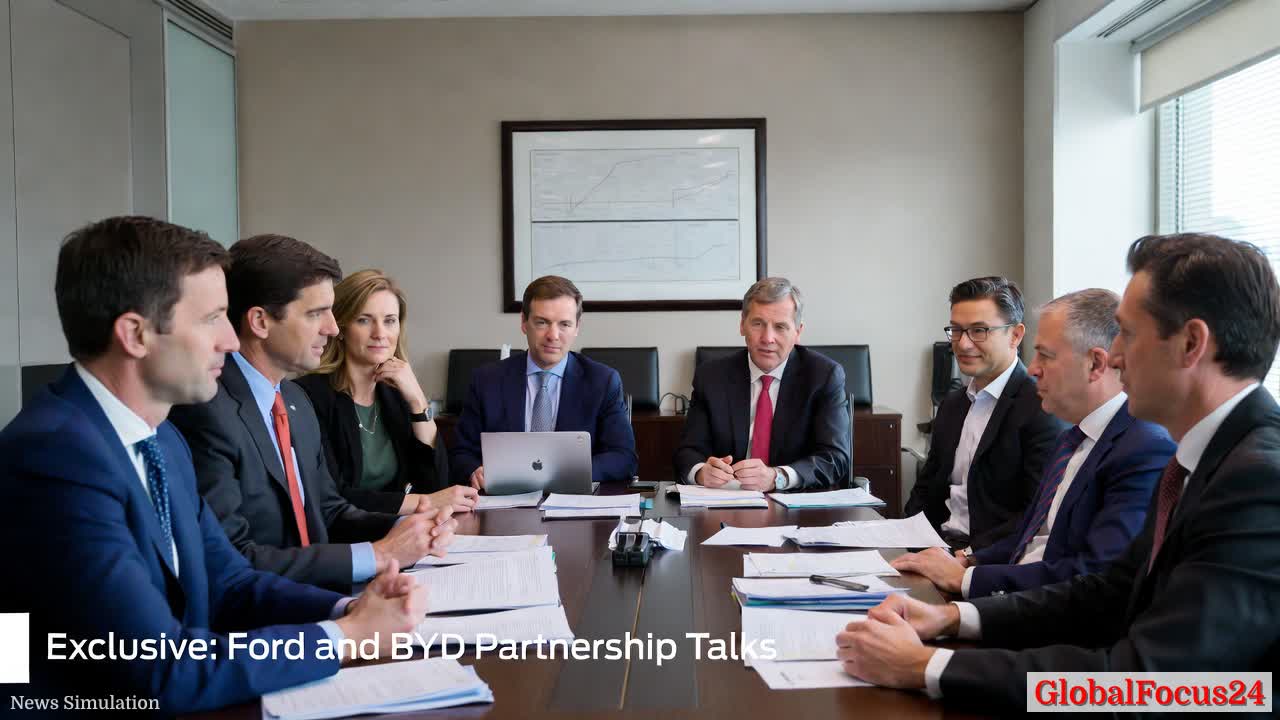
Ford and BYD Explore Battery Partnership as Automakers Refocus on Hybrid Vehicles
A Strategic Shift in a Slowing Electric Vehicle Market
Ford Motor Company and Chinese automaker BYD are in active discussions over a potential supply partnership that could reshape the global hybrid-vehicle supply chain. The talks center on Ford purchasing batteries from BYD for use in some of its hybrid models, marking a noteworthy collaboration between one of America’s oldest automotive manufacturers and China’s largest electric-vehicle and battery producer.
While the two automakers have not finalized the agreement, discussions reportedly include the possibility of Ford importing BYD-made batteries to its factories outside the United States. The move would represent a pragmatic step for Ford as it adapts to a global auto market where demand for fully electric vehicles has cooled, and consumer interest in hybrids has surged once again.
How EV Market Dynamics Are Shaping Automaker Strategy
A few years ago, electric vehicles (EVs) were seen as the inevitable future of personal transportation. Driven by government incentives, environmental awareness, and rapid innovation in battery technology, nearly every major automaker poured billions into building EV capacity and infrastructure. Yet the landscape has shifted dramatically over the past year.
High interest rates, uneven charging infrastructure, and slowing consumer adoption have tempered once-ambitious sales forecasts. In the United States, EV sales growth decelerated in late 2025 for the first time in nearly a decade. European and Asian markets have experienced similar slowdowns, leading automakers to recalibrate their product mixes toward hybrids, which blend internal combustion and electric power and alleviate consumer concerns over range and charging access.
For companies like Ford, this change has triggered a strategic reassessment. Instead of focusing solely on fully electric vehicles, Ford is investing heavily in hybrid technology as an intermediate step for customers transitioning away from gasoline engines. By partnering with BYD—a firm with one of the world’s most extensive battery manufacturing networks—Ford could secure a more stable and cost-effective supply of advanced batteries while mitigating risks associated with building new capacity from scratch.
BYD’s Expanding Reach in the Global Battery Landscape
BYD, headquartered in Shenzhen, China, has transformed from a battery maker into a global automotive powerhouse. Its ability to vertically integrate—from raw materials to finished vehicles—gives it a competitive advantage that few global rivals can match. The company currently ranks among the top producers of lithium iron phosphate (LFP) batteries, known for their durability, affordability, and safety.
These traits make LFP batteries particularly appealing for hybrid vehicles, where cost efficiency and reliability take precedence over maximum range. For Ford, acquiring BYD’s LFP batteries could lower production costs and improve profit margins on hybrid models sold in markets with price-sensitive consumers, such as Latin America, Asia-Pacific, and parts of Europe.
BYD’s ongoing expansion into overseas markets also aligns with this potential partnership. The company has opened or announced battery and vehicle plants in Thailand, Brazil, and Hungary, reflecting its growing ambition to serve global automakers as both a supplier and a competitor. Its collaboration with Ford could serve as a strategic balance—fostering cross-border cooperation even amid rising global trade tensions and regional industrial policies that encourage domestic production.
Ford’s Global Manufacturing and the Hybrid Pivot
For Ford, the timing of these talks could prove crucial. The American carmaker has faced profitability challenges in its electric-vehicle division, with EV losses widening in 2025 due to slower-than-expected sales and high development costs. By contrast, hybrid sales have shown strong performance, particularly in the U.S., where Ford’s Escape, Maverick, and F-150 hybrid models have consistently exceeded demand forecasts.
CEO Jim Farley has publicly emphasized that hybrids represent a “bridge technology” for Ford, giving customers an accessible path toward electrification without the range anxiety associated with fully electric models. To scale hybrid production efficiently, Ford will require a diversified and secure battery supply chain—something a partnership with BYD could provide.
While the company has major joint ventures with domestic battery firms like SK On and CATL for full EVs, sourcing hybrid batteries from an established supplier in Asia could accelerate manufacturing in regions outside North America. Importing batteries to Ford plants in Europe, South America, or even Southeast Asia could reduce logistical complexity and ensure more consistent supply.
Regional and Competitive Context
Across global markets, the hybrid resurgence is not unique to Ford. Japanese manufacturers such as Toyota and Honda, which maintained their hybrid focus even during the peak of EV enthusiasm, are benefitting from their foresight. Toyota’s global hybrid sales rose sharply in 2025, reinforcing its reputation as the leader in hybrid technology.
In Europe, stricter emissions standards are encouraging automakers to adopt multi-pathway strategies—supporting both hybrid and electric models until charging networks expand further. Meanwhile, in China, where BYD leads the domestic market, many consumers have turned toward plug-in hybrid vehicles (PHEVs) as an affordable and flexible alternative to full EVs.
This shifting consumer sentiment underscores a broader industry realignment. Automakers are no longer solely competing on who can build the best all-electric car, but rather on how effectively they can integrate a balanced portfolio of electric, hybrid, and internal combustion models that match local market demands.
Economic and Industrial Implications
Should a deal between Ford and BYD materialize, the economic impact would ripple across several sectors. For Ford, securing a reliable supply of high-quality batteries could help contain production costs and stabilize margins during what remains a volatile period for the auto industry. It could also improve Ford’s ability to manage working capital by reducing investment in battery R&D and production infrastructure.
From a regional industrial perspective, the collaboration could highlight the growing interdependence between American and Chinese manufacturers—even amid ongoing efforts by both nations to localize electric vehicle production. BYD’s batteries could also support Ford’s expansion in developing markets where hybrid models are more economically viable than full EVs.
At the same time, sourcing from a Chinese supplier might raise questions about trade policy and supply security, particularly as governments worldwide continue to scrutinize critical supply chains involving batteries and rare earth materials. Regulators may assess whether such arrangements comply with emerging local content rules and green industry initiatives designed to encourage domestic manufacturing.
A Moment of Pragmatic Collaboration
Although the outcome of the negotiations remains uncertain, the discussions between Ford and BYD reflect a pragmatic reality confronting the global automotive landscape. As the industry seeks a sustainable path forward through fluctuating demand, geopolitical uncertainty, and technological transition, partnerships like this could serve as an economic and strategic necessity.
Ford’s willingness to engage with a leading Chinese supplier signals a recognition that global competitiveness now depends on flexibility, not isolation. For BYD, collaborating with a major Western automaker would reinforce its growing status as a world-class supplier capable of serving diverse markets.
The next phase of negotiations will likely determine the scope and geographic focus of the partnership. Whether it centers on specific hybrid models, regional factory arrangements, or broader technology sharing, the Ford-BYD talks underscore a fundamental shift: in the race toward automotive electrification, collaboration may prove as vital as competition.
Outlook for the Coming Years
As automakers worldwide adjust their strategies for 2026 and beyond, the hybrid transition appears poised to play a central role in bridging the gap between gasoline and electric mobility. Governments may continue to incentivize electrification, but consumer preference—and economic pragmatism—are driving manufacturers to diversify their approach.
If finalized, a Ford-BYD partnership could serve as a case study in how automakers navigate the tension between technological innovation, global supply chains, and market realities. It represents more than a single contract negotiation; it is a glimpse into an industry recalibrating its ambitions to align with the evolving rhythms of global demand, affordability, and infrastructure readiness.
As the electric-vehicle dream matures into a more complex mix of solutions, hybrid technology—and the partnerships that sustain it—may define the automotive market’s next decisive chapter.