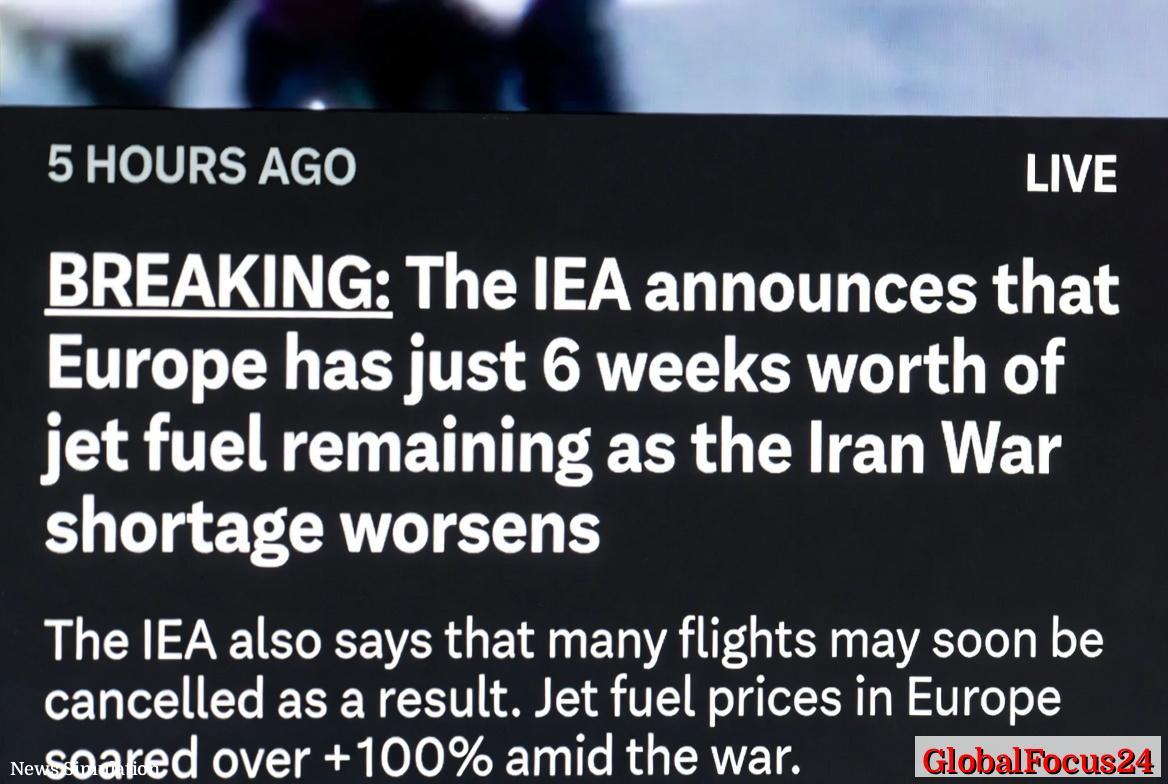
Europe Faces Dire Jet Fuel Shortage as Iran Conflict Deepens, IEA Warns
Mounting Crisis: Only Six Weeks of Supply Left
Europe is confronting an acute jet fuel shortage that could paralyze air travel within weeks, according to a new assessment by the International Energy Agency (IEA). The agency reported that the continent has approximately six weeks of jet fuel remaining, as the ongoing war involving Iran continues to strain global energy markets. Supply chains already weakened by years of geopolitical instability are now nearing a breaking point, raising the possibility of widespread flight cancellations and severe economic repercussions across the aviation sector.
The crisis marks one of the most serious energy supply disruptions in Europe since the height of the 2022 Russian gas crisis. This time, however, the epicenter of the shock lies closer to the Strait of Hormuz — a maritime bottleneck through which nearly a fifth of the world’s oil passes. The IEA’s warning reflects mounting fears that persistent instability in the Middle East could tip global oil markets into sustained volatility, with jet fuel now becoming a central casualty.
From Energy Independence to Scarcity
European airlines have long relied on a consistent flow of refined products from the Middle East, with additional imports from Asia and the United States filling gaps in supply. But the Iran conflict has effectively closed or disrupted several key shipping routes. Insurance premiums for vessels transiting the Persian Gulf have surged, and refiners are diverting output toward regions offering higher margins or greater logistical safety.
Over the past decade, Europe sought to strengthen its energy independence by diversifying crude and fuel imports. Yet jet fuel remained a particular vulnerability due to its refined nature and the specialized infrastructure required for production and storage. European refineries, operating at reduced capacity since the pandemic, have struggled to ramp up output quickly enough to offset lost imports. As a result, wholesale buyers find themselves competing for dwindling volumes, pushing prices up by more than 100% since the start of the year.
Economic Fallout Extends Beyond Airlines
The immediate concern is aviation, but the economic ripples extend far beyond the tarmac. Air freight operations are critical for Europe’s high-value export industries — from pharmaceuticals and advanced electronics to luxury goods and perishable foods. With jet fuel in short supply, logistics networks that depend on rapid international transport risk slowing down or halting altogether. Businesses already contending with high energy prices and inflation could face further cost pressures, threatening growth during an already fragile recovery.
Tourism, still rebounding from pandemic-era slowdowns, stands on shaky ground as well. Rising ticket prices and potential flight cancellations could disrupt summer travel plans and dampen consumer spending across major destinations like Spain, France, and Italy. Analysts warn that if the shortage continues into peak travel season, Europe may face one of its most turbulent summers in decades.
Airlines Brace for Turbulence
Airlines across the continent are preparing for contingency operations. Many carriers have begun implementing fuel-saving measures, rerouting flights, or considering capacity reductions in anticipation of tighter supplies. Larger operators with long-standing fuel contracts may weather the crisis better than smaller or budget airlines, which often buy fuel on shorter-term spot markets and are therefore more exposed to sudden price surges.
Several companies have reportedly started stockpiling fuel at major hubs, but storage capacity is limited, and replenishment could prove difficult. Airports in northern Europe, including Amsterdam, Frankfurt, and Heathrow, are believed to be managing inventories closely, while smaller regional airports may face disruptions sooner.
Some analysts suggest airlines could accelerate the retirement of older, less fuel-efficient aircraft to conserve reserves. Others predict that high fuel costs may temporarily reverse the trend of ultra-cheap short-haul travel that defined European skies for two decades. Either way, the economic model of low-cost aviation — a pillar of Europe’s interconnected economy — is facing acute stress.
Historical Parallels and Energy Security Lessons
Europe has faced aviation fuel shortages before, but never on this scale in peacetime. The closest parallels date back to the oil crises of the 1970s, when price shocks reshaped national energy strategies. Those events spurred significant investment in alternative energy sources, conservation measures, and international cooperation through institutions like the IEA itself.
However, today’s crisis differs in critical ways. Modern supply chains are far more globalized, and aviation’s central role in commerce and tourism makes it more economically sensitive than in previous eras. Additionally, Europe’s pivot away from Russian energy following the 2022 invasion of Ukraine reduced reliance on one major supplier but increased exposure to volatile global spot markets. As a result, the region now finds itself caught between geopolitical instability and limited domestic refining capacity.
Some energy experts argue that the jet fuel shortage underscores the need for longer-term structural changes — including greater investment in sustainable aviation fuels (SAF), expanded strategic reserves, and more resilient logistics infrastructure. The European Union has set ambitious goals for SAF adoption by 2030, but current production remains a fraction of total demand.
The Role of the Iran Conflict
The war involving Iran has disrupted more than just oil supply lines. It has destabilized neighboring export routes, drawn in regional actors, and increased military activity in areas critical to maritime trade. Repeated drone and missile attacks on tankers, along with wider military blockades, have delayed shipments of both crude oil and refined products bound for Europe. Even as some Gulf producers attempt to boost exports through alternative ports, capacity constraints and security risks limit how much rerouting can offset lost supply.
The IEA report indicated that refiners in Asia and North America are exploring ways to redirect output to Europe, but logistical challenges remain significant. Transporting large volumes of jet fuel over longer distances increases costs and shipping times, compounding the existing price escalation.
Price Surge Strains Consumers and Carriers
Wholesale jet fuel prices have now more than doubled since early January. As of mid-April, average prices in northwest Europe are hovering at levels not seen since late 2022, when global energy markets were still reeling from war disruptions in Eastern Europe. Airlines, facing limited ability to hedge at reasonable rates, are passing part of those costs to passengers through higher ticket fares.
The price surge has also raised concerns among policymakers about inflationary knock-on effects. Higher airfares could feed into consumer price indices across the Eurozone, complicating efforts by central banks to maintain stability. Economists warn that sustained energy inflation could force difficult decisions between preserving economic momentum and curbing rising costs of living.
Regional Comparisons: Europe vs. Global Markets
North America is faring somewhat better, supported by domestic refining capacity and diversified supply channels. U.S. refiners have ramped up exports to Europe, but transatlantic shipments cannot fully replace regional shortfalls. In contrast, Asia-Pacific countries, particularly Japan and South Korea, have managed to secure longer-term supply contracts, insulating them partially from current volatility.
Middle Eastern energy exporters, meanwhile, find themselves in a complex position — balancing domestic security concerns with the commercial opportunity of soaring prices. This dynamic has introduced further unpredictability into global energy markets, with futures traders reporting record volatility.
In Europe, the shortage’s impact is uneven. Northern nations with stronger logistical networks and access to major ports may maintain supplies slightly longer. Southern and eastern states — particularly those reliant on Mediterranean imports — face heightened vulnerability if tanker routes remain constrained.
Governments and the IEA Seek Emergency Measures
Policymakers across Europe are now mobilizing contingency plans. Several governments have reportedly initiated talks to release limited volumes from emergency fuel reserves, though officials acknowledge these measures offer only temporary relief. The IEA is coordinating with member states to manage strategic stock releases, similar to actions taken during previous oil disruptions.
Transport ministries are also exploring temporary relaxation of fuel blending or specification rules to enable substitution with compatible alternatives. Still, these stopgap measures cannot quickly resolve the structural deficit in refined jet fuel supplies.
The European Commission has convened an energy task force to assess immediate needs and coordinate responses between national regulators, refiners, and airlines. Officials emphasize that conservation efforts — such as optimizing flight routes and reducing non-essential operations — may become necessary if the crisis deepens.
The Road Ahead
Unless supply flows from alternative sources stabilize soon, the impact on Europe’s aviation sector could be severe and prolonged. The combination of high prices, logistical disruptions, and limited refinery output points to an extended period of adjustment. Industry analysts expect that if jet fuel inventories fall below a critical threshold within the next month, widespread flight reductions may become unavoidable.
The IEA’s assessment concludes with a stark warning: without decisive international cooperation and rapid logistical adaptation, Europe’s air transport system could face its most significant disruption in modern history. For a continent built on open borders, trade, and tourism, the return of grounded aircraft and empty runways would serve as a sobering reminder of just how vulnerable global mobility remains to the shifting tides of geopolitics.