)
Federal Workforce Shrinks at Historic Pace as March Jobs Decline Reaches 1960s Levels
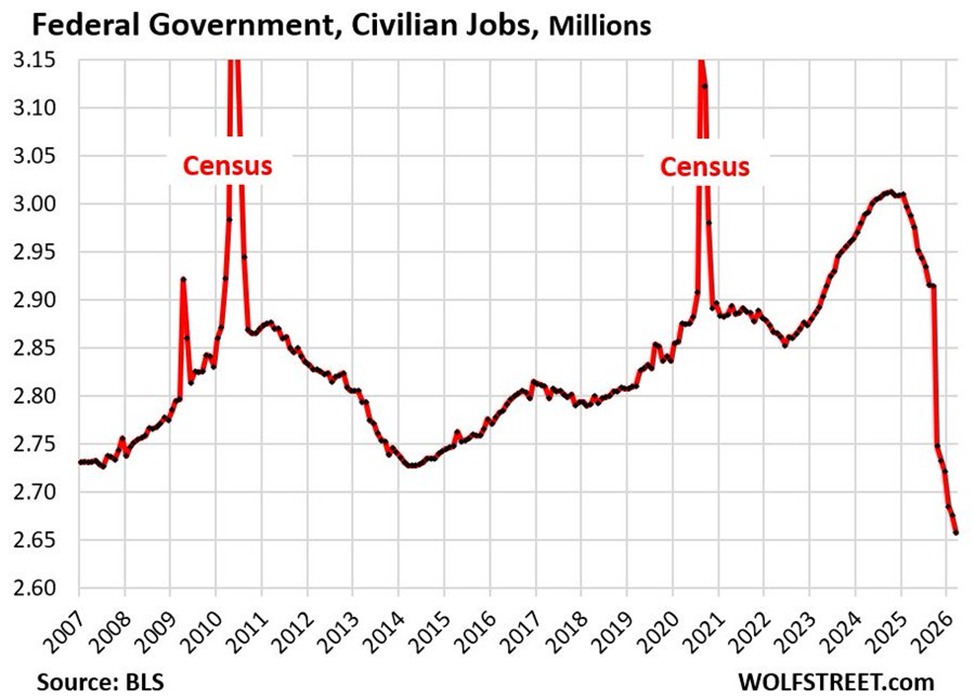
The federal government finished March with a dramatic drawdown in its civilian workforce, marking the latest milestone in a long-running contraction that has reshaped hiring, operations, and service delivery across agencies. The Bureau of Economic and Workforce Data reported a net loss of 18,000 jobs for the month, bringing total federal employment to 2.66 million and dropping the headcount to the lowest level since 1966. The move extends a 14-month streak of monthly reductions that have redefined the labor profile of the U.S. government at a moment when public services face growing demand and evolving mission priorities.
Historical outlook: a distant echo of a leaner era
The March decline echoes a broader historical trend: periods of sustained downsizing followed by relative stabilization, often tied to shifts in policy priorities, budget constraints, and structural reforms. In the mid-1960s, the federal workforce fluctuated against the backdrop of expansive social programs and wartime-era staffing norms giving way to reorganizations in the post–World War II era. Today’s contraction comes amid a very different economy—one shaped by digital modernization, tighter appropriations, and a renewed emphasis on efficiency and mission-focused staffing. Analysts note that the current trajectory reflects a deliberate strategy to recalibrate the federal footprint while maintaining core capabilities in areas such as national security, public health, science, and infrastructure.
Economic impact: budgeting, service delivery, and regional ripple effects
- Budgetary implications: across the executive branch, agencies have pursued targeted reductions that align with annual appropriations and multi-year fiscal plans. Thejob declines interact with flat or gradually growing program funding in several departments, prompting shifts in workload distribution, outsourcing decisions, and the prioritization of critical functions. The interplay between reduced headcount and fixed operating costs creates a management environment where automation, process improvement, and strategic hiring freezes become central tools for maintaining continuity.
- Service delivery considerations: as headcount tightens, some frontline services experience longer processing times or heightened caseloads per employee. Agencies responsible for benefits administration, veterans’ services, veteran education programs, tax administration, and environmental monitoring report efforts to preserve timely service while undergoing organizational changes. The challenge for policymakers is to safeguard access to essential programs while enabling modernization efforts that can deliver longer-term cost savings and improved public outcomes.
- Labor market dynamics: the public sector’s shrinkage can influence private-sector demand in several ways. Reduced federal hiring may push private contractors to absorb more work, potentially driving demand in consulting, IT modernization, and facilities management. Conversely, slower federal employment growth can indirectly limit consumer spending and regional employment where government payrolls have historically anchored local economies.
- Regional distribution: the federal workforce is not evenly spread. Districts with large federal installation footprints or major agency hubs—ranging from national laboratories to defense-related facilities—tend to experience more acute staffing reductions. This redistribution can affect local tax bases, housing markets, school enrollment, and public services dependent on federal payrolls. Conversely, regions with growing private-sector opportunities may experience a shift in labor demand as public-sector roles recede.
Operational dynamics: modernization, efficiency, and the evolving mission
- Digital transformation and automation: agencies have increasingly pursued automation, cloud adoption, and data modernization to maintain service levels with leaner staffs. The emphasis on digital-first solutions often accompanies careful risk management, ensuring accessibility and security for sensitive programs.
- Workforce composition: reductions have not been uniform across occupations. Scientific, engineering, cybersecurity, and medical professionals may see different hiring and attrition patterns compared with administrative or support roles. The evolving mix reflects strategic priorities, where mission-critical functions retain stronger continuity even as overall headcount declines.
- Succession planning and retirements: demographics intersect with contraction as a portion of the workforce reaches retirement eligibility. Agencies face the dual challenge of preserving institutional knowledge while offering pathways for newer talent to assume leadership roles and specialized responsibilities.
Regional comparisons: performance and policy contexts across states
- Capitol region and defense corridors: areas heavily invested in national security and defense often experience focused staffing adjustments aligned with Department of Defense and intelligence community budgets. The implications for regional labor markets include shifts in contractor activity and demand for specialized facilities maintenance.
- Science and technology hubs: states hosting national laboratories or major research programs may experience different pacing in vacancy replacements or programmatic re-scoping. While some labs maintain continuity through targeted hiring, others adapt to more cautious staffing trajectories in the wake of funding reallocations.
- Public health and social services centers: regions with large networks of social programs and health services contend with balancing urgent service needs—such as benefits processing, screenings, and public health campaigns—with the fiscal discipline of fewer federal employees to administer those programs.
- Rural and smaller metropolitan areas: in communities with a heavy reliance on federal installations, reductions can have outsized effects on local economies. Local governments and institutions may respond with partnerships or incentives to preserve essential services and attract private-sector investment.
Policy context: what the contraction signals for governance and accountability
- Budget discipline and reform momentum: the ongoing headcount reduction aligns with broader fiscal strategies aimed at improving efficiency, reducing overhead, and optimizing program delivery. Policymakers often cite the need to reallocate resources toward high-impact activities and to modernize legacy processes that historically required large administrative footprints.
- Oversight and accountability: as the workforce shrinks, scrutiny of program performance intensifies. Agencies are increasingly measured by outcomes, timelines, and user satisfaction metrics, rather than sheer staffing levels. This shift incentivizes stronger performance management, clearer lines of responsibility, and more transparent reporting to the public.
- Labor policy and wage scales: federal employment remains a benchmark for public-sector compensation, benefits, and work-life policies. Changes in the federal workforce can influence private-sector expectations for wages and benefits, particularly in markets with a high concentration of government-related roles.
Public reaction and societal context: navigating change in real time
Public sentiment around government staffing is often a barometer of trust in public institutions. In communities where residents rely on timely benefits, rapid processing of applications, or robust public health responses, the perception of a leaner federal workforce can evoke a mix of concern and pragmatism. On one hand, observers warn of potential service slowdowns or delays. On the other, supporters emphasize the drive toward more efficient government that delivers value with fewer resources. Across media and civic forums, residents weigh the costs and benefits of modernization, transparency, and accountability in a changing federal staffing landscape.
Historical context for enduring transformation
This decade-long trend sits within a broader arc of transformation that has rewritten the relationship between citizens and government services. From the implementation of digital portals and automated systems to the consolidation of agencies and realignment of missions, the federal workforce has repeatedly adapted to shifting demands. The March figures add a noteworthy data point to this ongoing journey, illustrating how policy choices, technological adoption, and strategic considerations intersect to shape the size and composition of the nation’s public workforce.
Operational guidance for stakeholders
- For agencies: prioritize critical functions, invest in cross-training, and leverage automation to sustain service levels. Maintain clear performance metrics and transparent reporting to ensure accountability while operating with leaner teams.
- For policymakers: balance fiscal prudence with the imperative to preserve essential public services. Consider targeted hiring where mission urgency is highest and pursue reforms that reduce bottlenecks without sacrificing public safety, health, or welfare.
- For communities and businesses: monitor regional impacts and explore partnerships that can buffer potential service gaps. Engage in public-private collaborations that support continuity of core programs and community resilience.
Conclusion: a turning point with long-term implications
The March employment data reflects a deliberate recalibration of the federal footprint, one that will reverberate through budgets, services, and regional economies for years to come. While the headcount figure traces a historical low not seen since the 1960s, the broader narrative centers on modernization, efficiency, and strategic focus. As agencies continue to navigate this transition, observers will watch how investments in technology, process reform, and talent development translate into tangible improvements in public service delivery. The conversation about federal staffing is not solely about numbers; it is about how a leaner federal government can sustain essential functions, safeguard public welfare, and adapt to an ever-changing policy landscape.