)
Fairness and the Future of Economic Opportunity: Beyond Equal Incomes
Rethinking What Makes an Economy Fair
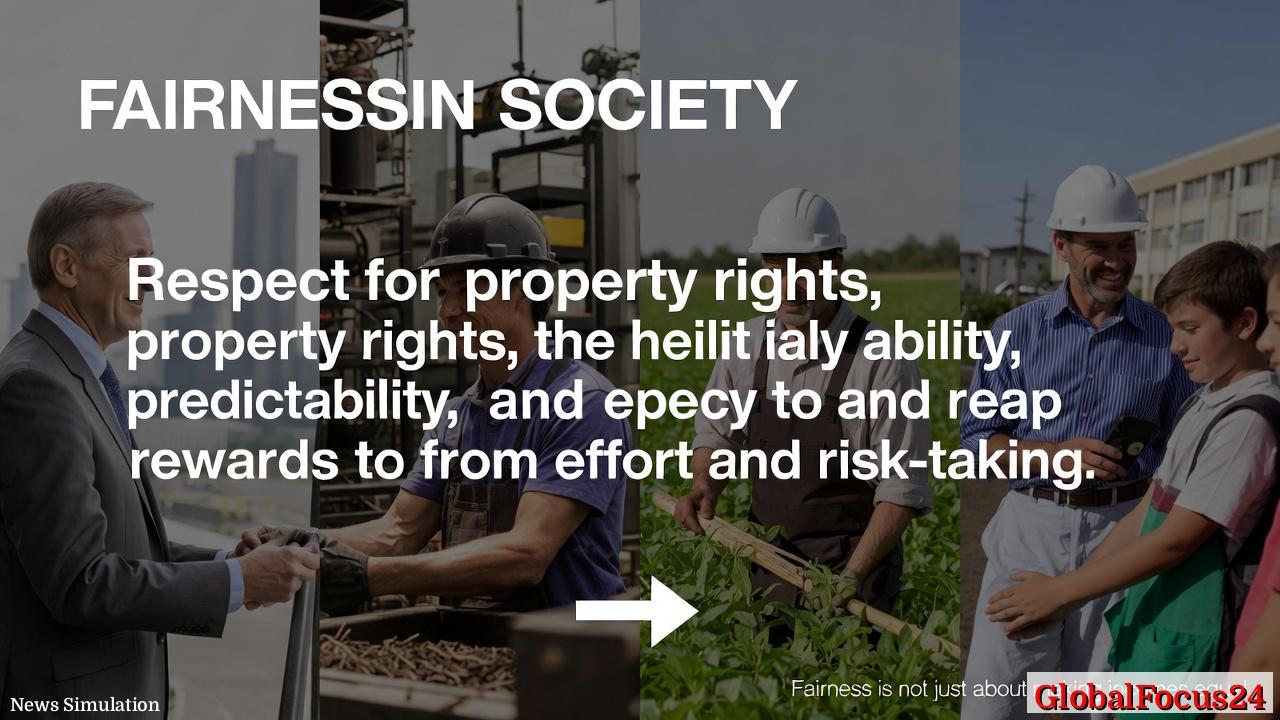
Fairness in economic life is often reduced to a simple idea: make incomes more equal and the system will be just. Yet this narrow view overlooks the deeper foundations that allow a society to balance opportunity, responsibility, and stability. A genuinely fair economic system does far more than smooth out paychecks. It protects property rights, offers predictable rules, and makes space for individuals and businesses to reap the rewards of their efforts and risk‑taking.
In public debates, fairness is frequently framed as a struggle between the “haves” and “have‑nots.” But as economies become more complex and interconnected, that framing no longer captures the full picture. The question is not only who gets what today, but also how rules are set, how stable they are, and whether people can reasonably plan their future around them.
Beyond Income Equality: A Broader Vision of Fairness
Equal incomes can be achieved in many ways, not all of them fair. Heavy-handed redistribution can compress income differences while undermining other pillars of a just economy. Conversely, an economy with significant income differences can still be widely viewed as fair if people believe that success is attainable, the rules are transparent, and property is secure.
A broader concept of fairness in economic policy tends to include four core elements:
- Reasonable protection of property rights, so that what people build and save is not arbitrarily taken.
- Predictable and transparent rules that allow individuals and firms to plan ahead.
- A clear link between effort, risk, and reward, so that work and innovation genuinely pay off.
- A basic floor of security and opportunity, ensuring that misfortune does not permanently exclude people from economic life.
This wider lens shifts the discussion away from a singular focus on outcomes and toward the fairness of the processes that generate those outcomes.
The Historical Roots of Fair Economic Systems
The idea that fairness requires more than equal incomes has deep historical roots. Early commercial societies placed heavy emphasis on property, contracts, and the enforcement of rules. Merchants and artisans needed assurance that their investments, goods, and agreements would be respected, whether they were trading across a city or across a continent.
Over time, societies that offered stronger protection of property rights and more predictable laws tended to develop more vibrant markets and faster growth. People were more willing to leave traditional roles, start businesses, or move to new occupations when they believed their gains would not be arbitrarily seized. Fairness in this sense did not mean that everyone earned the same, but that everyone could rely on a consistent framework of rules.
At the same time, the history of industrialization showed the limits of focusing solely on property and contract. Long hours, unsafe working conditions, and the absence of social protections in many early industrial economies sparked intense debates over fairness. The responses – labor laws, social insurance, and public education – aimed to broaden opportunity and reduce extreme hardship without abandoning the basic principles of property and market exchange.
The historical pattern is clear: when societies have combined respect for property and predictable rules with policies that widen opportunity, they have tended to achieve both rising prosperity and a stronger sense of fairness. When they have emphasized only one side – either strict protection of owners with little social support, or extensive redistribution with weak respect for property – economic performance and public trust have often suffered.
Property Rights as a Pillar of Fairness
Property rights can appear, at first glance, to be primarily about protecting the wealthy. In reality, they are central to fairness for ordinary people as well. A worker’s savings, a family’s home, or a small entrepreneur’s equipment all depend on legal systems that recognize and defend ownership. Without this protection, those with power – whether political or economic – can distort outcomes far more than differences in income alone.
Secure property rights allow individuals to:
- Save and invest without fearing arbitrary seizure.
- Use property as collateral, turning assets into a bridge to new opportunities.
- Plan for the long term, knowing that what they build can be passed to the next generation.
In many emerging economies, weak property rights have trapped millions in informal arrangements. People build houses or businesses on land they do not formally own, leaving them vulnerable to eviction or extortion. Efforts to formalize property – by issuing titles, enforcing contracts, and clarifying land laws – are often justified not just in terms of efficiency, but fairness: they place the poor and the middle class on more equal legal footing with political and economic elites.
A fair system, then, is one where property rights are broadly accessible and consistently enforced, rather than a privilege reserved for a narrow group.
Predictability: The Often Overlooked Dimension of Fairness
Fairness is not only about who gets what, but about whether people can understand the rules and anticipate how they will be applied. Predictability is crucial for both economic planning and social trust.
Unpredictable rules – sudden tax changes, arbitrary regulations, or inconsistent enforcement – can make people feel that outcomes are rooted in luck or connections rather than effort. When a family or business cannot forecast regulations, taxes, or legal decisions, they may delay investment, avoid expansion, or move their activity into the shadows. Over time, this erodes both growth and confidence in institutions.
By contrast, a reasonably predictable environment offers:
- Stable, transparent tax systems that change infrequently and with clear notice.
- Regulatory frameworks that are applied consistently across regions and groups.
- Legal systems where similar cases are treated similarly, and where appeals are meaningful.
Predictability does not mean rigidity. Economies need to adapt to new technologies, crises, and demographic shifts. But when changes are made through clear procedures, with understandable reasons and realistic timelines, people are more likely to see the system as fair even if they disagree with specific decisions.
Rewarding Effort and Risk-Taking
A central component of economic fairness is the perception that effort and risk-taking matter. If working harder, acquiring skills, or starting a business makes little difference to one’s prospects, people may withdraw effort and lose faith in the system.
Rewarding effort and risk does not mean that every venture will succeed, or that every talented person will rise. Market economies remain subject to shocks, competition, and chance. However, a fair system increases the probability that:
- Education, experience, and diligence translate into higher earnings.
- Entrepreneurs and innovators can enjoy a significant share of the value they create.
- People who take reasonable risks are not punished by rules that confiscate gains while leaving them fully exposed to losses.
This alignment between effort and reward supports both economic performance and a sense of justice. It encourages investment in human capital, fuels innovation, and underpins a culture in which initiative is respected.
At the same time, historical experience shows that an exclusive focus on rewarding success, without attention to those who fail or face structural barriers, can fuel social tension. Many systems therefore combine performance-based rewards with social safety nets, aiming to preserve incentives while preventing deep, persistent exclusion.
Economic Impact of a Broadly Fair System
The broader definition of fairness – encompassing property rights, predictability, and rewards for effort – has significant economic implications. When people trust that the system is fair in these dimensions, they are more likely to:
- Invest in education and training, confident that skills will be valued.
- Start businesses, knowing that clear rules and stable institutions support long-term planning.
- Participate in formal markets rather than operating informally or outside the law.
This trust reduces transaction costs, lowers the need for informal protections, and makes long-term contracts and partnerships more viable. Over time, this can lead to higher productivity, more innovation, and stronger, more resilient growth.
By contrast, when property is insecure, rules shift unpredictably, or rewards appear disconnected from merit, capital may flee, talent may relocate, and citizens may disengage from formal economic life. Efforts to achieve income equality through measures that undermine these foundations can, paradoxically, shrink the economic pie and make it harder to sustain social programs and public investment.
A system that respects property, maintains predictable rules, and rewards effort tends to generate the resources needed to finance education, infrastructure, and social protection. In this way, economic performance and fairness are not necessarily in conflict; properly balanced, they reinforce one another.
Regional Approaches and Comparisons
Around the world, different regions have tried to balance these elements of fairness in distinct ways. Some high-income economies have paired robust protections for property and open markets with extensive social welfare states, using taxation to fund health care, education, and income support. Others have emphasized lighter taxation and more limited redistribution, relying on market wages and private provision to shape outcomes.
In parts of Europe, for example, the combination of strong labor protections, universal services, and a high level of taxation reflects a view that fairness requires both respect for property and a substantial degree of income smoothing. In many of these countries, the legal system is designed to be predictable and accessible, with clear procedures and a strong emphasis on the rule of law. This framework seeks to ensure that workers and firms alike can plan for the future within a stable environment.
In several East Asian economies, long-term planning, export-oriented industrial strategies, and large investments in education have supported rapid growth and rising incomes. While property rights and predictable regulation have been central to their development, these countries have often focused more on broad-based opportunity and national development goals than on direct income equalization alone.
Emerging markets and developing economies face different constraints. In places where legal systems are weak, corruption is widespread, or property rights are unclear, citizens may view the system as fundamentally unfair regardless of the distribution of income. Efforts in these regions often center on formalizing land and business ownership, improving the judiciary, and strengthening basic public services. Fairness here is closely tied to bringing more people into the protection of the law.
These regional differences underscore the same underlying principle: fairness is multidimensional. Equal incomes are only one part of a much larger landscape that includes institutional quality, legal protections, and the credibility of public policy.
Public Perception and the Politics of Fairness
Fairness is both an economic and a psychological concept. The way people perceive the system can be as important as the specific policies on paper. Two countries with similar inequality statistics may face very different levels of public dissatisfaction, depending on how citizens view opportunity, corruption, and the reliability of institutions.
When people see wealth as the result of hard work, innovation, and risk, they may tolerate significant income gaps. When they believe success is driven by special connections, opaque rules, or manipulation, even smaller differences can generate anger. Public reactions often focus less on the absolute level of inequality and more on whether the path to success appears open and the rules appear impartial.
This perception is shaped by:
- Everyday encounters with bureaucracy, courts, and law enforcement.
- The transparency of government decisions, especially on taxation, spending, and regulation.
- The visibility of both upward mobility and downward mobility – whether people can rise, and whether those who break rules face consequences.
Maintaining a sense of fairness therefore requires continuous attention, not just occasional reforms. Economies evolve, new industries emerge, and shocks test institutions. Systems that adapt while preserving core principles – property rights, predictable rules, and rewards for effort – are better placed to retain public trust.
Toward a More Comprehensive Debate on Fairness
As discussions about inequality, opportunity, and economic justice intensify, narrowing the conversation to income levels alone risks missing what ultimately sustains a fair society. A system that simply compresses incomes, without safeguarding property or maintaining predictable, transparent rules, may prove both economically fragile and socially unsatisfying.
A more comprehensive approach to fairness recognizes that:
- Property rights matter because they protect the efforts and aspirations of households and small businesses, not just large owners.
- Predictable rules matter because they allow people to plan, invest, and trust institutions.
- Rewarding effort and risk-taking matters because it links personal responsibility to economic outcomes and encourages innovation.
At the same time, fairness also requires policies that broaden opportunity, support those facing hardship, and ensure that success is not limited to those who begin life with advantages. Balancing these priorities is complex, but the historical record suggests that societies that manage it well are more prosperous, more stable, and more cohesive.
By shifting the debate from a narrow focus on equalizing incomes to a broader conversation about rules, rights, and rewards, policymakers and citizens can better evaluate reforms, anticipate trade‑offs, and work toward economic systems that are both dynamic and widely perceived as just.