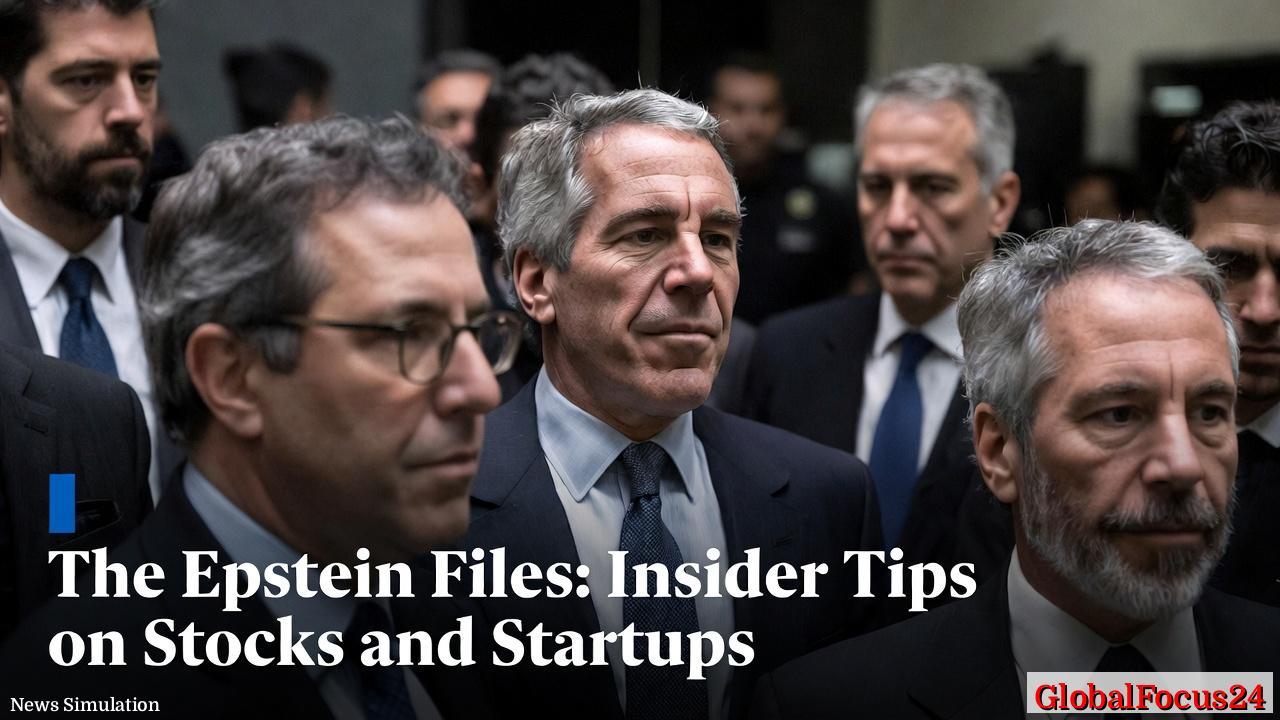
Jeffrey Epstein Collected Insider Tips on Stocks and Startups From His Network
Newly obtained documents reveal that Jeffrey Epstein, the disgraced financier who died in federal custody in 2019, leveraged his social network of billionaires, scientists, and global leaders to access confidential financial information about major companies and startups. The records illustrate how easily Epstein obtained insider intelligence from influential associates and used it to inform his personal investment decisions — often to significant profit.
How a Network of Influence Became a Gateway to Market Secrets
For years, Epstein cultivated a circle of powerful contacts in finance, technology, and science. Through a combination of charisma, access, and wealth, he positioned himself as both an intellectual confidant and financial adviser to some of the world's most notable figures. What has become clear from recent disclosures is that Epstein’s connections went beyond personal friendship — they gave him an informal pipeline into nonpublic corporate information.
Epstein’s email correspondence often included a provocative line in his signature: “The contents of this message may constitute inside information.” The disclaimer, while unconventional, hinted at the blurring of lines between privileged knowledge and legitimate investment research. In retrospect, it reads as an admission of the kind of access Epstein regularly enjoyed.
Early Intel on a Biotech Boom
Among the most striking episodes involves Boris Nikolic, a former science adviser to Bill Gates. In 2012 and 2013, Nikolic shared documents with Epstein relating to the tech philanthropist’s private investments in biotechnology firms. These materials detailed financial structures, ownership percentages, and investment rights in Foundation Medicine, a molecular diagnostics company that was then beginning to attract attention in the genomics sector.
Epstein moved quickly on this information. In January 2014, he purchased 25,000 shares of Foundation Medicine at roughly $27.50 each. Within weeks, the company’s stock price surged. Nikolic later emailed Epstein noting gains of nearly 30 percent, with projections for continued appreciation. Epstein increased his position to about 50,000 shares, bringing his average cost down to $25.38. When Roche acquired full ownership of Foundation Medicine in 2018 at $137 a share, the profit on Epstein’s investment would have been substantial.
This episode reflects both Epstein’s access and his opportunistic approach. Foundation Medicine’s rise coincided with a broader wave of investor enthusiasm for genomic analysis, a field viewed as instrumental in the future of precision medicine. Epstein, though lacking formal scientific expertise, positioned himself as a participant in this frontier by leveraging privileged intelligence.
Gene Editing and the Editas IPO
Epstein’s relationship with Nikolic continued into the mid-2010s, extending to Editas Medicine, a high-profile gene-editing firm developing CRISPR-based therapies. Nikolic sat on the company’s board, and Gates held a meaningful investment. On the day Editas priced its initial public offering in 2016, Nikolic reportedly informed Epstein that demand was overwhelming and the deal was “heavily oversubscribed.” Epstein responded by purchasing 3,200 shares shortly thereafter, paying nearly $32 per share.
The trade aligned with a surge of public fascination around CRISPR, which had emerged as one of the decade’s most revolutionary biomedical innovations. In the context of U.S. securities law, such pre-IPO insight — if shared outside official disclosures — would typically raise compliance concerns. Yet Epstein’s ability to act on this information underscores the informal and often unchecked flow of market intelligence within elite circles.
Wall Street Connections and Banking Data
Epstein’s influence was not confined to the biotech sector. Beginning in the late 2000s, his association with Jes Staley, a longtime JPMorgan Chase executive, granted him access to confidential financial data at one of the nation’s largest banks. Emails from 2009 showed Staley providing Epstein with internal compensation projections that estimated 34 JPMorgan employees would each earn more than $10 million that year.
Around the same time, Epstein purchased JPMorgan preferred stock, maintaining at least $5.7 million worth of holdings by 2019. The timing and nature of these purchases suggest that Epstein viewed inside corporate metrics as a valuable — if ethically questionable — investment guide.
In 2010, Staley also sent Epstein details about a private transaction involving members of the Pritzker family, major figures in Chicago business and philanthropy. The information described their pending sale of a controlling interest in credit-reporting giant TransUnion to the private-equity firm Madison Dearborn Partners. The deal was not yet public when Epstein received Staley’s message, giving him weeks of advance knowledge before its formal announcement.
Global Ties and the Israeli Startup Ecosystem
Epstein’s dealings extended internationally, most visibly through his ties to Ehud Barak, the former Israeli prime minister. Barak chaired a technology startup known as Reporty, which developed digital emergency response platforms. In 2016, Barak emailed Epstein the minutes of a company board meeting that revealed plans to raise $10 million in venture capital financing. Epstein had already loaned $1 million toward Barak’s personal $1.5 million investment.
The arrangement blurred distinctions between friendship, finance, and influence. Epstein eventually converted his loan into an ownership stake in the company, which rebranded as Carbyne two years later. By late 2025, Axon Enterprise — best known as the maker of Taser devices — acquired Carbyne for $625 million, turning Epstein’s early involvement into another profitable venture, even though he had died years earlier.
The Apollo Connection and Predictive Financial Data
Among Epstein’s most lucrative associations was his long-running relationship with Leon Black, co-founder of Apollo Global Management. In 2015, Black’s family office sent Epstein an internal forecast predicting Apollo’s upcoming dividend distribution would total 34 cents per share. Two months later, the officially announced payout was 33 cents, validating the near-perfect accuracy of Epstein’s advance data.
Epstein had invested approximately $5 million in Apollo’s initial public offering in 2011, and by early 2019 that stake was worth roughly $7.7 million. His ties to Black became a cornerstone of his wealth, though both men later faced intense scrutiny over their relationship once Epstein’s criminal history resurfaced. Black resigned from Apollo in 2021 amid questions about his financial ties to Epstein, but maintained that his interactions were limited to estate planning and philanthropic advice.
Historical Context: The Currency of Information
The Epstein case underlines a centuries-old truth about markets: information has always been the most valuable commodity. From early trading houses in Amsterdam to the advent of Wall Street telegraphs, those who gained data first often reaped the greatest rewards. However, the modern regulatory framework — shaped by Depression-era reforms and enforced through agencies such as the Securities and Exchange Commission — was designed precisely to prevent the selective sharing of “material nonpublic information.”
Epstein’s activities blurred that line repeatedly. While there is no direct evidence that he faced insider-trading charges, his correspondence demonstrates how interpersonal privilege can bypass formal information barriers. The pattern reflects a larger reality of global finance: personal networks often shape opportunities as much as capital or expertise.
The Economic Impact and Ethical Fallout
Though Epstein’s investment volume was small compared with institutional players, his trades reveal how private intelligence can distort market fairness. Access to sensitive business data, even unintentionally shared, can influence pricing, liquidity, and investor sentiment. When large-scale investors act on unpublicized details, retail traders — the everyday investors without connections — are left at a systemic disadvantage.
The revelations also raise questions about corporate governance and compliance within elite institutions. How could executives and advisers so openly discuss restricted data with an individual already known for legal and ethical controversies? The answer lies partly in Epstein’s perceived intellect and social influence, which allowed him to operate as a kind of shadow adviser to people in positions of immense authority.
Comparing Patterns Across Financial Hubs
Epstein’s behavior mirrors historical scandals in other major financial centers. In London during the 1980s, insider trading controversies involving investment houses such as Guinness and Morgan Grenfell similarly exposed how social proximity enabled information leakage. In Tokyo, the 1990s “Recruit scandal” revealed collusion between politicians and corporate insiders in share allocations ahead of public offerings. Each of these events, like Epstein’s network, spotlighted the vulnerabilities inherent in opaque, relationship-driven finance.
In Silicon Valley, where venture capitalists and founders frequently share nonpublic funding details, the fine line between networking and insider information remains a persistent compliance concern. Epstein’s involvement in biotech startups, given his lack of formal industry role, intensified those concerns and demonstrated how gray-zone knowledge can circulate outside regulated professional contexts.
The Legacy of an Information Broker
At the time of his death in 2019, Epstein’s estate was valued at approximately $577 million — an extraordinary fortune for someone without a conventional business enterprise. His wealth derived less from traditional investment management and more from personal leverage: advising the wealthy while benefiting from information few others could access. His strategy, though ethically dubious, embodied a pattern that continues to challenge regulators — the monetization of relationships in a world where trust and discretion overlap with profit and secrecy.
As regulators, journalists, and historians continue to examine Epstein’s financial activities, the story functions as a cautionary tale about the soft boundaries of influence in modern capitalism. Where access meets ambition, the flow of privileged information remains one of the most persistent forces shaping global markets — and one of the hardest to contain.