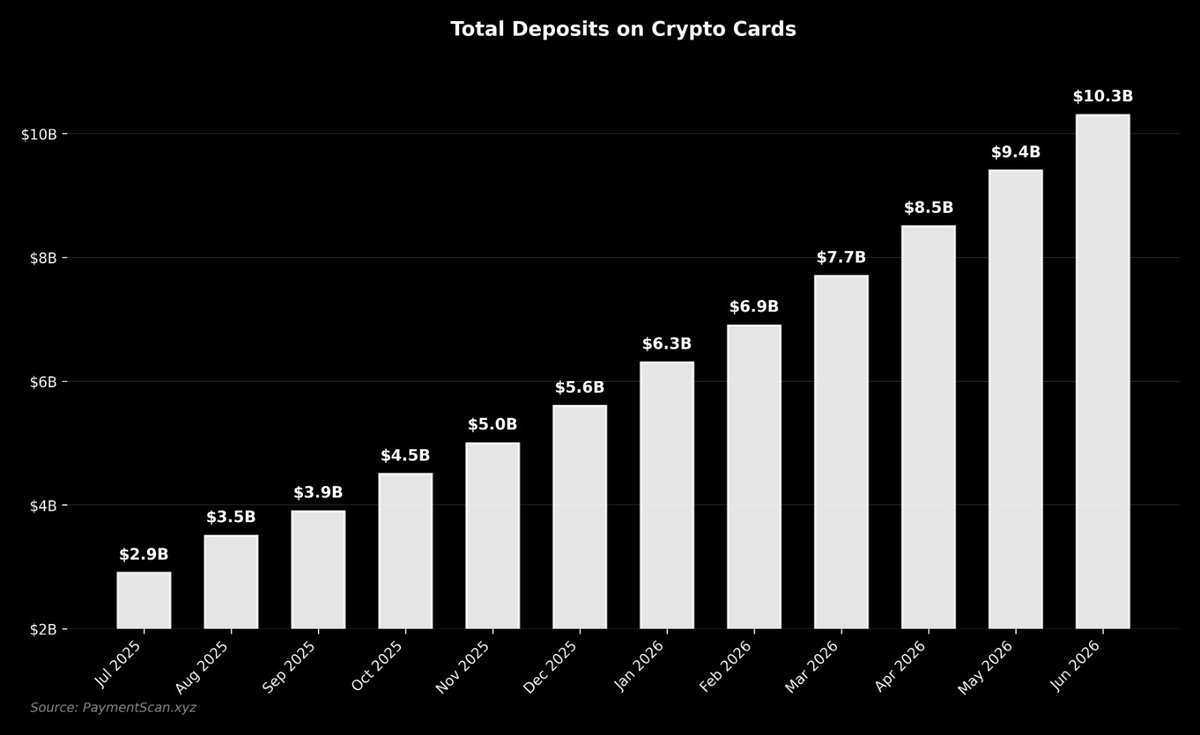
Crypto Card Deposits Surpass $10 Billion as Stablecoin Payments Accelerate Global Adoption
Record-Breaking Growth Signals Shift in Digital Payments
Total deposits held across cryptocurrency-linked payment cards have exceeded $10 billion for the first time, marking a significant milestone in the evolution of digital finance. The figure represents an 82% increase since the beginning of the year and nearly 250% growth compared to the same period last year, underscoring a rapid acceleration in consumer and institutional adoption.
Crypto cards—debit or prepaid cards that allow users to spend digital assets such as Bitcoin, Ethereum, and stablecoins—have steadily moved from niche financial tools to mainstream payment instruments. The latest surge suggests a broader transformation in how digital assets are being used, shifting from speculative holdings toward everyday financial utility.
At the center of this expansion is the rising prominence of stablecoins, which are increasingly being used as a bridge between traditional finance and blockchain-based systems.
Stablecoins Drive Payment Rail Evolution
Stablecoins, digital currencies pegged to fiat currencies like the U.S. dollar, have emerged as a critical driver behind the surge in crypto card deposits. Their price stability and near-instant settlement capabilities make them particularly well-suited for payments, remittances, and commerce.
Unlike more volatile cryptocurrencies, stablecoins provide predictability in value, enabling users to load funds onto crypto cards without exposure to significant price fluctuations. This has made them attractive not only to retail users but also to businesses seeking efficient alternatives to traditional payment networks.
Several factors are contributing to the rise of stablecoin-powered payments:
- Faster transaction settlement compared to traditional banking systems, often within seconds.
- Lower transaction fees, especially for cross-border payments.
- Increased accessibility in regions with limited banking infrastructure.
- Seamless integration with digital wallets and financial apps.
The growth in crypto card deposits reflects these advantages, as users increasingly store stablecoin balances for everyday spending rather than converting to fiat currency in advance.
Historical Context: From Speculation to Utility
The journey to this milestone has been shaped by years of development in the cryptocurrency ecosystem. In the early 2010s, digital assets were primarily viewed as speculative investments, with limited real-world application. Early crypto cards faced challenges including regulatory uncertainty, limited merchant acceptance, and technological constraints.
By the late 2010s and early 2020s, improvements in blockchain scalability, wallet infrastructure, and regulatory clarity began to reshape the landscape. Major financial technology firms and crypto-native companies introduced more sophisticated card products, often backed by partnerships with global payment networks.
The introduction of stablecoins marked a turning point. As these assets gained traction, they provided a practical solution for bridging digital currencies with everyday transactions. Over time, crypto cards evolved from experimental products into reliable financial tools, capable of supporting routine spending, online purchases, and international transfers.
The current surge in deposits reflects the culmination of these developments, signaling a broader maturation of the digital asset economy.
Regional Trends Highlight Uneven but Rapid Adoption
Adoption of crypto cards and stablecoin payments varies significantly by region, shaped by local economic conditions, regulatory frameworks, and technological infrastructure.
In North America, particularly the United States, growth has been driven by increased consumer familiarity with digital assets and the integration of crypto services into mainstream financial platforms. Users are increasingly leveraging crypto cards for convenience, rewards programs, and access to decentralized financial services.
Europe has seen strong adoption as well, supported by relatively clear regulatory guidelines and a competitive fintech landscape. Countries such as Germany, France, and the United Kingdom have witnessed rising demand for crypto-enabled payment solutions, particularly among younger consumers.
In contrast, emerging markets have demonstrated some of the fastest growth rates. In regions including Latin America, Southeast Asia, and parts of Africa, stablecoins are often used as a hedge against currency volatility and inflation. Crypto cards in these areas serve not only as payment tools but also as gateways to financial inclusion.
Key regional drivers include:
- High inflation rates prompting demand for stable stores of value.
- Limited access to traditional banking services.
- Strong mobile adoption enabling digital wallet usage.
- Growing remittance flows benefiting from lower-cost transfers.
These regional dynamics have contributed significantly to the overall increase in crypto card deposits, highlighting the global nature of the trend.
Economic Impact and Financial System Implications
The rapid rise in crypto card deposits carries broader implications for the global financial system. As more users adopt stablecoin-based payments, traditional banking and payment networks face increasing competition from blockchain-based alternatives.
One notable impact is the potential reduction in transaction costs. By bypassing intermediaries, stablecoin payments can offer more efficient settlement, particularly for cross-border transactions. This has implications for industries ranging from e-commerce to remittances, where cost savings can be substantial.
Additionally, the growth of crypto cards is influencing consumer behavior. Users are becoming more comfortable holding and spending digital assets, blurring the line between traditional and decentralized finance. This shift may encourage further innovation in financial products, including lending, savings, and investment services built around digital currencies.
Financial institutions are also taking notice. Many banks and payment providers are exploring partnerships with crypto firms or developing their own digital asset offerings to remain competitive. This convergence of traditional and digital finance is expected to accelerate as adoption continues to grow.
Technology and Infrastructure Fuel Expansion
The surge in crypto card deposits is supported by significant advancements in underlying technology. Improvements in blockchain scalability, transaction throughput, and security have made it easier for payment systems to handle large volumes of transactions efficiently.
At the same time, user experience has improved dramatically. Modern crypto wallets offer intuitive interfaces, real-time transaction tracking, and seamless integration with payment cards. This has lowered the barrier to entry for new users, enabling broader adoption.
Interoperability between different blockchain networks and financial systems has also played a crucial role. Users can now move funds across platforms with greater ease, enhancing the utility of crypto cards as everyday financial tools.
Security enhancements, including multi-factor authentication and advanced encryption, have further strengthened user confidence, addressing concerns that previously limited adoption.
Market Competition Intensifies Among Providers
As the market for crypto cards expands, competition among providers is intensifying. Companies are differentiating their offerings through features such as cashback rewards, lower fees, and support for multiple digital assets.
Some providers focus on integrating decentralized finance features, allowing users to earn yield on stored assets while maintaining spending capabilities. Others emphasize regulatory compliance and partnerships with established financial institutions to build trust among users.
This competitive landscape is driving innovation and improving service quality, benefiting consumers and accelerating overall market growth.
Public Perception and Mainstream Awareness
Public perception of cryptocurrency has evolved alongside the growth in crypto card usage. While skepticism remains in some quarters, increasing familiarity with digital assets and their practical applications is contributing to broader acceptance.
Media coverage, educational initiatives, and the involvement of major financial brands have all played a role in shaping public awareness. As more individuals use crypto cards for everyday transactions, the technology becomes less abstract and more integrated into daily life.
The milestone of $10 billion in deposits serves as a visible indicator of this shift, reflecting not only market growth but also changing attitudes toward digital finance.
Outlook: Continued Growth with Key Challenges Ahead
Despite the rapid expansion, the crypto card market faces several challenges that could influence its trajectory. Regulatory developments remain a critical factor, as governments around the world continue to refine their approaches to digital assets and stablecoins.
Market volatility, cybersecurity risks, and the need for standardized frameworks are also areas of concern. Addressing these issues will be essential to sustaining long-term growth and ensuring user confidence.
However, the underlying trends suggest continued momentum. As stablecoins gain further acceptance and payment infrastructure continues to evolve, crypto cards are likely to play an increasingly prominent role in the global financial ecosystem.
The crossing of the $10 billion threshold represents more than a numerical milestone; it signals a broader transformation in how value is stored, transferred, and spent in an increasingly digital world.