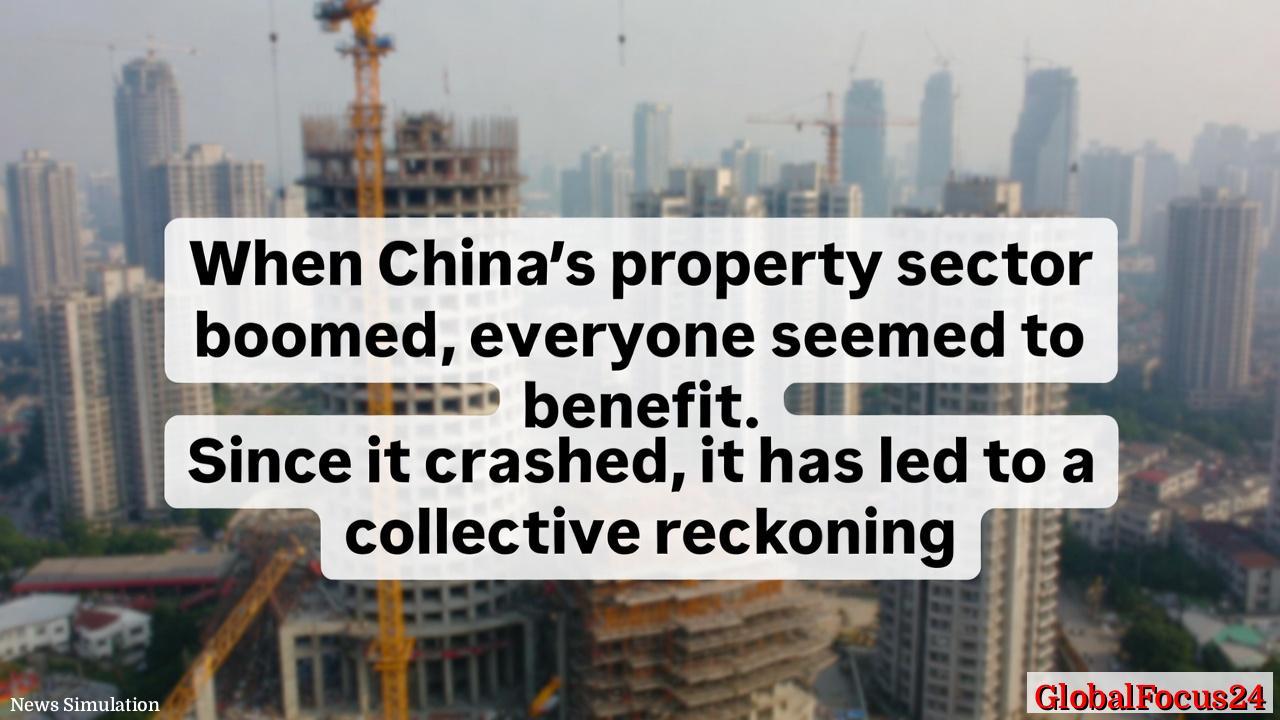
China's Property Crash Reshapes the Nation’s Economic Future
For years, China’s property market stood as both symbol and engine of the country’s meteoric rise. Cranes towered above new cities, apartments sold within hours of launch, and homeownership became the ultimate marker of financial success. That era of unrelenting growth has ended. The collapse of the property boom has not only rattled investor confidence but has also forced a fundamental shift in how China’s economy functions — from a structure built on real estate and debt, to one now grappling with the consequences of its own expansion.
From Rapid Growth to Alarming Slowdown
The golden age of Chinese real estate began in the late 1990s after the government liberalized housing markets, allowing private purchases for the first time in decades. Residential property quickly became the most popular investment, buoyed by rising incomes, easy credit, and urban migration. Developers raced to capitalize, transforming once-sleepy provincial towns into skylines of glass and steel.
However, by the mid-2010s, cracks had begun to show. Debt-fueled expansion pushed property prices far beyond the reach of the average household. Developers became dependent on presales — selling homes before construction — to keep liquidity flowing. It was a model that worked only as long as faith in perpetual growth persisted. When that faith faltered, it exposed a fragile system built on leverage and speculation.
A Crisis Decades in the Making
The property slump that began in earnest around 2020 did not arrive without warning. Authorities had already flagged concerns about “irrational exuberance” and introduced the so-called “three red lines” policy, limiting borrowing by heavily indebted developers. This regulatory tightening marked a turning point.
Giant corporations that once symbolized the promise of urbanization suddenly found themselves unable to refinance debts or complete projects. Defaults cascaded through the sector, and unfinished apartment blocks dotted city fringes from Shenzhen to Shijiazhuang. For many middle-class families, the fallout was personal: down payments evaporated, and homes they had saved decades to secure remained skeletal structures of rebar and concrete.
The Human Cost of a Market in Retreat
The social consequences have proven as severe as the financial ones. Thousands of households joined online campaigns demanding accountability for halted projects. In some regions, mortgage boycotts spread as buyers refused to continue payments for undelivered properties. These acts, rare in China’s tightly controlled financial environment, signaled the depth of public frustration.
For younger generations, the dream of owning a home — once viewed as key to social stability and mobility — has grown increasingly distant. Many now postpone major life milestones such as marriage or childrearing, contributing to broader demographic challenges that already weigh on the country’s long-term outlook.
Economic Reverberations Across Sectors
Real estate had long been intertwined with nearly every corner of China’s economy. Construction accounted for a sizable share of GDP, while local governments relied on land sales to fund infrastructure and services. When the property market stumbled, it sent shockwaves through steel, cement, and appliance industries, as well as through municipal balance sheets that had come to depend on high land prices.
Developers’ outstanding debts — exceeding trillions of yuan — amplified the risk to financial institutions. Even without a wave of systemic bank failures, the stress has been noticeable. Lending standards tightened, credit growth slowed, and business confidence sagged. Local economies built around housing investment found themselves scrambling to identify alternative sources of growth.
A New Phase of Adjustment
In response, policymakers have gradually shifted their focus from aggressive growth toward risk containment. Measures have included easing mortgage rules in selected cities, offering bailouts for unfinished projects, and directing state-backed institutions to acquire distressed assets. Yet these actions — while preventing widespread panic — have not reignited buyers’ enthusiasm.
Analysts describe a prolonged adjustment period in which the housing sector will remain subdued even as other parts of the economy stabilize. The larger challenge lies in finding new drivers of consumption and productivity to replace property speculation as household wealth’s main pillar.
Comparing Regional Outcomes
The downturn’s impact has not been uniform. Coastal cities such as Shanghai and Guangzhou have managed to maintain relative stability due to stronger labor markets and diversified economies. Meanwhile, smaller inland cities, previously buoyed by construction-led growth, have suffered sharp declines in property values and surging unemployment among migrant laborers.
This divergence highlights a long-standing structural imbalance. For decades, local governments in less-developed regions financed modernization through land auctions, often bidding up prices with borrowed funds. When market demand contracted, this financial mechanism collapsed, leaving municipalities with limited fiscal options.
Lessons from International Precedents
Comparisons with past housing busts — from Japan’s 1990s stagnation to the global financial crisis of 2008 — offer instructive parallels. In Japan, an overreliance on property collateral led to decades of deflation and sluggish growth. In the United States, the collapse of mortgage-backed securities caused a systemic banking panic.
China’s situation differs in key ways: its capital controls limit large-scale capital flight, and the state maintains significant influence over banks and credit allocation. Yet the underlying dynamics — excessive leverage, speculative fervor, and a sudden loss of confidence — are strikingly familiar. Avoiding a similar “lost decade” will require not only financial stabilization but also deeper reforms that channel investment into more productive industries.
Historical Context: The Built Environment as Identity
The modern Chinese cityscape tells the story of 30 years of extraordinary transformation. Entire districts rose from farmland within a generation, reshaping lifestyles and expectations. Real estate wealth underpinned social hierarchies and became interwoven with family identity; apartments were gifts, dowries, and retirement plans all at once.
That psychological attachment amplifies today’s disillusionment. For households that equated property ownership with security and success, the notion of falling home prices challenges core assumptions about progress. As sociologists have observed, the property boom was not only an economic event but also a social contract — one now under renegotiation.
Local Government Pressures
Municipalities find themselves at the center of the crisis. For years, land sales financed as much as half of their annual revenues. With demand evaporating, cities must seek new income sources while managing ballooning local debt tied to infrastructure and public works.
Some have turned toward industrial upgrading, digital services, or green energy initiatives to offset the shortfall. Yet transitions of this magnitude take time. The property downturn has thus exposed how dependent local administrations became on the very market that is now in decline.
Searching for a Path Forward
In the longer term, China’s economic planners have signaled an intent to transition toward a consumption-driven model less reliant on property and exports. That shift requires boosting household incomes, expanding social safety nets, and encouraging private innovation — goals that are ambitious but necessary for sustainable growth.
Financial analysts note that stabilizing the housing market remains crucial for restoring consumer confidence. However, many argue that renewed speculative activity would only delay inevitable adjustment. Instead, they suggest the government focus on completing existing projects, improving rental housing supply, and expanding rural urbanization policies that distribute economic opportunity beyond tier-one cities.
Signs of Gradual Stabilization
Recent data shows modest signs of improvement. Construction activity in some regions has resumed, and mortgage rates have eased, offering slight relief to first-time buyers. Still, nationwide sentiment remains cautious. Transactions remain far below pre-2020 levels, and developers continue to offload assets at steep discounts to manage liquidity.
International investors remain watchful, interpreting developments in China’s property market as a measure of the broader global economic balance. A full recovery appears distant, but the sense of immediate crisis has softened, giving way to realism about the sector’s new role in a maturing economy.
The Aftermath and Outlook
The fall of China’s property empire represents more than a cyclical downturn — it marks the unwinding of a growth model that defined an era. Real estate once embodied the country’s optimism, but its excesses now force a recalibration toward sustainability, innovation, and quality of life.
Whether this transformation succeeds will depend on how swiftly policy adapts and how deeply public trust can be restored. The cranes may rise again, but this time, the foundations will need to rest not only on concrete and capital, but on a more balanced vision of prosperity.