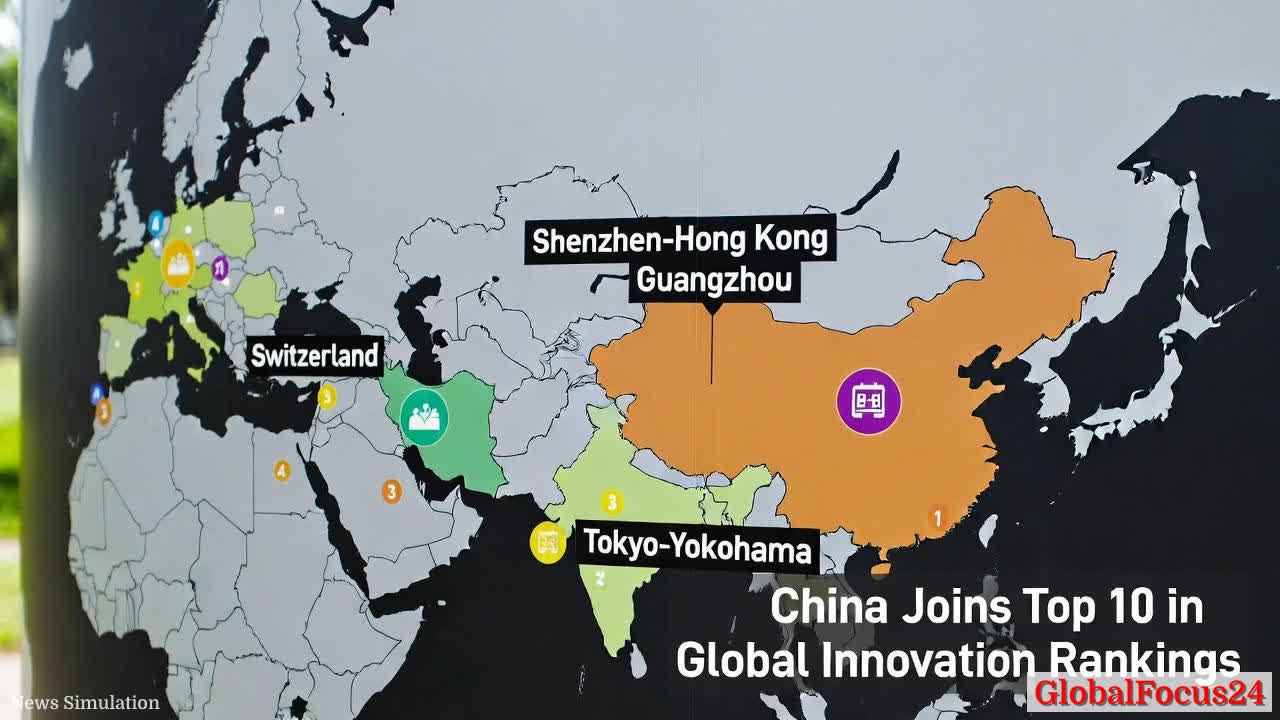
China Enters Top 10 in Global Innovation Rankings, Shaping a New Era of Tech Leadership
A sweeping assessment of 139 economies has crowned China among the world’s most innovative nations for the first time, marking a historic shift in the global innovation landscape and displacing longstanding European leaders. The achievement, reported by the World Intellectual Property Organization (WIPO) and compiled from a broad set of indicators including patents, research and development intensity, and knowledge-based output, signals a recalibration of where ideas translate into economic vitality. While Switzerland, Sweden, the United States, the Republic of Korea, and Singapore continue to anchor the upper echelon, China’s ascent into the top tier underscores a broader movement toward mid‑income and emerging economies playing crucial roles in global technological progress.
Historical context: a long arc toward innovation leadership
For decades, innovation dominance has cycled among regional powerhouses. Western Europe and North America traditionally set the pace with dense ecosystems, robust university networks, and deep industrial bases. Germany, in particular, has been celebrated for engineering excellence and formidable patent activity, reflecting a deep reservoir of manufacturing know-how and a tradition of precision. The new rankings, however, reflect a more pluralized map of innovation where investment scale, digital infrastructure, and policy support converge to accelerate breakthroughs across sectors such as telecommunications, artificial intelligence, advanced manufacturing, and green technologies.
China’s blueprint for innovation accelerated in the 21st century, moving beyond export-led growth to become a hub for cutting-edge research, semiconductor ambitions, and digital platforms. Government-led initiatives, domestic market scale, and a rapidly expanding pool of skilled labor have produced a fertile environment for startups and incumbents alike. This evolution aligns with broader national strategies that emphasize self-reliance in critical technologies and a push toward high-value manufacturing, AI, quantum computing, and clean energy.
Economic impact: accelerating growth, redefining competitiveness
The movement into the top 10 is more than a prestige marker; it has tangible implications for global commerce and investment flows. Countries that rank highly for innovation tend to attract increased investment, collaboration opportunities, and talent mobility. For China, the ranking supports the narrative of a diversified economy where tech firms, hardware manufacturing, and software platforms coalesce to drive productivity gains across industries. The ripple effects extend to supply chains, where Chinese innovation ecosystems can accelerate the adoption of smart manufacturing, 5G and beyond, and cloud-based services that power domestic and international customers.
A closer look at regional dynamics reveals a nuanced landscape. Europe maintains a strong presence at the top, with Switzerland and Sweden among the most consistently innovative economies, reflecting deep research capacities, stable regulatory environments, and robust intellectual property ecosystems. The United States remains a magnet for both venture capital and research excellence, benefiting from a long-standing ecosystem that blends universities, private sector R&D, and cross-industry collaboration. Asia’s strong performance is characterized by the Republic of Korea and Singapore as well as a rising China, with specialized clusters that integrate hardware, software, and services.
Regional comparisons also highlight the performance of middle-income economies. India, Türkiye, and Viet Nam have shown notable improvement, signaling a shift toward higher-value activities and greater integration into global supply chains. These economies often leverage large domestic markets, rising STEM education, and policy instruments designed to bolster entrepreneurship and technology transfer. The emergence of such players reflects a broader trend: innovation is no longer the province of a few traditional powerhouses but a distributed capability rooted in diverse regional strengths.
Innovation clusters: where ideas turn into impact
The ranking underscores the importance of dense innovation clusters that foster collaboration, knowledge spillovers, and rapid experimentation. Shenzhen–Hong Kong–Guangzhou stands out as a premier cluster in the global rankings, illustrating how cross‑border ecosystems can accelerate hardware and software breakthroughs, capitalizing on proximity to suppliers, talent pools, and venture funding. Tokyo–Yokohama follows closely, demonstrating how metropolitan breadth and historical industrial depth sustain sustained R&D output and commercialization.
Such clusters illustrate a critical principle for policymakers and business leaders: connectivity matters as much as raw talent. When ports of innovation are well integrated with capital, talent, and regulatory clarity, ideas scale from prototype to production, creating jobs, improving productivity, and expanding export opportunities. The emergence of new clusters in other regions may further reshape the global map of innovation in the years ahead, driven by targeted investments in digital infrastructure, university-industry collaboration, and incentives for startups.
Implications for governance and policy
The shift into the top 10 invites policymakers to reflect on the levers that sustain high-impact innovation. Intellectual property regimes, while essential to protect creators, must balance incentives with diffusion to ensure knowledge transfer and broad-based benefits. Education systems that cultivate STEM skills, critical thinking, and problem-solving are fundamental to sustaining a pipeline of talent that can support evolving industries. Public investment in research and development—paired with policies that reduce barriers to private-sector R&D and procurement of cutting-edge technologies—will continue to shape the trajectory of future growth.
Another dimension is the alignment of innovation with sustainable development. As nations pursue breakthroughs in energy storage, manufacturing efficiency, and climate-friendly technologies, the economic gains from innovation will increasingly intersect with environmental goals. Regions that align their innovation strategies with sustainability objectives may unlock new markets and build resilience against shocks, from price volatility to supply chain disruptions.
Global supply chains and competitiveness
In a global economy, innovation is a critical determinant of comparative advantage. Nations that can translate research into scalable products and services gain leverage in international markets. For China, this means harnessing state-supported R&D to push into higher-value segments such as advanced electronics, autonomous systems, and green technologies. For other top-tier innovators, maintaining leadership will require continued investment in frontier research, talent retention, and a favorable ecosystem for startups to thrive.
The top 10 status also has implications for multinational firms seeking to diversify their investment in innovation. Companies may pursue cross-border partnerships, joint ventures, and regional laboratories to tap into the strengths of different clusters. The ability to align corporate strategy with regional innovation ecosystems can yield faster time-to-market for new products and improved resilience against global risk factors.
Public sentiment and perception
Public reaction to shifts in innovation leadership often reflects broader hopes and concerns about the future economy. A growing sense of opportunity accompanies the news for workers in high-tech sectors, researchers, and students entering STEM fields. Conversely, communities that feel left behind by rapid technological change may express concern about job displacement and the implications of automation. Policymakers can respond with inclusive programs that retrain workers, expand access to education, and provide a pathway for families and communities to participate in the benefits of a more innovative economy.
Future trajectory and uncertainties
While the current ranking marks a milestone for China and an ongoing evolution in global innovation, the path ahead remains contingent on a range of factors. Trade dynamics, geopolitical tensions, and macroeconomic conditions can influence investment levels in R&D and the pace of technology diffusion. At the same time, the rapid advancement of digital platforms, AI, and next-generation networks presents both opportunities and challenges for governance, privacy, and ethical considerations.
Looking ahead, regions that cultivate cross-border collaboration, invest in talent development, and create open, competitive markets are likely to sustain momentum in innovation. With the Chinese economy continuing to diversify its tech base, and with other leaders reinforcing their capacities, the global innovation landscape may become more multi-polar, with several hubs driving critical breakthroughs in the coming decades.
Synthesis: a new era for global innovation leadership
The ascent into the top 10 signals more than a ranking shift; it marks a broader reconfiguration of where and how innovative activity occurs. As China’s innovation ecosystem matures alongside established leaders, global clients, investors, and researchers will likely recalibrate their strategies to engage with a wider set of tech centers. The resulting dynamics could yield faster diffusion of new technologies, more varied collaboration opportunities, and a richer palette of solutions to global challenges—from clean energy transitions to digital inclusion and resilient infrastructure.
In sum, the 139-economy World Intellectual Property Organization assessment captures a moment of transition in the global economy. It highlights the growing importance of diversified innovation pipelines, regional clusters, and strategic policy choices that shape a country’s capacity to turn ideas into economic value. For firms and policymakers alike, the key takeaway is clear: sustained investment in research, development, and the ecosystems that nurture invention remains essential to securing long-term competitiveness in an interconnected world. The coming years will reveal how these top-tier innovators, including the newly minted member of the top 10, balance growth with inclusion, compete on a global stage, and translate intellectual breakthroughs into tangible improvements for people and communities around the world.