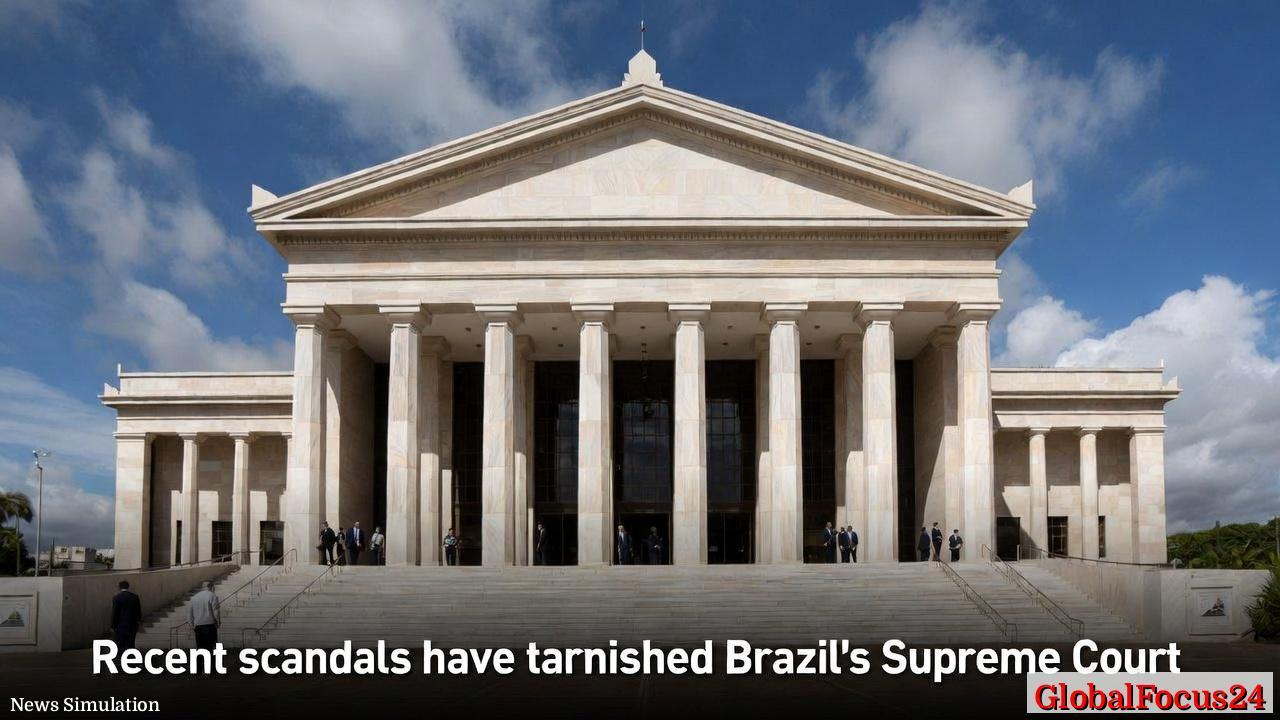
Brazil’s Supreme Court Confronts Crisis of Credibility Amid Mounting Public Scrutiny
A judiciary under strain
Brazil’s Supreme Federal Court (STF), once a pillar of stability in one of Latin America’s most turbulent democracies, is now confronting an escalating crisis of credibility. A series of controversies and allegations of judicial overreach have eroded public confidence in the institution, raising urgent questions about its role as the ultimate guardian of Brazil’s Constitution. As public trust wanes, legal scholars and civic leaders warn that the STF must confront criticism openly and transparently if it hopes to preserve its legitimacy and defend Brazil’s democratic order.
The crisis marks a turning point for the court, which in recent years has found itself at the center of bitter political battles—from corruption investigations involving Brazil’s elite to rulings on freedom of speech and misinformation. While the court’s defenders argue that it has acted to shield democracy from authoritarian threats, its detractors accuse it of selective justice and overstepping its constitutional limits. The result is a public perception of an institution adrift, disconnected from the society it is meant to serve.
From trust to tension: how the crisis developed
The STF’s modern history is closely linked to the consolidation of Brazilian democracy after the end of military rule in 1985. For decades, the court enjoyed a reputation as an impartial arbiter, essential for enforcing the rule of law. Landmark rulings on civil rights, environmental protection, and anti-corruption measures cemented its image as a progressive force in the nation’s institutional framework.
However, the last decade has seen the court embroiled in controversies that threaten to undo much of that goodwill. The 2014 “Operation Car Wash” corruption probe, which exposed systemic graft across government and business, thrust the judiciary into the political spotlight. Several rulings that reversed or altered convictions in these cases—often perceived as lenient toward powerful figures—sparked accusations of inconsistency and elitism.
More recently, the STF’s expansive interpretation of its authority in disinformation cases, particularly its decisions to launch investigations without external requests, has drawn criticism from both political conservatives and civil-liberties advocates. Critics argue that such actions blur the line between judicial and prosecutorial powers, weakening the principle of due process.
Public reaction and erosion of confidence
Public surveys in late 2025 showed a growing sense of disillusionment. According to national polling institutes, confidence in the STF has declined to some of its lowest levels since democratization, trailing behind other major institutions such as the federal police and electoral court. Analysts point to perceptions of politicization as a key driver of this trend, with many Brazilians seeing the court as an active participant in partisan conflicts rather than a neutral arbiter.
In the streets and across social media, calls for greater transparency are intensifying. Demonstrations in São Paulo, Brasília, and Rio de Janeiro have highlighted public frustration with judicial privilege and the opaque nature of internal decisions. Many Brazilians, particularly younger generations, argue that the court must better explain its actions and show commitment to accountability if it is to retain moral authority.
Legal experts emphasize that the court’s credibility is vital not only for its own survival but for the stability of Brazil’s democratic system. “Without an independent and trusted judiciary,” one constitutional scholar said, “the entire balance of power collapses. The Supreme Court cannot afford to lose the confidence of the people.”
Economic implications of judicial instability
Beyond its political ramifications, the crisis of trust has begun to carry economic consequences. Investors view judicial predictability as a cornerstone of stable governance, essential for contract enforcement and regulatory consistency. Uncertainty surrounding the STF’s independence has led to caution among both domestic and foreign investors, who worry that political interference could affect judicial outcomes.
The Brazilian real experienced intermittent volatility in 2025 amid disagreements between the court and Congress over fiscal reforms. Market analysts warn that further erosion of judicial credibility could exacerbate capital flight or deter new investment in key sectors such as energy, infrastructure, and technology.
The perception of judicial inconsistency also complicates Brazil’s position in global markets. International institutions, including credit rating agencies, closely monitor the strength of democratic institutions when evaluating a country’s long-term stability. Any perception of judicial bias or unpredictability can translate into higher borrowing costs and reduced investor confidence.
Historical echoes: lessons from past crises
Brazil’s current judicial unrest echoes earlier moments in its democratic history. During the late 1990s and early 2000s, the STF faced criticism for slow-moving cases and internal divisions that delayed major rulings. Yet it maintained public trust by adopting reforms to increase transparency, such as broadcasting its sessions live—an unprecedented move for a Latin American court at the time.
These efforts reinforced the idea that accountability could coexist with judicial independence. Now, observers argue, the STF faces a similar test: to prove that it can modernize once again without sacrificing its core principles.
Comparatively, other regional powers have grappled with similar issues. Argentina’s Supreme Court underwent significant internal reforms in the early 2000s following public backlash over perceived political entanglements. Chile’s judiciary likewise faced scrutiny during its constitutional reform process but emerged stronger after implementing transparent procedures and strengthening oversight bodies. These examples suggest that openness, not insulation, may be the best path forward for Brazil’s court.
Calls for reform within the judiciary
Amid mounting criticism, several current and former justices have proposed measures to increase accountability. Among the ideas under discussion are fixed, non-renewable terms for Supreme Court appointments—currently lifelong until retirement at age 75—and stricter recusal rules for judges with political or personal ties to ongoing cases.
Legal associations have also urged the court to improve communication with the public. Regular press briefings, clearer explanations of judgments, and more accessible legal language could help narrow the gap between the court and citizens. Transparency, experts argue, would make the judiciary less vulnerable to disinformation and partisan manipulation.
Some reformers advocate for external oversight by independent bodies, a controversial proposal that has sparked debate about separation of powers. While critics worry such oversight could lead to political interference, proponents argue it is necessary to rebuild trust in an era of heightened public scrutiny and digital misinformation.
The broader democratic challenge
The STF’s trials unfold against a backdrop of persistent polarization in Brazilian politics. The past decade’s repeated confrontations between the judiciary, the executive, and Congress have created an environment where institutional trust is fragile. Each branch claims to defend democracy, yet their frequent clashes often erode the very cohesion needed to uphold it.
Brazil’s judiciary stands at a crossroads: either reaffirm its impartiality through transparency and reform, or risk deepening the public’s sense of alienation. The STF’s actions in the coming months will likely determine how its legacy is remembered in the next phase of Brazilian democracy.
Observers note that judicial self-reflection is rare, but necessary. Courts, unlike electoral offices, cannot rely on ballots to renew legitimacy; they depend entirely on trust built through coherence and fairness. That legitimacy, hard-earned after decades of dictatorship, cannot be taken for granted.
Regional comparisons and global context
Across Latin America, public faith in judicial institutions varies widely. Uruguay and Chile maintain relatively high confidence levels, partly due to long-standing traditions of independence and efficient case management. Mexico, by contrast, has battled similar controversies over judicial corruption and executive pressure. Brazil’s current situation falls somewhere in the middle—still robust enough to function as a check on political power, but increasingly vulnerable to internal and external strains.
Globally, the tension between judicial oversight and public accountability has become a defining challenge for democracies. Even in mature systems, courts have faced backlash over decisions on sensitive issues such as election integrity, social policy, and governance. Brazil’s experience mirrors a broader struggle to maintain balance between judicial autonomy and democratic transparency in an age of instantaneous information and hyperpartisan debate.
The path forward
Restoring public confidence in Brazil’s Supreme Federal Court will not be a matter of rhetoric but of demonstrated integrity. Experts agree that several steps could prove decisive:
- Reinforcing the clear separation of judicial and investigative powers.
- Increasing transparency through regular communication and publication of decisions in plain language.
- Promoting merit-based appointments to ensure judicial competence and independence.
- Embracing external dialogue with civil society and academia to foster understanding of judicial processes.
Ultimately, the STF’s survival as a respected institution depends on its ability to embody the values it defends. Its mandate is not self-preservation but the preservation of constitutional democracy—an ideal that requires both courage and humility.
In the eyes of many Brazilians, the Supreme Court now stands as both a symbol of democratic resilience and a warning of how quickly institutions can lose their luster when they retreat from accountability. Whether the court emerges strengthened or diminished will hinge not on verdicts handed down from its marble halls, but on its willingness to face the nation’s questions with openness, consistency, and a renewed commitment to justice.