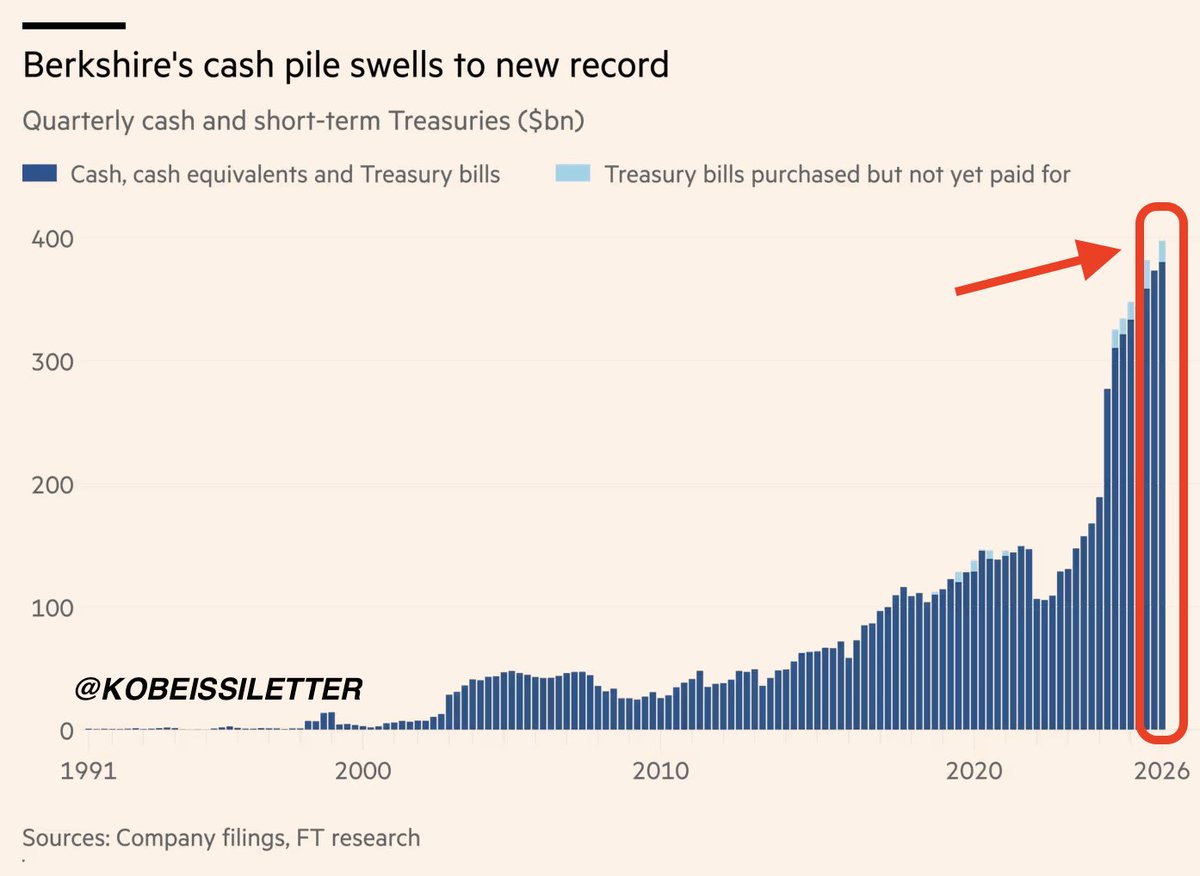
Berkshire Hathaway Posts Record Cash Balance, Signals Cautious Yet Steadfast Investment Stance
Berkshire Hathaway, the multinational holding company led by Warren Buffett, reported a record cash balance of $397 billion in its latest quarterly update, highlighting a cautious posture as market valuations remain elevated. The company also disclosed a net reduction in equity holdings for the quarter, continuing a multi-year pattern of selling equities while bolstering liquidity through Treasury bills and other short-duration assets. At the same time, Berkshire’s operating businesses demonstrated resilience, contributing to a solid improvement in operating profit for the period. The juxtaposition of a swollen balance sheet with steady operational performance paints a nuanced picture of a conglomerate prioritizing liquidity and risk management in a volatile market environment.
Historical context: capital allocation philosophy in a long-running portfolio
To understand Berkshire’s recent cash build, it helps to recall the firm’s long-standing approach to capital allocation. Since its early days as a conglomerate with a few core subsidiaries, Berkshire has sought a balance between deploying capital into profitable acquisitions or stock repurchases and preserving liquidity to weather unpredictable macro forces. In the current cycle, Buffett and his investment team have repeatedly cited high valuations and macro uncertainties as reasons to maintain substantial liquidity, even as the company generated sizable operating earnings from its diverse array of businesses, including insurance, utilities, manufacturing, and consumer franchises.
The cash pile is not a new phenomenon for Berkshire, but the scale reached in this update marks a milestone that draws attention from analysts and market watchers. Historically, Berkshire has used cash to fund large acquisitions or opportunistic investments when mispricings or distressed assets presented themselves. Yet in recent years, the emphasis has shifted toward a more conservative stance: preserve capital, deploy only when a high-conviction opportunity arises, and maintain a fortress balance sheet that can absorb shocks during downturns. The latest figures reinforce that philosophy, underscoring how capital managers prioritize optionality and risk mitigation in uncertain times.
Economic impact and implications for markets
Berkshire’s record cash balance carries several economic implications both for the markets and for its portfolio of operating businesses. First, a sizable cash cushion reduces the need to access potentially expensive or volatile external funding during a downturn, enabling Berkshire to act decisively when private-market opportunities or strategic assets become available at favorable prices. The willingness to hold Treasury bills and short-term investments also shelters the conglomerate from the downside of sudden liquidity strain in a cyclical downturn, which can in turn influence how the firm views risk premia across its subsidiaries.
Second, Berkshire’s ongoing net equity sales contribute to a broader theme in U.S. equity markets: a shift from passive, broad-based equity ownership toward more selective, opportunistic repositioning by established conglomerates. While the aggregate impact of a single company selling equities is often limited in scale relative to overall market activity, Berkshire’s size means these decisions can ripple through the prices of popular holdings, particularly if the dispositions are concentrated in a few large positions. Investors tend to scrutinize how these sales align with Buffett’s public commentary on market valuations and the opportunity set for long-term investors.
Third, the preference for treasury exposure over equity investments signals a risk-off stance amid valuation concerns. The appetite for short-duration, high-quality assets can cap the pace of equity fundraising and influence the sector allocation of major capital allocators. This dynamic may feed into broader patterns of capital flows, as other institutional investors reassess their own exposure to equities near market highs and seek stability through alternative assets, liquidity management tools, or hedging strategies.
Regional and sectoral comparisons
While Berkshire Hathaway is a global conglomerate with diverse holdings, its domestic footprint remains strongest in the United States, where it derives revenue from insurance operations, energy distribution, manufacturing, and consumer goods. The latest quarterly update highlights that even with a pause in aggressive equity deployment, Berkshire’s operating segments are performing well. For example, the insurance and energy businesses typically exhibit defensive characteristics during periods of market volatility, providing cash flow reliability that supports the firm’s liquidity posture.
By comparison, regional investment patterns across peer institutions show a similar push-pull: when valuations are elevated, some large investors favor liquidity and high-quality fixed income, while others pursue selective equity bets in industries with secular growth. In contrast to a banner year of buybacks or large-scale acquisitions common in booming markets, Berkshire’s current approach emphasizes capital preservation and opportunistic deployment. This stance is not unique to the United States; global investors have been weighing the balance between liquidity, risk hedging, and long-horizon equity exposure, particularly in periods of macro uncertainty, inflation concerns, and central-bank policy shifts.
Operational resilience across Berkshire’s subsidiaries
Beyond the cash balance and equity dispositions, Berkshire’s operating businesses reported an 18% increase in operating profit for the period, illustrating that the company’s diverse portfolio remains robust despite a cautious external environment. The strength of the operating companies underscores a central tenet of Berkshire’s value proposition: a collection of durable franchises whose cash-generating capabilities can fund both ongoing operations and future investments, even when external conditions are less favorable for aggressive capital deployment.
Insurance operations, a cornerstone of Berkshire’s cash generation, typically contribute stable underwriting profits and composite returns that help cushion the conglomerate during periods of equity market volatility. Utilities and energy businesses continue to generate predictable cash flows, while manufacturing and consumer-facing subsidiaries provide a mix of resilience and cyclical sensitivity. The 18% rise in operating profit suggests that demand for Berkshire’s diversified product lines and services remains solid, even as broad markets exhibit volatility. This dual narrative of strong fundamentals and liquidity discipline epitomizes Berkshire’s long-running strategy of earning reliable operating earnings while maintaining optionality through a large cash reserve.
Strategic considerations for stakeholders
- For shareholders: Berkshire’s liquidity posture offers downside protection and potential optionality for future investments when the valuation environment becomes more favorable. Investors should monitor progress in managing macro risk, interest-rate trajectories, and the company’s willingness to deploy capital into high-conviction opportunities.
- For employees and partners: The overall health of Berkshire’s operating businesses reinforces job stability and ongoing collaboration opportunities across its portfolio. A conservative approach to capital allocation can translate into long-term resilience, ensuring the continuity of core operations and strategic initiatives.
- For the broader market: Berkshire’s cadence of equity sales and cash accumulation may influence perceived risk appetite among large-cap investors. The firm’s stance could encourage other capital allocators to pursue a balanced mix of liquidity and selective investments, potentially shaping upcoming periods of market activity.
Historical performance benchmarks and investor sentiment
Over the decades, Berkshire Hathaway has cultivated a reputation for prudent capital management and disciplined risk-taking. The current cash balance, while record-setting, should be evaluated in the context of the company’s historical capital allocation choices, track record on returns, and the resilience of its operating businesses. Investors will likely weigh whether the cash position represents a strategic runway for future acquisitions or a precautionary buffer against potential market shocks. The sentiment surrounding Berkshire remains anchored in confidence about its leadership's ability to identify durable franchises at attractive prices, even if the near-term path for equity markets is uncertain.
Regional comparisons reveal a broad trend among major diversified groups, with many emphasizing liquidity as a strategic asset. In regions where market volatility has spiked, companies with strong balance sheets and diversified revenue streams tend to outpace peers that overextend themselves in chasing growth without sufficient liquidity. Berkshire’s approach—strong operating earnings, substantial cash reserves, and measured equity dispositions—aligns with a conservative risk framework that prioritizes resilience and long-term value creation over rapid, speculative deployment.
Public reaction and market dynamics
News of Berkshire’s cash balance and equity sales has generated discussion among market participants and financial media. Analysts emphasize that a record cash hoard does not imply inactivity; rather, it signals readiness to act when favorable opportunities arise. Public reaction often centers on whether Berkshire will deploy capital into acquisitions that could meaningfully shift the landscape of corporate ownership or whether it will continue to prioritize liquidity as a hedge against macro risks. The balance between waiting for the right moment and remaining sufficiently liquid to seize opportunities is a classic dilemma for Berkshire, and one that underscores the depth of strategic thinking behind its capital allocation choices.
Advantages and potential risks
- Advantages: A large cash balance provides flexibility to pursue high-conviction investments, fund bolt-on acquisitions, or withstand downturns without relying on external financing. The diversified revenue base of Berkshire’s operating companies mitigates some risk associated with market swings in any single sector.
- Potential risks: Prolonged high cash balances could mean missed opportunities if market conditions improve and prices of quality assets rise. Persistent equity sales might also draw scrutiny from investors seeking more aggressive capital deployment. Balancing liquidity with strategic investments remains an ongoing challenge.
Looking ahead: what to watch
- Valuation environment: How long valuations remain elevated will influence Berkshire’s willingness to deploy capital into new stock purchases or opportunistic acquisitions.
- Interest rates and monetary policy: Changes in yield curves and central-bank guidance can affect the relative attractiveness of cash, Treasuries, and equities.
- Operational performance: Sustained strength in Berkshire’s operating businesses will support overall financial health and provide a robust base for future capital decisions.
- Market opportunities: The emergence of mispriced assets or distressed opportunities could prompt Berkshire to deploy capital in a way that could shift market dynamics.
Conclusion: balance, patience, and long-term focus
Berkshire Hathaway’s latest quarterly update underscores a deliberate, patient approach to capital allocation. A record cash balance of $397 billion reflects a strategic preference for liquidity and risk management in an environment of elevated market valuations. At the same time, the company’s 18% rise in operating profit hints at underlying strength across its diversified portfolio. For investors and observers, the message is clear: Berkshire remains a disciplined steward of capital, ready to act when opportunities align with its long-term, value-oriented framework while maintaining the financial flexibility to weather uncertainty.
As markets evolve, Berkshire’s continuing emphasis on liquidity, measured equity dispositions, and robust operating earnings will likely shape how investors interpret the conglomerate’s next moves. The balance sheet stands as a testament to strategic patience, a core principle that has guided Berkshire through many cycles and will continue to influence its decisions in the years ahead.