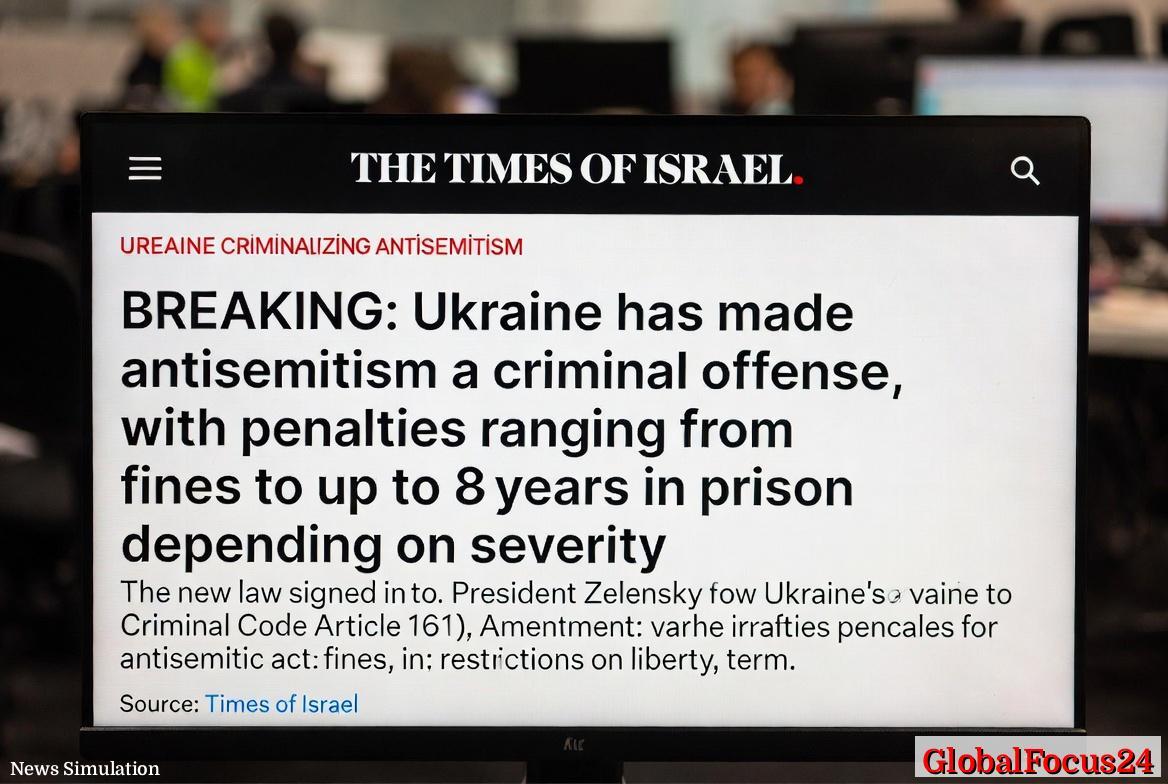
Ukraine criminalizes antisemitism: new penalties and broader protections in Article 161
Ukraine has enacted a landmark change to its criminal code, criminalizing antisemitic acts with penalties that escalate based on severity. The reform, signed into law by President Volodymyr Zelensky, expands protections against antisemitism and provides clearer definitions for offenses ranging from incitement to hatred to violence. The move signals Ukraine’s commitment to fighting discrimination in all its forms, while also aligning with international human rights expectations and regional considerations in Eastern Europe.
Historical context and the evolution of antisemitism law in Ukraine
Ukraine’s legal approach to antisemitism has evolved in tandem with broader European standards and national experiences. Historical episodes of antisemitic violence in the region, including during periods of political upheaval, underscored the need for robust, enforceable protections against prejudice. In the post-Soviet era, Ukraine has worked to strengthen civil rights through a series of reforms aimed at harmonizing domestic law with European norms. The current legislation builds on that trajectory by moving from general anti-discrimination provisions to precise criminal definitions and tailored penalties for antisemitic actions.
The amendment to Article 161 of the Criminal Code explicitly defines antisemitism in terms of motives and conduct, clarifying that manifestations of antisemitism—whether through hate speech, discriminatory practices, denial of the Holocaust, or violence—are prosecutable offenses. By enumerating acts such as incitement to hatred, discrimination, and restriction of rights, the law creates a framework for prosecutors to pursue cases that were previously difficult to classify under existing provisions. The approach reflects a broader shift in national policy toward zero tolerance for hate and a commitment to safeguarding minority communities.
What the law changes, in practical terms
- Core offenses and penalties: Basic antisemitic acts are punishable by fines, restrictions on liberty, or imprisonment of up to three years. This establishes a baseline that signals seriousness and accountability for lower-level offenses.
- Aggravating circumstances: The law imposes stiffer penalties when antisemitic acts involve violence, credible threats, abuse of official position, participation by a group, or consequences that are particularly severe. In such cases, penalties can escalate to imprisonment ranging from two to five years, with potential for up to eight years in the most serious situations.
- Protected rights covered: The amendments address not only violence but also incitement, discrimination, denial of the Holocaust, and the restriction of rights based on antisemitic motives. This broad scope helps ensure that hateful actions, even short of physical harm, are subject to criminal scrutiny.
- Official position and collective action: By recognizing aggravated circumstances such as abuse of authority or group-based offenses, the law seeks to deter coordinated hate campaigns and misuse of power to target Jewish communities.
Regional comparisons and regional implications
- Eastern Europe and the EU sphere: Ukraine’s move aligns with civil rights frameworks common across many European countries that treat antisemitic acts as criminal offenses with varying degrees of severity. Several neighboring states have comparable statutes that address discrimination and violence, reinforcing regional norms against antisemitism.
- Neighboring challenges: In the broader regional context, antisemitic incidents can flare during periods of social tension or political uncertainty. Ukraine’s law aims to deter such dynamics by signaling clear consequences for antisemitic conduct and by strengthening the rule of law.
- Urban versus rural enforcement: In large urban centers with diverse populations, enforcement of antisemitism-related crimes often intersects with hate crime reporting, community outreach, and educational initiatives. The law’s clarity can help prosecutors pursue cases consistently across regions while supporting local authorities in implementing preventative measures.
Economic impact and societal benefits
- Legal clarity and business climate: A clear legal framework around hate crimes improves societal predictability and supports a stable operating environment for businesses, particularly those with diverse workforces and international ties. Employers benefit from well-defined anti-discrimination rules that help manage workplace conduct and risk.
- Public safety and social cohesion: By criminalizing antisemitic acts and imposing meaningful penalties, the law aims to reduce hate-based incidents, contributing to safer neighborhoods and more inclusive communities. Reduced incidents can lessen costs associated with security, medical care, and social services that arise from hate crimes.
- Tourism and international relations: Demonstrating commitment to human rights strengthens Ukraine’s reputation among international partners and tourists who value safety and tolerance. This can have a positive, indirect effect on sectors ranging from hospitality to cultural events.
Implementation considerations and potential challenges
- Evidence and provocation: Prosecutors will need to establish intent and motivation in antisemitic offenses. The law’s emphasis on motives and aggravating circumstances requires careful investigation, including testimony, documentation, and corroborating evidence.
- Training and awareness: Regions with limited experience prosecuting hate crimes may require training for law enforcement, prosecutors, judges, and public defenders to ensure uniform application of the law and to prevent inadvertent biases during proceedings.
- Community engagement: The effectiveness of the law depends in part on trust between communities and authorities. Outreach initiatives, advocacy partnerships, and reporting channels can help ensure that victims feel supported and that offenses are promptly addressed.
- Balancing rights and concerns: While the aim is to prevent hate, authorities must balance criminal enforcement with protecting freedom of expression. The law’s definitions and thresholds for criminal liability are designed to minimize overreach while maintaining robust protections.
Public reaction and societal dynamics
- Community response: Jewish communities and civil society groups have welcomed clearer legal remedies against antisemitism, noting that accountability strengthens safety and dignity for all residents. Public statements from civic organizations often emphasize the importance of education, remembrance, and vigilant enforcement to deter prejudice.
- Media and discourse: The law’s passage has prompted broad discussion about how societies confront historical memory, Holocaust denial, and ongoing discrimination. Many observers view the legislation as part of a broader commitment to human rights that resonates beyond Ukraine’s borders.
- Government communications: Authorities frequently frame such measures as essential for upholding the rule of law and for demonstrating Ukraine’s alignment with international norms. Transparent reporting on case outcomes can bolster confidence in the system.
Historical memory and Holocaust education
- Denial and distortion: The law explicitly addresses Holocaust denial as a prosecutable offense in the broader category of antisemitic acts. This aligns with global efforts to preserve historical truth and counter misinformation that harms communities.
- Educational implications: Complementary measures, such as Holocaust education in schools, community programs, and public commemorations, are often pursued alongside legal reforms. These initiatives help cultivate a culture of remembrance and resilience against antisemitism.
Legal safeguards and due process
- International compatibility: The amendments are structured to uphold due process and align with international human rights standards. The focus on clearly defined offenses reduces ambiguities in reporting and prosecution.
- Oversight mechanisms: Independent oversight and judicial review can help ensure that enforcement remains fair and proportionate, and that victims have accessible pathways for redress.
Conclusion
Ukraine’s expansion of antisemitism protections through the criminal code marks a significant step in the country’s ongoing effort to strengthen civil rights and promote inclusive, safe communities. By defining antisemitic acts with precision and attaching proportional penalties that rise with severity, the law sends a clear message: hate has no place in Ukrainian society. As enforcement begins, the collaboration of law enforcement, the judiciary, civil society, and Jewish communities will shape the law’s effectiveness, its public reception, and its enduring impact on regional norms regarding hate crime prevention.
Note: This article reflects the legislative changes and their anticipated effects, presenting context, comparisons, and potential implications without political commentary or bias.