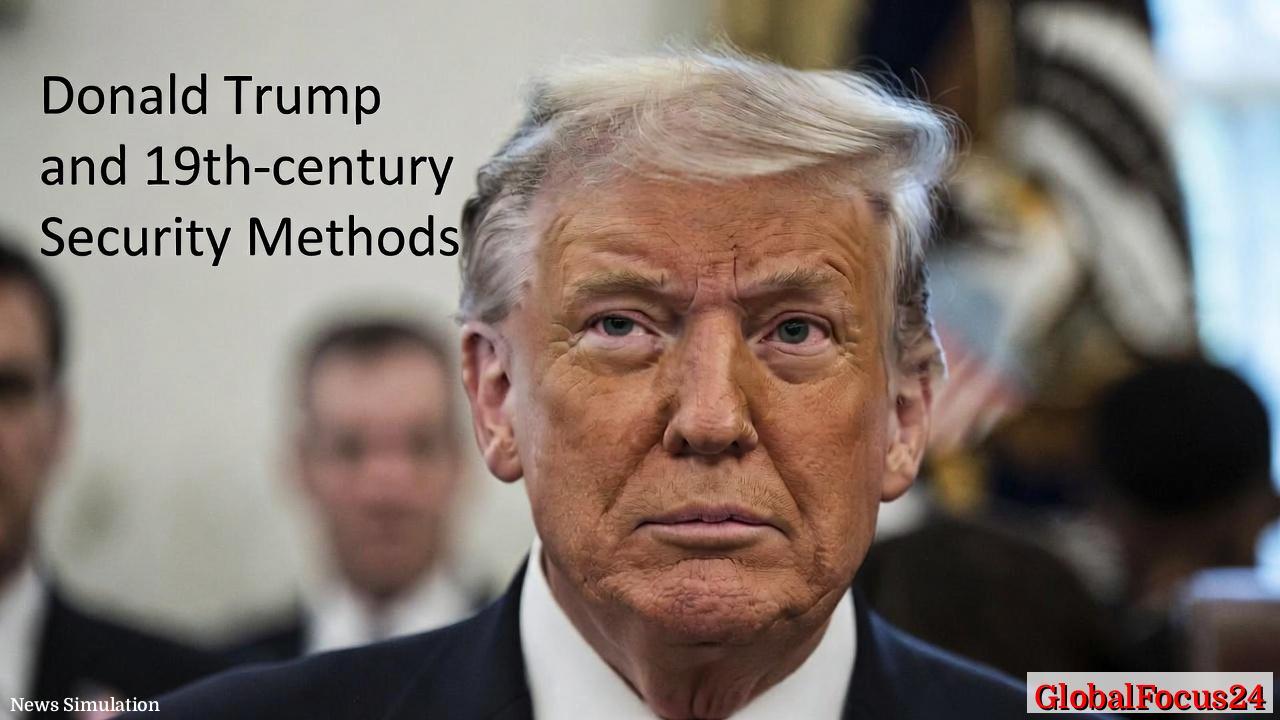
Trump’s 19th-Century Security Strategy Meets a 21st-Century World: Global Repercussions Unfold
A Strategy Rooted in the Past
In a world defined by artificial intelligence, digital espionage, and instantaneous communication, former President Donald Trump has turned heads once again — this time for employing security tactics drawn from an earlier era. Analysts describe his recent strategies as distinctly 19th-century in their inspiration, focusing on displays of national power, maritime control, and direct confrontation. Those methods, while evocative of historic great-power politics, have clashed sharply with the interconnected and interdependent realities of modern global security.
The move has rekindled debate among policymakers and scholars over whether traditional statecraft can be effectively applied to contemporary conflicts. While Trump’s approach has emphasized deterrence through visible strength and economic pressure, the ensuing results have often defied expectations, especially in regions where complex networks of alliances and trade dominate the geopolitical landscape.
The Strait of Hormuz Crisis
The most visible example of this clash between eras occurred in the Strait of Hormuz, one of the world’s most critical maritime chokepoints. The narrow passage, through which roughly one-fifth of global oil shipments typically pass, became the epicenter of an escalating crisis following renewed tensions with Iran. When hostilities erupted, Tehran’s closure of the strait to most international shipping sent major shockwaves through global energy markets.
Historically, the control of sea lanes has been a central feature of geopolitical power — a legacy underscored by the British Empire’s dominance of 19th-century trade routes. Trump’s administration sought to apply similar coercive tactics, using naval deployments to assert freedom of navigation and to pressure adversaries into compliance. However, the reaction proved unexpectedly hostile. Rather than retreating, Iran’s response was to block passage entirely, setting off one of the most significant disruptions to international shipping in a generation.
The result stunned Washington. Energy analysts estimate that even a brief closure of the Strait of Hormuz can spike crude prices by double digits, as markets price in the risk of prolonged instability. In this instance, the sudden cessation of maritime trade through the region set off an immediate scramble among energy-importing nations in Asia and Europe to locate alternative sources.
Economic Consequences Across Continents
The economic fallout from the conflict extended far beyond the Middle East. In markets from Tokyo to Frankfurt, stock indexes trembled as oil benchmarks surged. American consumers soon began to feel the ripple effects, as gasoline prices climbed and inflationary pressure mounted.
For the United States, the disruption underscored an uncomfortable paradox. The nation’s 21st-century economy, built upon global supply chains and energy interdependence, proved highly sensitive to the very type of high-stakes brinkmanship that once defined 19th-century diplomacy. The mix of saber-rattling and economic nationalism, while intended to project strength, instead revealed the vulnerabilities of a tightly coupled global economy.
The situation echoed the early 1970s oil crises — but with key differences. Then, geopolitical power rested largely with energy producers and Western industrial states. Now, with renewable transitions underway and diversified economies in play, the shock illuminated how much global energy flows remain critical despite aspirations of independence from fossil fuels. European nations, in particular, were forced to draw down strategic reserves while negotiating emergency shipments from North Africa and the United States.
Lessons from History
To some historians, Trump’s reliance on methods reminiscent of earlier centuries is both deliberate and symbolic. In the 19th century, global influence often hinged on control of territory, shipping routes, and raw materials. The projection of naval force was not merely a deterrent but also a declarative statement of sovereignty.
Yet, in today’s context, such tactics confront substantial limitations. International relations in the 21st century hinge not only on military capability but also on multilateral institutions, economic interdependence, and cyber networks that can amplify or undermine coercive strategies. In this environment, displays of force rarely yield the straightforward results of earlier centuries.
A vivid historical parallel lies in the Great Game — the 19th-century contest between the British and Russian empires for control of Central Asia. Back then, power was measured in terms of spheres of influence and access to trade corridors. Trump’s recent policies toward Iran and maritime chokepoints evoke similar thinking: influence over strategic geography as a means of controlling global outcomes. But unlike the Great Game, modern geopolitics plays out before a real-time global audience, with instantaneous market reactions and non-state actors capable of reshaping outcomes overnight.
Global Reaction and Diplomatic Friction
The global response to Washington’s approach has been a mixture of surprise, pushback, and recalibration. European allies, traditionally aligned with U.S. security stances, grew uneasy over the reliance on unilateral shows of force. Naval maneuvers and sanctions-heavy diplomacy reminded many of older doctrines that predated the cooperative frameworks built after World War II. Meanwhile, nations in Asia — heavily dependent on Middle Eastern energy — urged restraint and sought new routes through pipelines and regional trade partnerships.
The closure of the Strait of Hormuz also prompted a reassessment of maritime security among Gulf states. Saudi Arabia and the United Arab Emirates, both seeking stability for their energy exports, had to weigh the risks of prolonged confrontation against the economic costs of market disruption. Diplomatic intermediaries, including neutral states and international organizations, moved quickly to broker partial re-openings of the strait, though progress remained halting.
This era of unexpected defiance has underscored limits to traditional coercive diplomacy. Threats that once carried significant leverage now encounter a world more prepared to react unpredictably. As one senior European diplomat noted privately, “The language of power has changed — but not everyone is speaking the same century.”
The Domestic Dimension
Within the United States, the crisis sparked intense debate over the proper balance between strength and adaptability in foreign policy. Critics argue that reviving antiquated power strategies overlooks the complexity of today’s interconnected world. Supporters counter that these moves reassert U.S. dominance at a time when emerging powers challenge established norms of maritime freedom and international influence.
Economic indicators painted a mixed picture. Defense contractors saw surges in orders as naval resources were redeployed, while agricultural exporters suffered from shipping delays and tariff reprisals. Regional manufacturing hubs reliant on imported materials — particularly in the Midwestern and Gulf Coast economies — reported production slowdowns attributed to rising transportation costs.
Meanwhile, consumers grappled with higher fuel costs and price jumps on imported goods, echoing the inflationary aftershocks of earlier energy disruptions. The Federal Reserve faced renewed tension between stabilizing prices and supporting growth, reviving a scenario reminiscent of late 1970s stagflation risks.
Comparisons with Other Regions
Across the globe, nations took note of the situation’s unfolding logic. In East Asia, the South China Sea offered a regional parallel: a vital waterway dense with strategic rivalries where traditional maritime brinkmanship encounters the realities of modern diplomacy. Observers drew comparisons between U.S.-Iran maritime tensions and the ongoing disputes over reef militarization and shipping rights in the Pacific. The difference, however, lay in the response mechanisms — where multilateral negotiation frameworks and economic interdependence often temper overt confrontation.
In Europe, historical memory runs deep. The nations that once relied on gunboat diplomacy in the 19th century have since evolved into cooperative blocs governed by shared institutions. The European Union’s reaction to the crisis reflected that evolution: caution in rhetoric, reliance on coordinated sanctions, and a preference for mediation over military signaling. European ports experienced logistical delays, especially in Rotterdam and Marseilles, further exposing the continent’s dependency on secure maritime flows.
The Future of Power Projection
As the global order recalibrates around this new reality, policymakers and analysts alike are asking whether the 19th-century mold of power projection can coexist with 21st-century challenges. The evidence from the Strait of Hormuz suggests that older frameworks of deterrence risk backfiring when applied to hyperconnected systems. In today’s world, disruptions spread not in slow-moving telegrams or trade blockades but in milliseconds via market algorithms and viral media.
This evolving context may force a strategic reckoning. Sustained displays of power still hold symbolic significance, yet their practical effectiveness is diminishing in a world dominated by economic networks, semiconductor supply chains, and digital infrastructure. Security today depends as much on data flows and cyber resilience as on troops and fleets.
Still, history shows that transitions in the language of power are rarely smooth. Just as industrial-age empires struggled to adapt to the diplomatic revolutions of the 20th century, modern states are wrestling with how to integrate classic tools of deterrence into a world shaped by transparency and instant reaction. The lessons of the past, while valuable, may not fit neatly into a world defined by quantum communications and decentralized finance.
A Stark Reminder of Global Interdependence
The unfolding crisis around the Strait of Hormuz and its ripple effects serve as a reminder that power, even when projected with confidence, can trigger unintended consequences when applied through outdated frameworks. The U.S. administration’s surprise at the world’s responses — and the world’s equal surprise at Washington’s methods — illustrates the widening gap between traditional doctrines and contemporary realities.
In the end, the confrontation has not only reshaped global trade and energy flows but also reopened a deeper question: in an age where security depends on collaboration as much as competition, can 19th-century strategies still succeed in the 21st century? The answer, still unfolding across oceans and continents, may redefine how nations measure strength in an era that refuses to play by old rules.