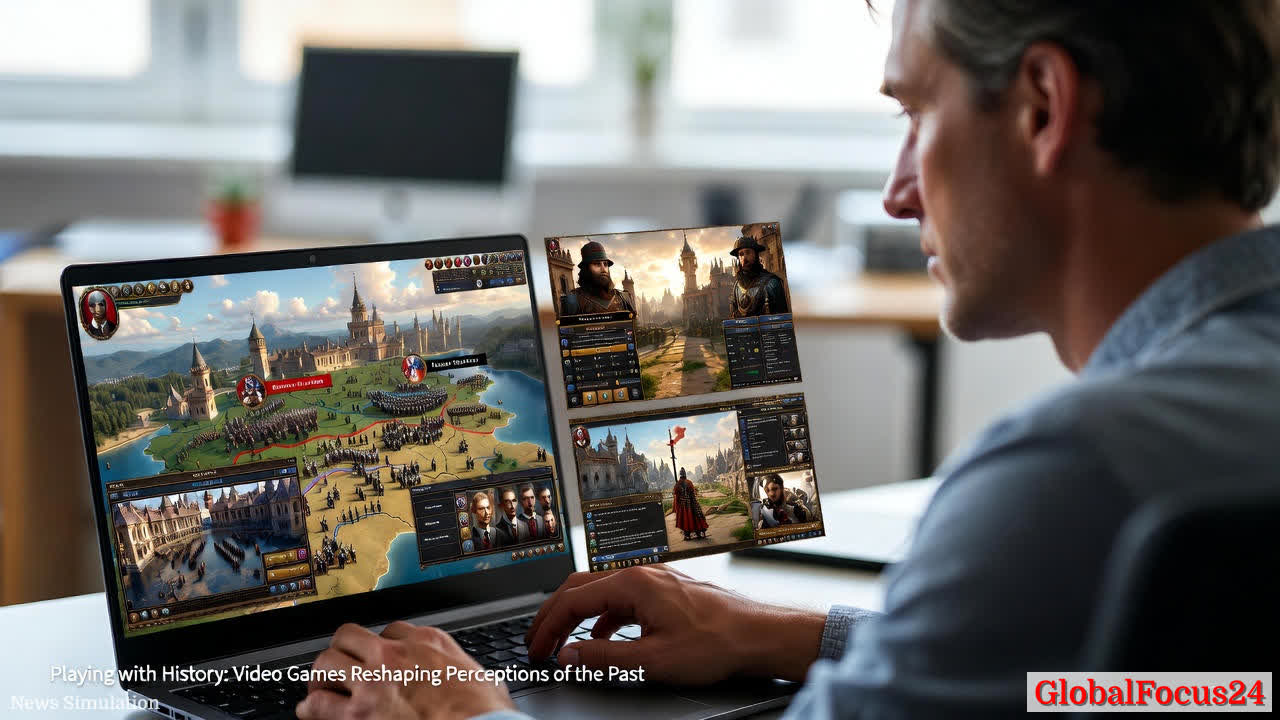
Playing with History: How Video Games Are Reshaping Perceptions of the Past
Video games are increasingly influencing how people learn about and interpret historical events, blending entertainment with education in ways that traditional classrooms have long sought to achieve. From grand strategy epics to immersive action titles, modern games offer interactive experiences that invite players to grapple with the complexities of past eras, revealing the tensions, trade-offs, and contingent moments that shape world history. As this cultural phenomenon expands, it is reshaping public understanding of history, informing regional perspectives, and altering expectations for the role of media in education and memory.
Historical Scope and Player Agency
Grand strategy series such as Europa Universalis, Crusader Kings, and Hearts of Iron sit at the core of the modern gaming conversation about history. These titles place players in the roles of historical actors or statesmen, tasked with managing diplomacy, trade, military campaigns, and internal dynamics across centuries. The appeal lies not only in reenacting known events but in exploring alternate trajectories—“what if” scenarios that illuminate the fragility and contingency of historical outcomes. In Europa Universalis, for instance, the player navigates the early modern period from the 15th to the 19th century, modeling the interwoven forces of exploration, colonization, and state-building. The ability to influence or even reverse the course of events underscores the agency that players have to test hypotheses about causation and consequence in ways that static textbooks rarely permit.
Crusader Kings shifts the lens to dynastic politics, where personal relationships, succession laws, and familial strategies shape broad political patterns. Hearts of Iron immerses players in the strategic complexities of global conflict, emphasizing alliance-building, resource management, and strategic decision-making during World War II. Across these titles, the gameplay mechanics translate dense historical processes—economic networks, political legitimacy, religious diplomacy, and technological progress—into tangible challenges for players to solve. The result is a dynamic pedagogy that foregrounds process over endpoint, highlighting how long, incremental shifts accumulate into transformative historical changes.
Beyond these staples, the Total War series blends tactical battlefield control with strategic governance, offering a hybrid model that mirrors the multi-layered reality of warfare through time. Its historical breadth—from ancient Rome to the Napoleonic era—allows players to observe how military organization, supply chains, and public opinion interact in shaping campaign outcomes. In East Asia, Koei’s titles explore the Three Kingdoms period and the Sengoku era, emphasizing leadership choices, alliance-building, and clan dynamics that influenced regional power structures for generations. Such coverage demonstrates how regional histories contribute to global patterns, reinforcing the interconnectedness of continents and cultures across centuries.
Education, Education, and the Neural Pathways of Learning
Educators and historians have long noted that active participation in simulation or role-playing contexts enhances memory retention and comprehension. When players experiment with different decisions and observe the consequences, they engage in a form of experiential learning that can deepen understanding of cause and effect, incentives, and trade-offs. This approach aligns with contemporary research on interactive learning, which suggests that learners who manipulate variables and test hypotheses retain information more robustly than those who passively consume content.
Yet, the educational value of historical games hinges on accuracy and context. Because entertainment objectives often drive design, some titles precipitate simplifications or urban myths that can distort understanding if uncorrected. Critical engagement—supplementing gameplay with reliable historical sources, scholarly commentary, and classroom discussions—helps mitigate these risks. In practice, effective use of games in education combines play with guided reflection, research-backed interpretation, and curated reading that situates in-game events within broader historical narratives.
Historical Context and Regional Comparisons
The appeal of historical games intersects with regional identity and collective memory. In Europe, where many of these titles originate and where periodization and national historiography are topics of ongoing dialogue, players often encounter macro-level events—empires rising and falling, religious reformations, and the diffusion of ideas—through a continental lens. The Scandinavian, Iberian, and central European experiences are frequently woven into campaigns that spotlight trade networks, maritime expansion, and dynastic politics, triggering reflections on how regional developments contributed to global transformations.
In Asia, game designers frequently foreground centuries of political fragmentation, consolidation, and cultural exchange. Portrayals of China’s imperial cycles, Japan’s warring states, and the interplay of Southeast Asian polities illustrate how local histories interact with broader world systems. These narratives can illuminate the long durations of state formation and the diffusion of technologies, religions, and legal codes—topics that resonate with regional curricula and public memory.
In the Americas and Africa, games sometimes emphasize exploration, conquest, and empire-building within the context of colonization and indigenous resilience. When designed with sensitivity and accuracy, these portrayals enable players to explore the ethical and strategic dimensions of frontier expansion, the resilience of indigenous societies, and the enduring legacies of colonial-era institutions. Regional comparisons underscore that history is not a monolith; it is a tapestry woven from diverse experiences, each with its own rhythms, pressures, and outcomes.
Economic Impact and Industry Evolution
The influence of historical video games extends into the broader entertainment and tech industries. As demand for high-fidelity simulations grows, developers invest in more sophisticated models of governance, trade networks, and warfare. This push fuels software improvements, from artificial intelligence that better captures historical decision-making processes to more nuanced economic simulations that reflect supply and demand, inflation, and resource scarcity. The resulting sophistication benefits not only entertainment audiences but also researchers and educators seeking more accurate tools for study and engagement.
Moreover, the monetization and distribution models surrounding these games influence regional markets. The rise of digital distribution platforms lowers barriers to entry for developers worldwide, enabling smaller studios to publish titles that explore specific historical periods or local histories. This democratization broadens the range of voices and perspectives represented in historically themed games, contributing to a more nuanced global dialogue about the past.
Public Reaction and Cultural Perception
Public reception to historical gaming is mixed, reflecting a balance between admiration for immersive learning and concern about historical accuracy. Fans celebrate the depth of simulation, the opportunity to test hypotheses about history, and the educational angles embedded in narrative design. Critics, on the other hand, highlight the risk of conflating entertainment with scholarly consensus, cautioning against oversimplifications and the potential perpetuation of myths if misunderstood by players without critical guidance.
Despite these debates, the cultural footprint of historical games is undeniable. Museums, libraries, and educational organizations increasingly integrate gaming concepts into programming, offering augmented reality experiences, scavenger hunts, and interactive exhibits that translate virtual decision-making into tangible historical inquiry. Public institutions acknowledge that, when paired with rigorous curatorial efforts, games can catalyze curiosity, encourage archival exploration, and foster critical thinking about how history is constructed and taught.
The Road Ahead: Technological Innovations and the Future of Learning
Technological advances portend a more immersive future for historical gaming. Virtual reality (VR) and augmented reality (AR) promise to place players inside historically grounded environments, enabling sensory-rich explorations of architectural forms, urban planning, and battlefield choreography. For students and hobbyists alike, these developments could transform learning from passive observation to embodied experience, where exploring a medieval city or a Roman military camp becomes an active, multisensory investigation.
Artificial intelligence is likely to yield more responsive and historically informed NPCs (non-player characters), creating dynamic political and social ecosystems that react to player choices in nuanced ways. Such advances could support more sophisticated simulations of diplomatic negotiations, economic policy, and cultural exchange, offering a sandbox for testing policies and witnessing emergent outcomes over long timescales. As models become more data-driven, designers may increasingly consult archival sources, digital histories, and scholarly datasets to ground in-game systems in evidence, reducing distortions and enhancing interpretive value.
Educational integration remains a central objective. Schools and universities may adopt curated curricula that align game campaigns with established historical frameworks, linking in-game events to primary sources, historiography, and critical analysis. In this scenario, students could conduct comparative studies across civilizations, analyze the drivers of empire-building, and examine how economic networks shaped geopolitical power. The result would be a blended learning environment that leverages the motivational appeal of games while maintaining rigorous academic standards.
Challenges and Considerations for Developers and Educators
Several challenges shape the ongoing evolution of historical gaming. First, balancing entertainment with accuracy requires multidisciplinary collaboration, bringing together historians, educators, designers, and data scientists to craft experiences that are both compelling and credible. Second, inclusivity and representation demand careful storytelling choices to avoid erasing or mischaracterizing marginalized groups whose histories are integral to the broader narrative. Third, assessing learning outcomes from game-based experiences calls for robust evaluation frameworks that capture not only factual recall but also critical thinking, inquiry skills, and the ability to connect past and present contexts.
Despite these hurdles, opportunities abound. Developers can experiment with modular design that enables players to explore alternative scenarios while maintaining anchors in verifiable facts. Curators and educators can curate companion resources that guide players toward primary sources, scholarly articles, and museum collections, turning gameplay into a gateway to deeper research. And policymakers can recognize the potential of historical games as supplementary tools for civic education, cultural heritage promotion, and public historical literacy.
Conclusion: A Dynamic Medium for Understanding the Past
Video games have emerged as a significant, evolving channel through which history is invited into the public imagination. By enabling players to manipulate variables, test hypotheses, and experience the consequences of decisions across centuries, these titles illuminate the mechanisms that drive historical change. They contribute to a more nuanced public discourse about the past, one that acknowledges complexity, celebrates inquiry, and recognizes the long arc of human experience.
As technology advances, the line between entertainment and education will continue to blur. The most impactful historical games will not merely recreate past eras but will invite players to participate in the ongoing process of historical interpretation. They will challenge assumptions, encourage critical reflection, and prompt learners to consult diverse sources, weigh evidence, and articulate reasoned viewpoints about how history unfolds. In this sense, interactive media stands as a powerful ally for history education, offering a dynamic, accessible, and increasingly sophisticated way to engage with the past while acknowledging its enduring relevance to the present and future.