US Tariff Revenue Surges 234% to Record $264 Billion in 2025
Record-Breaking Year for US Tariff Collections
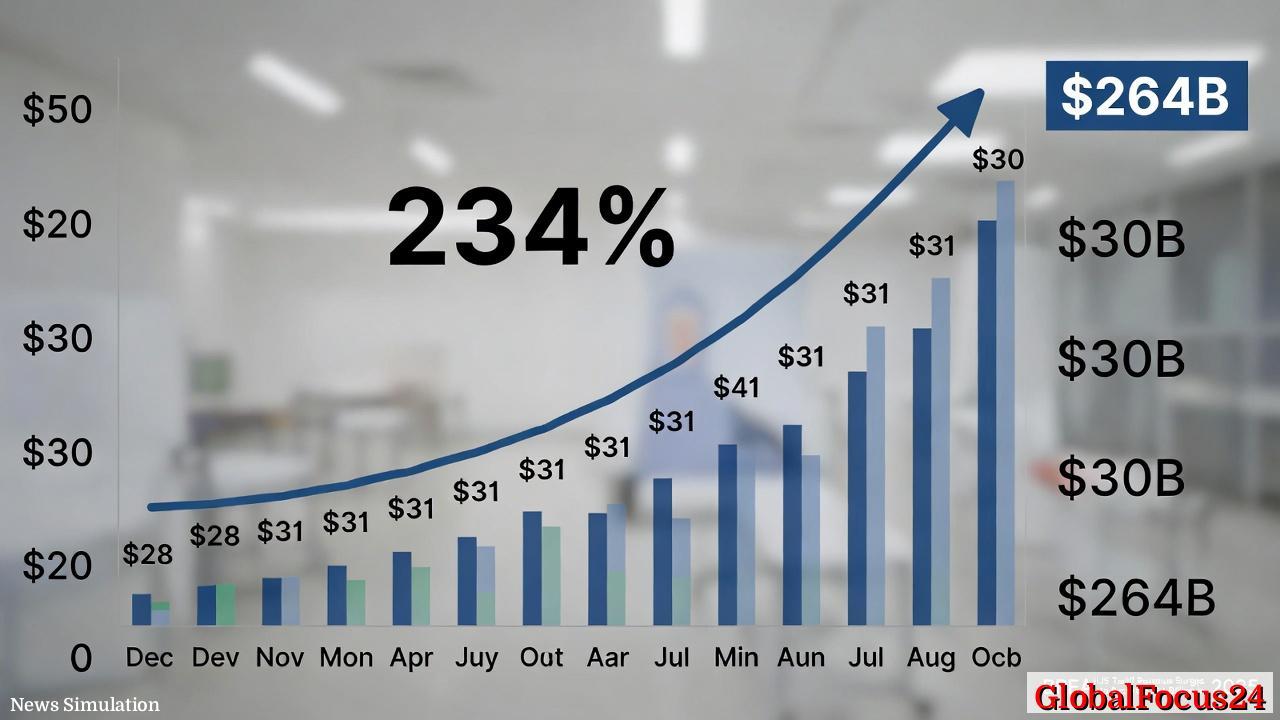
The United States government collected a record $264 billion in tariff revenue in 2025, a sharp escalation that underscores how trade duties have become a central, and increasingly sizable, source of federal income. The total represents a 234% year-over-year increase, translating into an additional $185 billion compared with 2024 and marking one of the most dramatic single-year jumps in tariff receipts in modern US history. For policymakers, businesses, and consumers, the surge highlights both the scale of current trade measures and their growing significance for the broader economy.
The final months of 2025 were particularly notable, with tariff revenue in December alone reaching $28 billion, a 300% rise from the same month a year earlier. November and October each brought in $31 billion, and over the second half of the year monthly tariff revenue averaged roughly $30 billion, illustrating a sustained, rather than episodic, elevation in collections. Projections suggest that, if current conditions persist, tariff revenue could climb further to around $360 billion in 2026, implying year-over-year growth of roughly 36%.
Historical Context of US Tariff Policy
Tariffs have been a part of US economic policy since the nation’s earliest years, initially serving as a primary source of federal revenue before the introduction of the federal income tax in 1913. In the 19th century, customs duties often accounted for the majority of Washington’s income, funding government operations at a time when domestic tax systems were still in their infancy. Over time, as the US economy expanded and diversified, tariffs gradually shifted from a fiscal tool toward an instrument for managing trade relationships and protecting domestic industries.
The mid-20th century was marked by a trend toward lower tariffs and broader trade liberalization, particularly after the Second World War. Initiatives under the General Agreement on Tariffs and Trade, and later the World Trade Organization, aimed to reduce barriers and encourage global commerce, helping entrench the United States as a central player in an increasingly interconnected trading system. Against this backdrop, tariff revenue typically represented a relatively small share of federal receipts, with duties applied selectively and often at modest rates.
In recent years, however, tariff policy has reemerged as a prominent feature of US economic strategy. Successive administrations have turned to tariffs to address trade imbalances, respond to perceived unfair practices, and support domestic manufacturing, often targeting specific sectors such as steel, aluminum, technology components, and critical minerals. The resulting expansion in the tariff base and, in some cases, higher duty rates has set the stage for the substantial increase in tariff revenue reported for 2025.
Anatomy of the 2025 Revenue Surge
The 234% year-over-year increase in 2025 tariff revenue reflects both broader coverage of imported goods and the volume of trade flowing through US ports and border crossings. When tariffs apply to a wider array of products, even stable or modestly rising import levels can generate sharply higher collections. In addition, elevated prices for certain categories of goods, whether due to supply chain constraints, commodity price fluctuations, or strong demand, can amplify the impact of a given tariff rate because duties are often calculated as a percentage of the import value.
Monthly data underscore the consistency of the trend. Over the second half of 2025, tariff receipts averaged around $30 billion per month, rather than spiking in only one or two months, suggesting that higher duties and broader coverage have become structural, not temporary, features of the current regime. December’s $28 billion, following $31 billion in both October and November, points to a plateau at historically elevated levels. Absent significant changes in policy or trade flows, the projected $360 billion in revenue for 2026—about 36% higher than 2025—would represent a further entrenchment of tariffs as a major revenue source.
Behind thefigures lie several forces: targeted duties on strategic sectors, ongoing trade frictions with key partners, and efforts to encourage reshoring or diversification of supply chains. While the precise mix of contributing factors varies by product and region, the aggregate result is clear—imports covered by tariffs are entering the US in large volumes, and the government is collecting far more per dollar of imports than in previous decades.
Economic Impact on Prices, Trade, and Growth
The surge in tariff revenue has direct and indirect implications across the US economy, touching government finances, corporate balance sheets, and household budgets. At the federal level, $264 billion in 2025 tariff receipts represents a meaningful addition to revenues, providing fiscal space that can be used to offset other expenditures or reduce borrowing needs. However, tariffs are generally paid by importers, and the costs can be passed along the supply chain, eventually influencing consumer prices.
For businesses that rely heavily on imported components or finished goods, higher tariffs can compress profit margins unless companies adjust by raising prices, switching suppliers, or reconfiguring production. Some firms may respond by accelerating efforts to diversify sourcing, shifting certain operations closer to home or to countries with more favorable trade terms. Others may accept narrower margins in the near term, particularly when demand is strong or alternatives are limited, absorbing part of the tariff cost in order to maintain market share.
Consumers may experience the effects in more subtle ways, such as higher prices for imported electronics, appliances, vehicles, or goods with complex global supply chains. While the precise pass-through from tariffs to retail prices can vary by sector and competitive conditions, sustained duties of the scale implied by 2025’s record revenue tend to exert upward pressure on import-intensive categories. Over time, shifts in consumer behavior, including increased demand for domestically produced substitutes or delayed purchases of higher-cost goods, can influence both inflation dynamics and industry structure.
The broader macroeconomic impact depends on how tariff revenue and associated price effects interact with growth, investment, and employment. Higher trade barriers can weigh on global economic activity by dampening cross-border flows, yet they can also spur targeted investment in domestic production and logistics if companies perceive long-term changes in policy. The net result is often mixed, differing by industry: sectors shielded by tariffs may see more stable or rising output, while those dependent on imported inputs may encounter higher costs and more complicated planning.
Regional and Global Comparisons
The United States is not alone in using tariffs and trade measures as active tools of economic policy, though the scale of its 2025 revenue sets it apart among major economies. In the European Union, tariff collections tend to be lower relative to total government revenue, reflecting a long-standing emphasis on multilateral trade agreements and internal market integration. The bloc relies more heavily on value-added taxes and other forms of domestic taxation, with tariffs playing a more modest role except in specific sectors or as part of targeted trade actions.
In East Asia, economies such as Japan and South Korea have also generally maintained moderate average tariff rates while pursuing trade agreements that prioritize manufacturing exports and integrated supply chains. While these countries employ anti-dumping and safeguard measures when necessary, tariff receipts have not typically reached the levels implied by recent US collections. Emerging economies, by contrast, sometimes rely more on customs duties as a share of total revenue, particularly where domestic tax bases are less developed, but their absolute collections remain smaller due to their lower overall trade values.
The recent US trajectory sits at the intersection of advanced-economy policy and emerging-economy revenue patterns: duties are being leveraged not only for trade leverage and industrial strategy, but also as a significant fiscal line item. This sets a notable contrast with other large, high-income economies that have tended to treat tariffs primarily as instruments of trade policy rather than major revenue sources. As global supply chains evolve, the way different regions balance tariff use with other tools—such as subsidies, regulations, and tax incentives—will shape competitiveness and trade flows for years to come.
Outlook for 2026 and Beyond
The projection that US tariff revenue could reach $360 billion in 2026, an increase of about 36% over 2025, assumes that current policy settings and trade volumes remain largely in place. Such a trajectory would further solidify tariffs as one of the fastest-growing components of federal revenue, even if they still represent a smaller share than income or payroll taxes. It would also signal that, despite trade tensions and efforts by some companies to reconfigure supply chains, significant volumes of tariffed imports continue to enter the country.
Several variables will determine whether that projection materializes. Changes in tariff rates, the expansion or rollback of specific measures, or new trade agreements could all affect the revenue path. Global economic conditions, including growth in key trading partners and shifts in commodity prices, may influence the value and composition of imports, thereby altering the duty base. The pace at which businesses adapt—either by absorbing costs, passing them on, or relocating production—will also shape how much revenue tariffs ultimately generate in practice.
For now, the 2025 figures underscore a pivotal moment in US trade and fiscal policy. Tariffs, once a relatively modest and predictable part of the federal balance sheet, have surged into a more central role, reflecting changing strategic priorities and the realities of an interconnected global economy. How the United States navigates this new landscape—balancing revenue needs, trade objectives, business competitiveness, and consumer impacts—will be closely watched by markets, trading partners, and the public as 2026 unfolds.