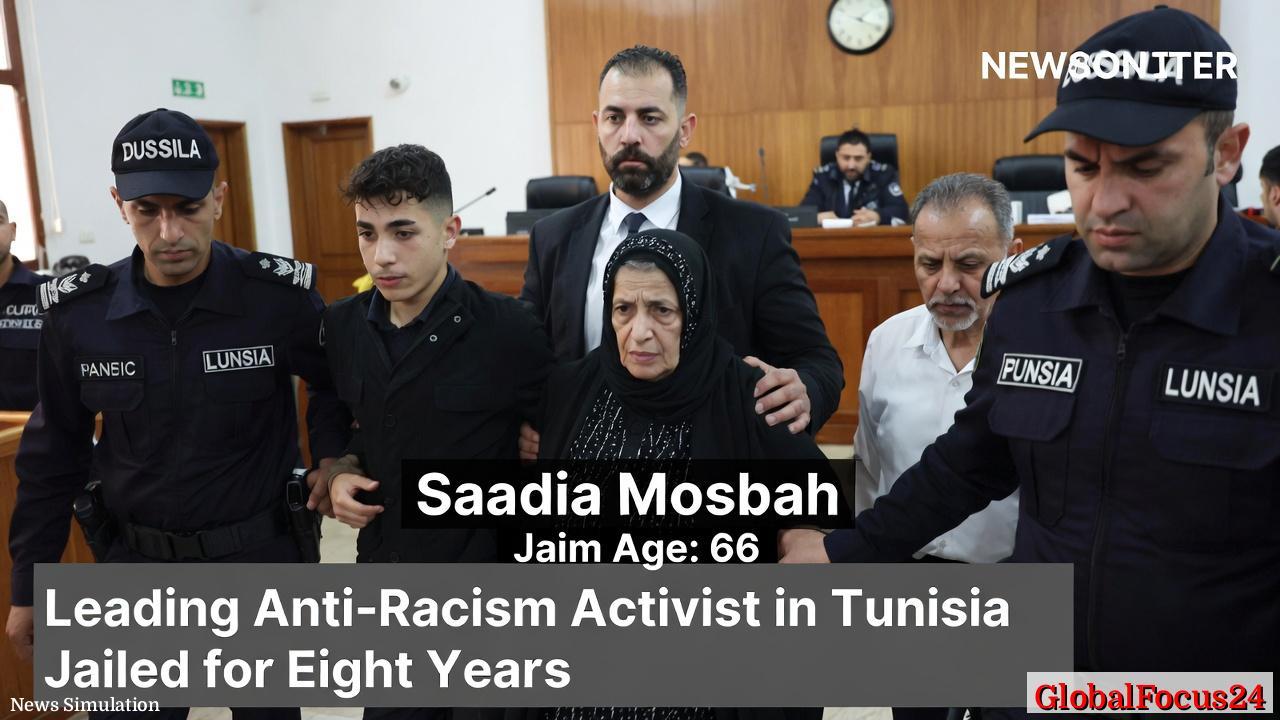
Tunisian Anti-Racism Activist Saadia Mosbah Sentenced to Eight Years in Prison on Money Laundering Charges
Veteran Campaigner Convicted Amid Widening Crackdown on Civil Society
TUNIS — A Tunisian court has sentenced prominent anti-racism activist Saadia Mosbah to eight years in prison on charges of money laundering and illicit enrichment, deepening concerns among human rights groups about the country’s growing pressure on civil society organizations. The ruling, delivered Thursday at a court in Tunis, also included a $35,000 fine and prison terms for two of Mosbah’s associates — her son, who received a three-year sentence, and another activist, who was sentenced to two years.
Mosbah, 66, is the founder and president of Mnèmty, a non-governmental organization known for supporting sub-Saharan migrants and campaigning against racial discrimination in Tunisia. Her conviction follows an arrest in May 2024 that sparked widespread outcry from local and international advocacy groups. They describe the case as part of an escalating campaign to silence voices challenging official policies on migration, race, and human rights.
Court’s Decision and Allegations
The Department of Justice accused Mosbah of financial misconduct linked to foreign donations received by Mnèmty, alleging the funds were misused for personal gain. Prosecutors claimed irregularities were discovered in financial transfers and accounting documents. Her legal team, led by attorney Hela Ben Salem, rejected the accusations as baseless, saying the verdict represents an attempt to criminalize humanitarian efforts and divert public attention from the government’s failure to manage Tunisia’s deepening migration crisis.
Ben Salem described the judgment as a “major shock,” adding that her client had acted transparently in all financial dealings. “This is less a trial about money and more a trial about the right to speak,” she said after the verdict.
A Decades-Long Fight Against Racism
For more than 20 years, Saadia Mosbah has been one of Tunisia’s most visible figures challenging systemic racism and defending the rights of the country’s Black minority and migrants from sub-Saharan Africa. Born and raised in Tunis to parents of Black Tunisian descent, she has consistently called attention to entrenched discrimination in employment, housing, and public services.
In recent years, her advocacy gained national prominence after then-President Kais Saied delivered a 2023 speech describing irregular migration as part of a “criminal plan to alter Tunisia’s demographics” — remarks widely criticized for inflaming xenophobia. Following the speech, violent attacks and evictions targeting sub-Saharan migrants surged across parts of southern and coastal Tunisia. Mnèmty stepped in to provide emergency food, shelter, and legal aid to hundreds displaced by the unrest.
Tunisia’s Troubled Human Rights Landscape
The verdict comes amid a broader pattern of state action against activists, journalists, and opposition figures that has drawn concern from international observers since President Saied dissolved parliament in 2021 and began consolidating power through decrees. While government officials argue such measures aim to restore order and curb corruption, rights organizations say they represent a rollback of the democratic gains achieved after Tunisia’s 2011 revolution — the uprising that triggered the Arab Spring and inspired movements across North Africa and the Middle East.
Groups including the World Organisation Against Torture and the Observatory for the Protection of Human Rights Defenders condemned Mosbah’s conviction, citing her age and health, and called for her immediate release. They described the prosecution as “emblematic” of Tunisia’s shrinking civic space and warned that the country risks isolating itself from key international partners.
Response From Civil Society and Public Reaction
News of Mosbah’s sentencing has rippled through Tunisia’s activist networks, prompting street demonstrations and statements of solidarity. In downtown Tunis, dozens of protesters gathered outside the courthouse on Friday carrying banners reading “Racism is not a crime — justice for Saadia.” Many chanted her name while police maintained a heavy presence.
Several local lawyers and NGO directors say they now fear heightened scrutiny and potential legal threats. “There is a climate of intimidation,” said one organization leader, who requested anonymity for security reasons. “If this can happen to Saadia Mosbah, who has decades of respected work behind her, it can happen to any of us.”
Online, social media users shared photos of Mosbah at migrant aid events, while others criticized what they see as selective justice that punishes activists more harshly than officials implicated in corruption scandals.
Tunisia as a Migration Crossroads
Tunisia has become a central departure point for Africans seeking to cross the Mediterranean to Europe, particularly to the Italian island of Lampedusa, just 130 kilometers away. The International Organization for Migration estimates that tens of thousands of sub-Saharan migrants have passed through or lived in Tunisia in recent years.
The government has responded by heightening border security, deporting migrants, and tightening visa requirements. However, rights advocates argue that criminalizing organizations providing humanitarian assistance exacerbates the problem rather than solving it. They warn that migrants, many of whom flee conflict or economic hardship, face deteriorating conditions and lack access to health care or legal support.
Historical and Regional Context
Tunisia occupies a unique position in North Africa’s complex history of race and migration. Though its population is predominantly Arab and Amazigh, Tunisia is also home to a long-established Black community, concentrated in towns like Gabès and Sfax, descended from enslaved people and traders from sub-Saharan Africa. Despite formal abolition of slavery in the 19th century, racial hierarchies have persisted in social and economic life.
Compared with its Maghreb neighbors, Tunisia has made some progress in addressing racial inequalities. In 2018, it became the first country in the region to pass a landmark anti-discrimination law, criminalizing racial slurs and hate crimes. However, enforcement remains limited. The law’s passage raised hope among activists like Mosbah that Tunisia could serve as a regional model. Instead, they now see those gains undermined by renewed hostility and politicization of the migration debate.
Economic Pressures and Political Climate
Tunisia’s struggles with unemployment, inflation, and foreign debt have intensified public frustration, leading authorities to tighten control over dissent. Analysts note that as the economy stagnates, scapegoating migrants has become a convenient way to deflect anger. Official statistics show youth unemployment exceeding 35 percent in some regions, while inflation remains high. In this context, many Tunisians see migrants as competing for scarce jobs, even though migrants often occupy low-paying roles few locals want.
Observers argue that activists like Mosbah have become collateral damage in a broader campaign to consolidate authority and manage social tensions. The crackdown on civil society coincides with Tunisia’s efforts to secure additional financial support from international lenders — a political balancing act that may further constrain freedoms.
International Reaction and Future Implications
The international community has responded cautiously but with growing alarm. The European Union, Tunisia’s largest trade partner and a key funder of migration management programs, has expressed concern over the shrinking space for civic engagement. Diplomatic observers note that the Mosbah case could complicate Tunisia’s relations with European governments that rely on its cooperation to curb irregular migration. Human rights organizations are urging foreign partners to condition aid on stronger protections for activists and judicial independence.
If appeals fail, Mosbah’s imprisonment would mark one of the most severe punishments handed to a civil society leader since the revolution. Supporters hope global pressure can prompt a review or reopening of the case, though no official response from authorities has signaled willingness for leniency.
A Symbol of a Larger Struggle
For many Tunisians, Saadia Mosbah’s story has come to embody the crossroads the country faces: between its post-2011 promises of democracy and equality, and a new era of repression and isolation. Her supporters describe her as a symbol of Tunisia’s unfinished transition — a reminder that human rights advances can be fragile when economic hardship and political consolidation intersect.
As Mosbah begins her prison term, questions about Tunisia’s trajectory linger. Will the country reaffirm the freedoms earned through revolution, or solidify a system where advocacy itself becomes a crime? For now, civil society groups continue their appeals, hoping that the international spotlight on Mosbah’s case can ignite a broader conversation about justice, race, and the rule of law in modern Tunisia.