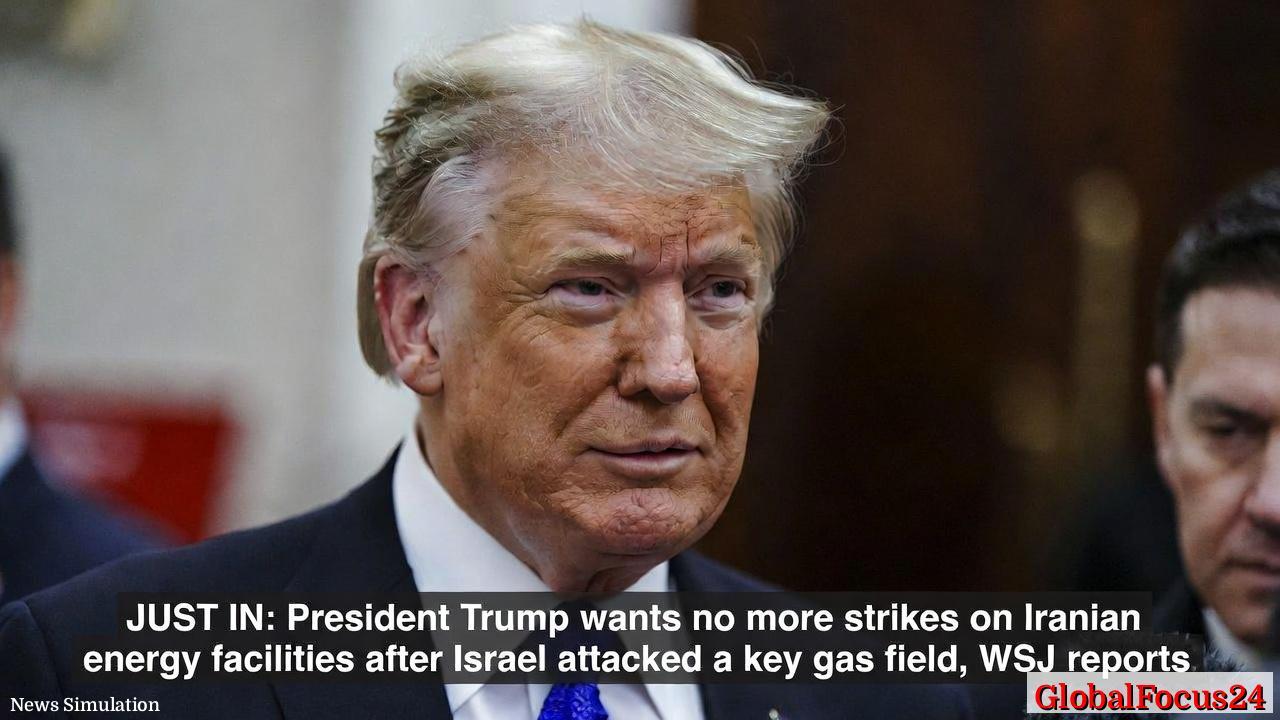
Trump Calls for Restraint After Israeli Strike on Iranian Gas Facility
U.S. President Urges Halt to Further Military Action
U.S. President Donald Trump has urged restraint following an Israeli airstrike on Iran’s South Pars gas field, signaling a shift in Washington’s posture amid rising tensions in the Persian Gulf. The attack, which occurred early Wednesday, targeted one of the world’s largest natural gas fields — a vital energy hub shared by Iran and Qatar — and was viewed as a direct message to Tehran after its blockade of the Strait of Hormuz disrupted global shipping lanes.
While President Trump reportedly supported the Israeli operation before it was launched, senior White House officials say he now believes the warning to Iran has been delivered and that continued strikes could risk a wider regional conflict. The administration’s new stance reflects concerns over economic stability, oil prices, and the potential for Iran to retaliate in ways that could threaten critical infrastructure across the Middle East.
The Strike on South Pars: A Strategic Target
South Pars is not just another energy site. It stands at the center of Iran’s gas production, accounting for roughly 70 percent of the country’s output. The field, discovered in 1990, stretches across the maritime border with Qatar, which refers to its side as the North Field. Together, the two form the largest natural gas reserve in the world.
Israeli aircraft reportedly struck compressor stations and pipeline facilities on the Iranian side of the field. Satellite imagery analyzed by regional monitoring groups showed fires and damage to surface installations, though the full extent of the disruption remains unclear. Iran’s Ministry of Petroleum described the attack as “limited in scope” and claimed emergency teams had contained the damage within hours.
Still, energy analysts caution that even minor hits to South Pars can ripple across global markets. “What matters is not just the physical damage, but the perception of vulnerability,” said an energy risk consultant based in Dubai. “Any strike on South Pars signals instability in the core of global gas supply.”
Tehran’s Response and Regional Fallout
Tehran has condemned the strike as “an act of aggression” and vowed consequences. Iranian state media reported increased deployments of anti-aircraft systems near key coastal installations. The Revolutionary Guard Corps issued a statement warning that “any further attack on Iranian energy assets will meet a decisive response.”
So far, however, Iran has refrained from direct retaliation. Analysts suggest the leadership in Tehran may be calculating that an escalation could weaken its own economic position. Already struggling with international sanctions and volatile oil revenues, Iran faces mounting pressure to keep exports flowing to friendly markets such as China, India, and Turkey.
Qatar, Iran’s co-owner of the South Pars field, publicly called for de-escalation. The Qatari foreign ministry issued a statement emphasizing that “regional cooperation is critical to maintaining global energy security,” an implicit reminder that the field lies at the heart of both countries’ prosperity. Doha’s reaction underscores its delicate balancing act — maintaining close ties with Western allies while sharing one of the world’s most valuable energy reservoirs with Tehran.
Energy Markets React to Growing Uncertainty
Following the strike, global energy markets reacted sharply. Brent crude prices jumped by nearly 5 percent in early trading, reaching a six-month high, while liquefied natural gas (LNG) futures rose amid fears of supply interruptions. Investors worried the incident could trigger further attacks on Persian Gulf energy infrastructure, from Saudi Arabia’s oil installations to Qatari export terminals.
The Strait of Hormuz, a narrow waterway through which about one-fifth of the world’s oil passes, remains a point of acute vulnerability. Iran’s earlier blockade — reportedly through naval exercises and restrictions on tanker movements — had already driven insurance premiums higher for shipping companies. The Israeli strike, intended to deter Tehran from such maneuvers, instead heightened investor anxiety over an already fragile global energy network.
Economists warn that sustained disruption could hit major importers across Asia and Europe. “Any prolonged tension in the Gulf has a direct impact on inflation and energy costs globally,” said a senior economist at a London-based investment bank. “From households in Europe to manufacturing hubs in East Asia, everyone feels the ripple.”
Washington’s Recalibration and Diplomatic Tightrope
President Trump’s call to halt further attacks reflects growing unease in Washington about uncontrolled escalation. According to senior administration advisers, the president views the Israeli strike as a necessary but sufficient signal to Tehran, designed to deter without provoking outright conflict. “The message has been sent,” one official said. “The objective now is to prevent the situation from spiraling.”
The shift also reveals broader strategic calculations. U.S. officials have long sought to balance support for Israel’s security with the need to maintain stability in global energy markets. Ongoing talks between Gulf Arab states and the United States about collective air defense arrangements could be complicated if open conflict erupts between Iran and Israel. Diplomats fear that additional strikes could derail months of quiet regional contact aimed at avoiding exactly this kind of confrontation.
Western allies, including the United Kingdom and France, have called for restraint on all sides. The European Union issued a statement urging “maximum moderation” and underscoring the importance of maintaining open navigation through the Strait of Hormuz. China and India, both heavily dependent on Gulf energy imports, have echoed similar appeals for calm.
Historical Echoes of Past Conflicts
The shadow of past Gulf crises looms large over this episode. The current tensions echo earlier confrontations in 2019 and 2020, when attacks on Saudi oil facilities at Abqaiq and Khurais temporarily cut global production and triggered spikes in crude prices. Then, as now, strategic strikes on energy assets served as geopolitical signals as much as military actions.
Going further back, the Iran-Iraq War of the 1980s saw the “Tanker War” phase, when hostilities in the Persian Gulf led to frequent attacks on shipping. The legacy of those decades still informs regional security thinking, with Gulf states viewing energy infrastructure as both an asset and a target in periods of heightened conflict.
For Israel, Wednesday’s operation fits a pattern of preemptive and deterrent military activities. In recent years, Israel has targeted Iranian proxies and assets across Syria and Iraq, aiming to contain Tehran’s regional influence. But a direct hit on Iranian territory — especially one tied to critical energy infrastructure — marks a notable escalation.
Regional Comparisons and Global Stakes
To understand the stakes, analysts often compare South Pars to key gas developments elsewhere. Qatar’s portion of the field supplies LNG to nearly every continent, accounting for roughly 20 percent of global exports. In comparison, the U.S. shale boom transformed North American supply chains but remains insulated from the Middle East’s immediate volatility. Europe, still recovering from disruptions in Russian gas supplies, now faces renewed uncertainty just as it attempts to stabilize imports through alternative routes and producers.
In this intricate balance, the Persian Gulf’s energy output remains irreplaceable. Unlike in other regions, redundancy is minimal: pipelines are vulnerable, and shipping routes narrow to chokepoints like the Strait of Hormuz and the Bab el-Mandeb. Any military flare-up risks not just local consequences but reverberations in electricity prices, industrial supply chains, and global inflation rates.
Domestic Reactions and Political Implications
Within the United States, reactions to Trump’s position have been mixed. Some lawmakers praised his caution, describing it as a pragmatic decision to avoid deeper entanglement in Middle Eastern conflicts. Others criticized the administration for what they view as inconsistency — backing an allied strike only to call for restraint afterward. For the broader public, rising fuel prices and concerns about global stability may prove more tangible than diplomatic nuance.
In Israel, officials framed the operation as a defensive measure to reassert deterrence against Iran’s actions in the Strait of Hormuz. Public reaction there was largely supportive, with opinion polls showing majority approval of firm action in response to Iranian provocations. However, some policy analysts warned that further escalation could strain Israel’s relations with Gulf partners that have quietly expanded cooperation in recent years.
Meanwhile, Iranian media portrayed the attack as evidence of Western aggression, with nightly broadcasts emphasizing national resilience and the continuity of gas production. The government has sought to project calm, but unverified reports suggest patrols and air defenses remain on high alert.
Looking Ahead: Cautious Calm or the Next Flashpoint?
As diplomatic channels buzz and energy markets adjust, the world watches for what comes next. For now, Iran appears to be recalibrating its response, aware that overreaction could invite broader retaliation or sanctions. Israel, having made its point, is likely to pause further operations under U.S. pressure. But the structural drivers of tension — rivalry over shipping lanes, nuclear ambitions, and proxy conflicts — remain unresolved.
President Trump’s appeal for restraint may mark a temporary pause, not a permanent solution. The strike on South Pars has reminded world leaders how fragile the balance remains in the Persian Gulf — a region where energy wealth and strategic geography continually collide with geopolitical ambition.
With each flare-up, the world edges closer to testing that balance again. Whether this latest episode becomes a turning point or just another chapter in the long history of Gulf tensions depends on what all sides choose to do next.