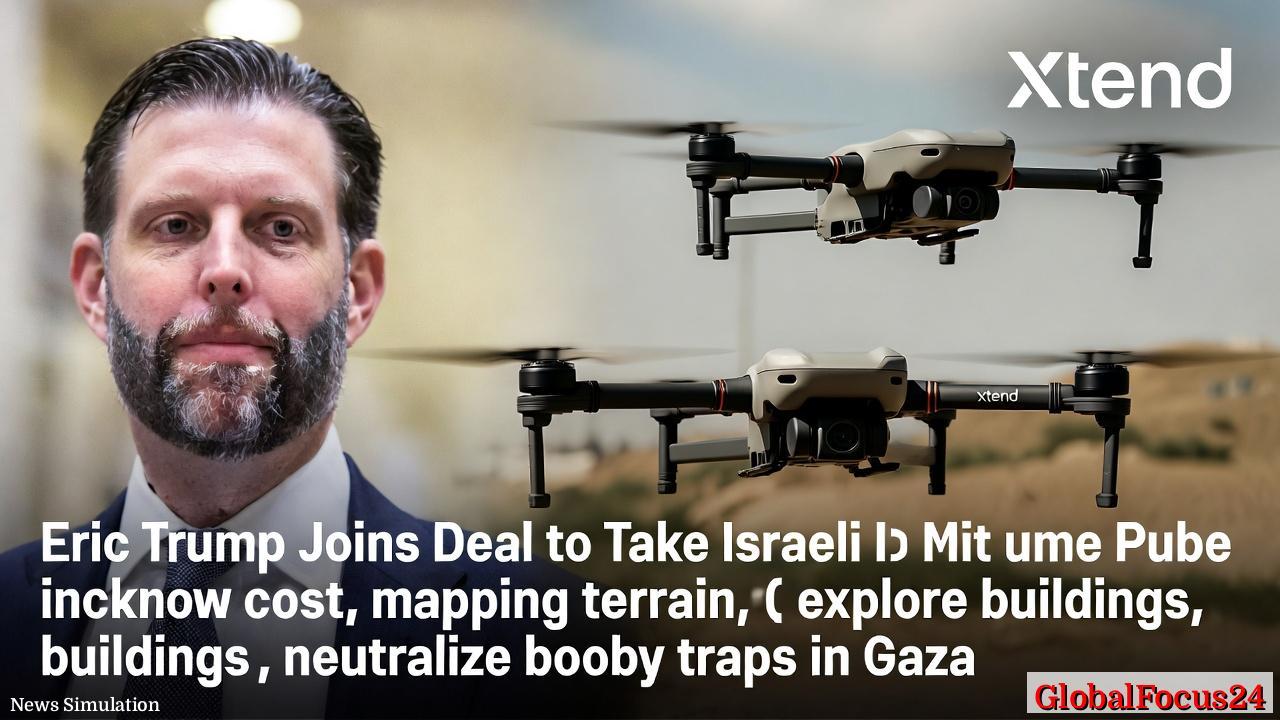
Eric Trump-Backed Israeli Drone Firm Sets $1.5 Billion Merger to Go Public in U.S. Market
In a move that blends strategic investment with a push into U.S. capital markets, Xtend, an Israeli drone developer known for low-cost unmanned systems, is merging with JFB Construction, a Florida-based contractor, in a transaction valued at approximately $1.5 billion. The deal aims to bring Xtend’s technology to the public arena through a merger with a smaller domestic SPAC-like partner, expanding manufacturing footprints in the United States and accelerating access to American investors and regulatory processes. The arrangement includes a private placement that features strategic investments from Eric Trump, alongside other participants tied to the broader Trump family commerce network.
Historical context and industry backdrop Drone technology has evolved from a niche military capability to a broad national security and industrial tool over the past decade. Early reliance on high-cost, complex platforms gradually gave way to modular, cost-effective systems designed for reconnaissance, mapping, and targeted operations in contested environments. Xtend’s business model reflects this shift: the company emphasizes affordability and rapid deployment, offering “low cost-per-kill” configurations that can be operated by smaller tactical units. While these capabilities have clear wartime utility—such as terrain mapping, building exploration, and penetrating tunnel networks—the commercial and geopolitical implications are far-reaching, including export controls, end-use monitoring, and adherence to international treaties governing armed drones.
From a regional perspective, Israel has cultivated a robust defense technology ecosystem, leveraging a strong industrial base, close defense collaboration with Western partners, and a highly skilled workforce. The country’s drone sector has drawn significant investment, government support, and strategic partnerships with multinational manufacturers. Xtend’s trajectory—moving toward U.S. production facilities and public markets—fits into a broader pattern of tech-enabled defense providers seeking proximity to American capital and procurement channels. This trend has been reinforced by the Defense Department’s ongoing interest in accelerating access to innovative unmanned systems, with multiple programs designed to promote rapid prototyping, production scaling, and domestic manufacturing capabilities.
Economic impact and manufacturing expansion The planned merger with JFB Construction is presented as a pathway to scale Xtend’s manufacturing operations in the United States, including the construction of a new facility in Florida. Florida’s business climate, logistics access to Atlantic ports, and talent pool in engineering and manufacturing all factor into the rationale for site selection. If realized, the investment could create jobs, stimulate ancillary industries in the supply chain, and bolster regional competitiveness in a sector characterized by steep upfront costs and long development cycles.
Beyond job creation, the merger is positioned to influence the broader supply chain for defense tech. Domestic production capabilities are increasingly prioritized by policymakers seeking to reduce dependency on overseas suppliers and to ensure resilience in critical technological sectors. Xtend’s U.S. manufacturing footprint could also encourage local suppliers, test facilities, and maintenance ecosystems that support ongoing readiness for allied defense needs. Nonetheless, the economics of drone production—where government contracting, certification regimes, and export controls shape revenue streams—mean that long-run profitability depends on securing enforceable contracts, consistent demand, and reliable export compliance.
Regional comparisons and market dynamics When compared to peers in the North American drone space, Xtend’s emphasis on affordability and modularity aligns with a broader market trend toward scalable, field-ready systems rather than high-end, specialized platforms. In the United States, domestic drone firms have benefited from a combination of public procurement programs, private investment, and academic-industry partnerships that accelerate rapid development and field deployment. By pursuing a public listing through a merger, Xtend seeks to harness the capital markets to fund scale, manufacturing capacity, and potential international distribution streams.
Regionally, the integration of Xtend into a U.S.-based corporate structure could intensify competition with other drone manufacturers and defense tech firms that have diversified their operations across North America and Europe. Companies with established manufacturing bases and diversified product lines may offer stronger resilience amid regulatory changes, pricing pressures, and shifts in defense budgets. In this context, Xtend’s strategy of combining cost-effective hardware with a pathway to public markets provides a distinct value proposition, albeit one that will require careful navigation of export controls, defense-related compliance, and potential political scrutiny.
Public markets, governance, and strategic considerations The merger involves a private placement and the involvement of notable investors who have ties to prominent business networks. Strategic investments from Eric Trump and others underscore the potential for high-profile attention, regulatory oversight, and heightened public interest. Governance arrangements, board composition, and robust compliance frameworks will be essential to ensure transparency and to address concerns about conflicts of interest that often arise when well-known political figures participate in private-sector ventures with national security implications.
From a corporate governance perspective, the deal also raises questions about risk management in high-stakes markets. Drones deployed for defense purposes sit at the intersection of technology, ethics, international law, and public policy. Ensuring a clear chain of custody for technology, rigorous end-use monitoring, and robust export licensing processes will be critical to maintaining investor confidence and safeguarding against misuse or regulatory sanctions.
Operational strategy and technology roadmap Xtend has positioned its product line around rugged, low-cost unmanned systems capable of supporting tactical teams in complex environments. The technology suite often includes terrain mapping, building reconnaissance, and navigation in subterranean settings, with configurations designed for compatibility with existing field procedures and intelligence workflows. The push to manufacture in the United States is not merely about location—it signals an intention to integrate Xtend’s platforms with U.S. logistics, maintenance, and after-sales support networks. Such integration is crucial for ensuring reliability, faster deployment, and streamlined training programs for allied partners.
Investment narrative and investor considerations For investors, the merger represents exposure to a growing domain within defense tech characterized by recurring revenue from maintenance, spares, software updates, and potential recurring contracts through government programs. Currency risk, technology transfer controls, and geopolitical dynamics will influence risk-adjusted returns. Prospective investors will watch how Xtend navigates certification processes, ETL standards for equipment used in hostile environments, and long-cycle procurement timelines that can affect cash flow.
Public reaction and societal context Public sentiment toward drone technology in modern warfare is nuanced. While the promise of enhanced situational awareness and operational efficiency is widely recognized in defense planning, concerns about escalation, civilian safety, and dual-use vulnerabilities persist. When high-profile figures participate in defense-related ventures, media scrutiny often increases, prompting closer examination of potential conflicts of interest, governance safeguards, and the balance between national security imperatives and market-driven incentives.
Operational milestones and timeline Key milestones to monitor include regulatory approvals for the merger, the successful establishment of the Florida manufacturing facility, and the ramp-up of production capacity to meet anticipated demand from U.S. and allied customers. The timing of stock market listing, capital deployment for plant construction, and integration with JFB’s operations will shape Xtend’s ability to scale efficiently and deliver on projected revenue streams.
Environmental, social, and governance considerations As with many defense-tech entities, ESG factors intersect with supply chain integrity, worker safety, and ethical deployment considerations. Responsible sourcing of materials, rigorous safety protocols in manufacturing and field operations, and transparent reporting on end-use controls are increasingly part of the expectations that investors and regulators place on sector players. Public-facing disclosures related to export compliance, risk management, and stakeholder engagement can provide clarity in an industry where technology with dual-use applications can raise complex questions about accountability.
Conclusion and outlook The $1.5 billion merger between Xtend and JFB Construction, reinforced by strategic investments from members of the wider business network connected to the Trump family, signals a notable moment for a defense-tech player pursuing U.S. manufacturing expansion and public-market access. The deal’s success will hinge on navigating regulatory oversight, achieving scale in production, and sustaining demand across domestic and allied defense programs. As drone technology continues to influence modern warfare and security strategy, Xtend’s trajectory will be watched as a barometer of how smaller, cost-effective unmanned systems can transition from experimental deployments to essential components of integrated defense ecosystems.
Public policy implications and industry-wide trends The broader industry implications include a renewed emphasis on onshore production, standardized testing, and streamlined procurement processes that align with national security priorities. Policymakers are increasingly attentive to the balance between encouraging technological innovation and maintaining rigorous safeguards against misuse. For the sector, the evolution toward domestic manufacturing and public investment channels highlights an enduring shift: innovation thrives when it is paired with robust regulatory clarity, disciplined governance, and transparent collaboration between defense contractors, government agencies, and the investment community.
In the near term, Xtend’s public-market milestone could attract additional capital as investors seek exposure to a sector with a mix of defense applications, humanitarian considerations, and commercial potential in industrial inspection, disaster response, and infrastructure monitoring. While the immediate impact of the merger on warfare outcomes cannot be overstated, the long-run effect will hinge on commercial viability, regulatory stability, and the company’s ability to translate advanced capabilities into reliable, scalable products that serve national security interests while upholding international norms.