Trump Issues Sharp Rebuke of Iran’s Negotiation Strategy, Signals Harder Line in Future Talks
Renewed Tensions Mark Latest Chapter in U.S.-Iran Relations
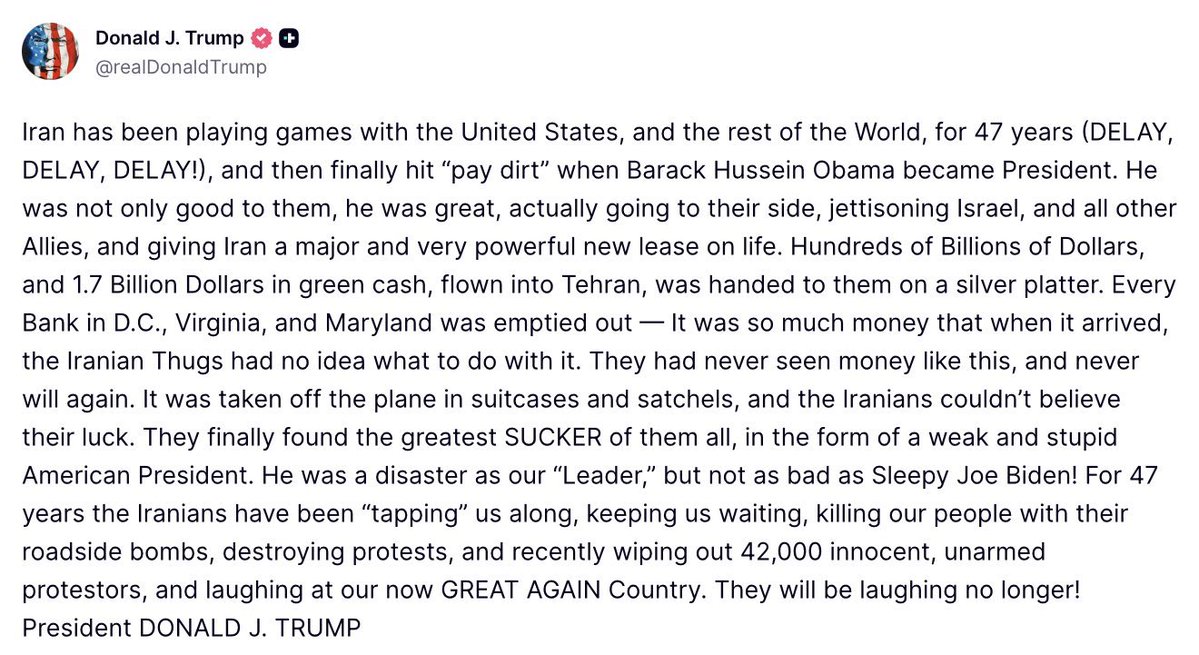
WASHINGTON — President Donald J. Trump has issued a forceful statement condemning Iran’s long-standing approach to negotiations with the United States, intensifying rhetoric that signals a potential shift toward a more confrontational diplomatic posture. The remarks, released late Sunday, reflect deepening frustration with what Trump described as decades of delay tactics and strategic maneuvering by Tehran.
In his statement, Trump accused Iran of “playing games” with successive U.S. administrations for nearly half a century. He pointed specifically to what he characterized as prolonged negotiation cycles, stalled agreements, and a pattern of extracting concessions without delivering meaningful compliance. The language underscores a broader recalibration in Washington’s tone toward Tehran, as policymakers grapple with evolving geopolitical realities in the Middle East.
Revisiting the 2015 Nuclear Deal
Central to Trump’s criticism was the Joint Comprehensive Plan of Action (JCPOA), the 2015 nuclear agreement negotiated under President Barack Obama. Trump reiterated his longstanding opposition to the deal, arguing that it provided Iran with substantial financial resources without sufficiently curbing its nuclear ambitions or regional activities.
The agreement, designed to limit Iran’s nuclear program in exchange for sanctions relief, unlocked billions of dollars in previously frozen assets. Trump’s statement highlighted this financial component, claiming that Iran received “hundreds of billions of dollars” along with $1.7 billion in cash payments. While the specifics of these figures have been debated by analysts, the broader economic impact of sanctions relief is widely acknowledged.
At the time, supporters of the JCPOA argued that the deal represented a pragmatic step toward reducing nuclear proliferation risks. Critics, including Trump, maintained that it failed to address Iran’s ballistic missile program and its involvement in regional conflicts. The agreement ultimately unraveled after the United States withdrew in 2018 during Trump’s first administration, reimposing sanctions and triggering a series of escalatory responses from Iran.
Historical Context: Decades of Diplomatic Friction
U.S.-Iran relations have been marked by tension since the 1979 Iranian Revolution, which led to the overthrow of the U.S.-backed Shah and the establishment of the Islamic Republic. The subsequent hostage crisis, in which 52 American diplomats were held for 444 days, set the tone for decades of mistrust and limited direct engagement.
Over the years, multiple attempts at diplomatic engagement have alternated with periods of heightened hostility. Sanctions, proxy conflicts, and disputes over nuclear development have defined the bilateral relationship. Trump’s statement draws on this historical backdrop, framing current negotiations as part of a broader pattern rather than an isolated challenge.
Economic Implications of Renewed Pressure
The renewed hardline rhetoric could carry significant economic consequences, particularly for global energy markets and regional trade. Iran remains a major player in the oil sector, holding some of the world’s largest proven reserves. Sanctions targeting its energy exports have historically influenced global oil prices, often contributing to volatility.
A more confrontational U.S. stance may lead to stricter enforcement of existing sanctions or the introduction of new measures. This could further constrain Iran’s economy, which has already faced inflation, currency depreciation, and reduced foreign investment in recent years.
At the same time, global markets are closely monitoring potential disruptions to supply chains in the Persian Gulf. Any escalation in tensions could impact shipping routes, particularly through the Strait of Hormuz, a critical chokepoint for global النفط transportation. Energy analysts note that even the perception of instability in the region can drive price fluctuations, affecting consumers and industries worldwide.
Regional Comparisons and Strategic Dynamics
Iran’s position in the Middle East is shaped by its complex relationships with neighboring countries and its involvement in regional conflicts. Compared to Gulf states such as Saudi Arabia and the United Arab Emirates, which maintain close ties with the United States, Iran operates within a different strategic framework, often aligning with non-state actors and pursuing asymmetric tactics.
Trump’s remarks also highlight concerns about Iran’s regional influence, including its support for allied groups across Iraq, Syria, Lebanon, and Yemen. These dynamics contribute to a broader geopolitical competition that extends beyond bilateral negotiations with Washington.
In contrast, diplomatic approaches in other regions have yielded varying results. For example, negotiations with North Korea have followed a different trajectory, characterized by direct leader-to-leader engagement and high-profile summits. While outcomes have been mixed, the comparison underscores the diversity of diplomatic strategies employed by U.S. administrations.
Human Rights Concerns and Domestic Pressures
The statement also referenced allegations of human rights abuses within Iran, including the suppression of protests. Trump cited reports of thousands of civilian deaths, framing the issue as part of a broader critique of the Iranian government’s actions.
Human rights organizations have documented incidents involving the use of force against demonstrators, particularly during periods of economic unrest. These concerns add another layer of complexity to negotiations, as policymakers balance strategic interests with advocacy for civil liberties.
Domestically, Iran faces ongoing economic challenges and public dissatisfaction, factors that may influence its negotiating position. Analysts suggest that internal pressures could either encourage compromise or lead to more rigid stances, depending on how leadership perceives external threats.
Signals of a Policy Shift
Trump’s latest statement may signal a return to a more assertive U.S. policy toward Iran, emphasizing deterrence and leverage over diplomatic compromise. During his previous administration, this approach was encapsulated in the “maximum pressure” campaign, which sought to compel Iran to renegotiate terms through economic isolation.
Whether this strategy will be revived in full remains unclear, but the rhetoric suggests a willingness to adopt tougher measures if negotiations do not yield desired outcomes. Observers note that such an approach could reshape diplomatic dynamics, potentially prompting responses from both allies and adversaries.
Public and International Reaction
Reaction to Trump’s statement has been mixed, reflecting broader divisions over how best to address Iran’s nuclear program and regional activities. Some analysts view the remarks as a necessary recalibration aimed at strengthening U.S. negotiating power. Others caution that heightened rhetoric could reduce opportunities for dialogue and increase the risk of miscalculation.
International stakeholders, including European allies, have traditionally favored a more measured approach, emphasizing multilateral engagement and incremental progress. The divergence in strategies highlights the challenges of maintaining a unified front in addressing complex global issues.
Outlook for Future Negotiations
The path forward for U.S.-Iran relations remains uncertain, shaped by a combination of diplomatic efforts, economic pressures, and regional developments. Trump’s statement underscores the enduring challenges of negotiating with a longstanding adversary while balancing competing priorities.
As policymakers assess next steps, key questions include whether renewed talks can bridge longstanding gaps, how economic measures will influence Iran’s decision-making, and what role international partners will play in shaping outcomes. The answers will likely determine not only the trajectory of bilateral relations but also the broader stability of the Middle East.
In the meantime, the latest developments serve as a reminder of the enduring complexity of U.S.-Iran relations, where history, economics, and geopolitics intersect in ways that continue to shape global affairs.