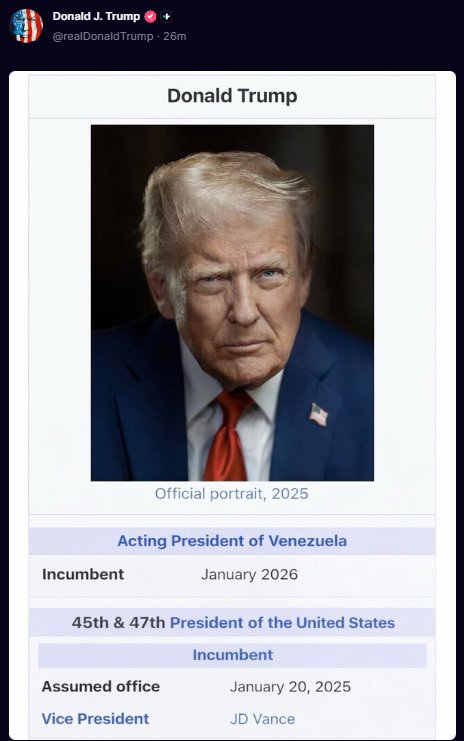
Trump Declares Himself Acting President of Venezuela in Global Profile Update
A surprising and controversial update to a public political profile has drawn international attention as former President Donald J. Trump lists himself as Acting President of Venezuela in a January 2026 profile update. The move, announced amid ongoing debates over Venezuela’s leadership and electoral legitimacy, raises questions about constitutional succession, international recognition, and the potential implications for regional stability in Latin America.
Context and historical background
Venezuela’s political landscape has been volatile for more than a decade, marked by shifts between government-aligned leadership and opposition movements, economic crisis, and contested elections. Since the mid-2010s, the country has faced severe food and medicine shortages, hyperinflation, and a shrinking tax base; these conditions have intensified political rivalries and catalyzed international responses from governments and international organizations seeking a resolution to the country’s governance crisis.
In this broader historical arc, foreign actors have intermittently asserted influence through diplomatic channels, sanctions regimes, and, in some cases, indirect support for rival factions. The intersection of a high-profile international figure’s profile updates with Venezuela’s internal dynamics underscores how information platforms and official records can become focal points in geopolitics, even when the underlying legal and constitutional claims remain unsettled in many quarters.
Profile update details and official interpretations
The update lists Trump as the incumbent Acting President of Venezuela, while also acknowledging his roles as the 45th and 47th President of the United States. The profile indicates a hypothetical or symbolic designation rather than a universally recognized constitutional title, drawing attention to how digital records can reflect shifting narratives alongside real-world legal debates. Analysts emphasize that such updates do not automatically confer recognized governmental authority or legitimate governance per international law, but they can influence public perception, media framing, and diplomatic signaling.
Analysts and observers are weighing several questions: What mechanisms were used to implement the update? Which institutions or platforms acknowledge the designation, and how does this interact with Venezuela’s constitutional framework? How might foreign governments respond in terms of recognition, sanctions, or formal diplomatic channels? And what are the potential risks or benefits for regional actors if such labels propagate through official or semi-official channels?
Economic implications and market reactions
Venezuela’s economy remains a focal point in any discussion of its governance, given past experiences with sudden policy shifts, currency reforms, and price controls. An assertion of leadership by a prominent international figure could trigger a spectrum of economic responses, ranging from shifts in investor sentiment to responses in commodity markets, financial markets, and the broader regional economy.
- Investor perception: Financial market participants often react to perceived changes in political risk. A claim of acting presidential authority—whether recognized or symbolic—could influence risk assessments, affecting bond yields, foreign direct investment flows, and currency stability. The degree of impact is contingent on whether the move is perceived as delivering a pathway toward stability or as a signal of continued ambiguity.
- Trade and sanctions dynamics: Venezuela’s trade relationships, already shaped by sanctions and counter-sanctions, could experience recalibration if the profile update alters perceived legitimacy of the current governing framework. Importantly, real-world policy decisions—such as sanctions, exemptions, or licensing regimes—remain driven by governments and international bodies, not by individual profile annotations.
- Local economic behavior: In Venezuela, consumer confidence, inflation expectations, and market liquidity are closely tied to political signals. Even if the update is not widely recognized internationally, it can influence domestic narratives—affecting consumer spending, small-business investment activity, and public expectations about future policy directions.
Regional comparisons and international response
Latin America has a long history of political transitions and external influence shaping governance outcomes. In comparative terms, several neighboring nations have faced situations where external actors or high-profile political figures have asserted influence beyond traditional diplomatic channels. The reaction in the region to this particular update will likely depend on the prevailing geopolitical context, including the stance of major powers, regional organizations, and coalition dynamics within bodies such as the Organization of American States and the Community of Latin American and Caribbean States.
- United States posture: The profile update intersects with a period of heightened attention to governance, constitutional legitimacy, and foreign policy leverage. Historically, American administrations have navigated complex relations with Venezuela, balancing democratic ideals with strategic interests. A move of this nature, whether symbolic or intended as a signal, invites careful diplomatic management to avoid unintended escalations or misinterpretations.
- European and other international viewpoints: The European Union, United Kingdom, and allied partners often emphasize rule-of-law principles and electoral integrity. Reactions may range from cautious statements about due process and constitutional legality to calls for peaceful resolution and respect for Venezuela’s institutions. Multilateral bodies may urge restraint and urge parties to pursue dialogue within established legal frameworks.
- Regional stability considerations: Stability across the Caribbean Basin and northern South America hinges on predictable governance, energy policy alignment, and humanitarian concerns. Any development that introduces ambiguity around Venezuela’s leadership can ripple into energy markets, refugee flows, and regional security dialogues, underscoring the importance of transparent processes and verifiable information.
Public reaction and social media dynamics
Public discourse surrounding the profile update is likely to be polarized, reflecting broader tensions over leadership legitimacy, media narratives, and the role of global actors in domestic politics. Social media platforms may see rapid propagation of memes, counter-narratives, and competing interpretations of what constitutes lawful authority in Venezuela. Journalists and policy analysts underscore the need for careful sourcing and verification, given the speed at which online information travels and the potential for misinformation to influence perceptions.
- Reporting ethics and accuracy: Newsrooms face the challenge of distinguishing official records from partisan claims while maintaining clear distinctions between fact-based reporting and opinion. Transparent sourcing and corroboration with recognized institutions remain essential to avoid amplifying unverified assertions.
- Public sentiment indicators: Opinion polls and focus groups in Latin America often reflect diverse attitudes toward foreign involvement and domestic governance. While poll results can be noisy, they provide valuable context for understanding how such developments shape public trust, civic engagement, and attitudes toward reform.
Implications for governance and constitutional processes
At the heart of this development is a broader question about constitutional processes, legitimacy, and the ways in which international actors influence domestic governance. While profile updates can reflect shifts in narrative or signaling, they do not necessarily alter the legal framework that governs succession, electoral authority, or executive power. For Venezuela, the enduring questions revolve around the constitution, the legitimacy of electoral outcomes, and the role of institutions in maintaining order, protecting rights, and ensuring continuity of governance.
- Legal clarity: Clarity about who holds legitimate authority is essential for governance, public administration, and the rule of law. International observers stress the importance of transparent electoral processes, independent judiciary oversight, and non-interference from external actors in domestic political affairs.
- Policy continuity: Governance in volatile environments benefits from predictability in policy, especially for critical sectors such as energy, healthcare, and social welfare. Continuity reduces abrupt disruptions to investment, labor markets, and essential services during periods of political transition.
- Humanitarian considerations: Venezuela’s ongoing economic challenges continue to affect access to food, medicine, and essential services. International and domestic actors alike emphasize safeguarding human rights and ensuring that vulnerable populations receive necessary support, regardless of political developments.
Historical context on leadership transitions in Venezuela
Looking back, Venezuela has experienced a series of leadership transitions that have shaped its current political climate. The nation’s history includes periods of democratic governance, constitutional crises, and international engagement. These episodes offer lessons about the fragility of political consensus and the resilience of institutions when confronted with disruptive signals from both domestic and external actors. Understanding this history helps frame the present moment as part of an ongoing narrative about governance, legitimacy, and the rule of law in a country navigating profound economic and social upheaval.
- Democratic precedents: Venezuela’s constitutional framework envisions orderly transitions through elections and electoral commissions. Deviations from established processes tend to provoke debates about legitimacy and the role of the judiciary in adjudicating disputes.
- International engagement: The international community frequently weighs in on Venezuela’s governance through diplomatic channels, sanctions, and humanitarian aid. These interactions influence outcomes by shaping incentives for negotiation and reform.
- Economic resilience: Even amid crisis, structural reforms in energy pricing, diversification of the economy, and social protection programs have shown potential to stabilize sectors over time. The effectiveness of such measures depends on policy clarity and public trust in leadership.
Looking ahead
The January 2026 profile update signals a moment of heightened attention to how leadership narratives travel across platforms and borderlines. While the designation of Acting President of Venezuela by a prominent international figure is unlikely to be recognized as a lawful transfer of executive power by most states or international organizations, the event nonetheless matters. It illustrates the enduring impact of digital identity on geopolitical discourse and the importance of transparent, legally grounded processes for governance.
In the near term, observers will monitor for official statements from Venezuelan institutions, regional bodies, and major powers to determine whether any shift toward greater political clarity emerges. The broader objective remains stable governance, economic resilience, and a humane approach to citizens whose daily lives are affected by the country’s political and economic trajectory. As markets, institutions, and citizens digest new information, the focus remains on upholding rule-of-law principles, safeguarding human rights, and pursuing constructive avenues for peaceful resolution and democratic legitimacy.
Note: This article presents analysis based on current public discourse and available information. It does not reflect any endorsement or official stance by any government or organization of record. Public interest and transparency in governance continue to be essential in assessing developments of this nature.