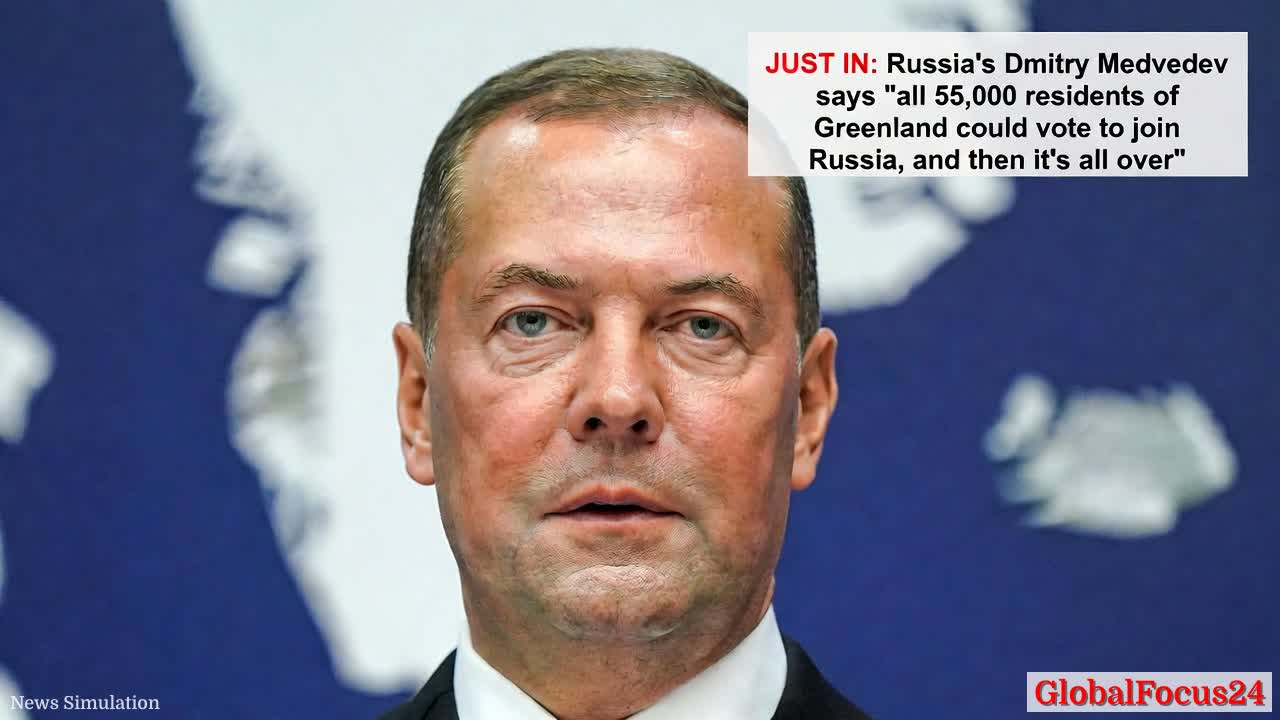
Medvedev’s Greenland Remark Draws Global Attention as Geopolitical Tensions Rise
A provocative remark attributed to Russia’s former president and current Security Council deputy chairman, Dmitry Medvedev, has resurfaced international curiosity about Greenland’s political status. In a social-media era where strategic maneuvering over Arctic resources and security access is increasingly routine, Medvedev’s comment—suggesting Greenland’s roughly 55,000 residents could vote to join Russia—has sparked debate about what such rhetoric means in practice, and how neighboring powers may respond in the coming years. While the remark appears to be a blustery facial expression rather than a formal policy initiative, it underscores the enduring relevance of Greenland in global strategic calculations and energy economics.
Historical context: Greenland in the larger Arctic narrative
Greenland’s status has long occupied a unique niche in international affairs. As the world’s largest island, Greenland sits atop significant mineral and energy potential, including rare-earth elements, uranium, hydrocarbons, and vast untapped offshore resources in the Arctic Circle. Its home rule, established in 1979 and expanded in 2009, grants Greenland a high degree of autonomy while acknowledging Denmark’s overarching constitutional framework. This arrangement has allowed Greenland to pursue substantial domestic governance, infrastructure development, and economic diversification, even as Denmark maintains defense and some foreign-policy responsibilities.
Historically, Greenland’s geopolitical relevance has ebbed and flowed with ice-sheet dynamics, shipping routes, and access to strategic chokepoints. The Arctic has long been a theater for great-power competition, from early 20th-century prospecting to 21st-century discussions about military presence, environmental stewardship, and critical-mineral supply chains. Greenland’s political identity—rooted in a strong sense of local autonomy and cultural heritage—has buffered the territory from being easily subsumed into a larger power’s orbit, even as external actors have sought influence through economic partnerships and security arrangements.
Economic impact: What Greenland means for regional and global markets
From an economic perspective, Greenland’s value lies in several overlapping domains:
- Natural resources and minerals: Greenland holds estimated reserves of rare-earth elements, rare metals essential to modern electronics and defense technologies, and potential hydrocarbon deposits. While many projects face environmental and logistical challenges, discoveries fuel investor interest and regional development plans.
- Fisheries and food security: The Greenlandic economy features a robust fishing sector that contributes significantly to local livelihoods and export earnings. Sustainable management of fisheries supports balanced growth and regional food security.
- Renewable energy and infrastructure: The territory’s substantial hydropower potential, combined with wind and other renewable resources, positions Greenland as a potential hub for green-energy initiatives that could power local communities and downstream markets.
- Tourism and cultural exchange: As Arctic intrigue grows, Greenland’s landscapes attract researchers, ecotourists, and adventure travelers. Responsible tourism can contribute to employment and branding of Greenland as a pristine, scientifically valuable destination.
Regional comparisons highlight Greenland’s distinctive path. Neighboring Arctic economies—such as Canada, Norway, and parts of northern Europe—have pursued varied mixes of resource development, indigenous rights, and sustainable-watershed policies. Greenland’s approach emphasizes local governance and a gradual, rights-respecting expansion of economic activity, balancing resource extraction with environmental stewardship and cultural preservation.
Geopolitical implications: Why any mention of joining Russia matters
Medvedev’s comment, while unlikely to reflect a concrete policy pathway, illustrates how Arctic politics intertwine with broader great-power competition. A few factors shape the significance of such rhetoric:
- Deterrence and signaling: In a region where security interests increasingly overlap with commercial activity, statements about territorial status can function as deterrent signals or bargaining chips. They sometimes reveal underlying anxieties about access to resources, alliance realignments, or naval and air defense arrangements.
- Alliance and alliance-formation dynamics: Greenland’s relationships with Denmark, the United States, and other NATO partners influence how external actors interpret provocative remarks. Any serious consideration of changing political status would involve complex legal frameworks, international treaties, and extensive stakeholder consultation.
- Resource sovereignty and environmental safeguards: As Arctic resource development intensifies, questions about who controls mining rights, licensing, and revenue distribution become central. Statements about joining a foreign power can ignite discussions about sovereignty, local governance, and the stewardship of fragile polar environments.
Public reaction and policy considerations
In Arctic communities, public sentiment on sovereignty, infrastructure development, and economic diversification is often nuanced. Residents weigh the potential benefits of greater investment and employment against concerns about cultural integrity, environmental risks, and the preservation of traditional livelihoods. National governments and regional authorities typically respond by highlighting legal frameworks, the importance of democratic processes, and commitments to indigenous rights and community consultation.
Any credible policy shift regarding Greenland’s status would likely involve a staged approach, including:
- Comprehensive feasibility studies and international legal assessments to understand implications for sovereignty, defense, and international relations.
- Public consultations and referenda with transparent, verifiable processes to reflect the will of Greenland’s people.
- Clear safeguards for environmental protection, cultural preservation, and local governance autonomy.
- Economic impact analyses to evaluate how any change might affect fisheries, mining, tourism, and energy infrastructure.
- Coordination among Denmark, Greenlandic authorities, and potential partner nations to ensure security and stability in the broader Arctic region.
Key data points shaping the current discourse
- Population and demography: Greenland’s population hovers around 56,000 people, with a strong majority residing along the coastline in towns and settlements connected by challenging terrain and seasonal accessibility.
- Resource potential: Estimates vary, but analysts emphasize the possibility of substantial mineral wealth and hydropower opportunities. Realizing these assets depends on infrastructure, investment, and regulatory clarity.
- Infrastructure constraints: Transportation, energy grids, and telecommunications in Greenland face high costs and logistical hurdles, influencing the economics of any large development project.
- Climate and environment: The Arctic’s evolving climate affects ice cover, shipping routes, and ecological systems, all of which bear on investment risk, permitting regimes, and long-term planning.
Public policy implications for Greenland and beyond
If Greenland were to pursue changes in its political alignment, regional policy would need to address several core areas:
- Economic resilience: Diversifying beyond traditional industries to include value-added processing, high-speed communications, and sustainable tourism would help stabilize the economy against commodity-price fluctuations.
- Indigenous rights and governance: Strengthening local representation in decision-making, protecting cultural heritage, and ensuring equitable distribution of benefits from resource development would be central to any transition.
- Security frameworks: Any redefined status would require careful negotiation of defense responsibilities, alliance commitments, and crisis-management protocols with neighboring powers and international organizations.
- Environmental stewardship: Stringent environmental safeguards and monitoring would be essential to protect Arctic ecosystems during exploration and development activities.
Conclusion: Navigating a complex Arctic future
Medvedev’s remark highlights the enduring sensitivity of Greenland’s status within the wider geopolitical arena. While it is unlikely that Greenland would imminently switch sovereign alignment, the episode reinforces how Arctic developments are inseparable from global strategic considerations. For observers and policymakers, the takeaway is clear: any meaningful discussion about Greenland’s future will demand careful legal scrutiny, inclusive local participation, and a balanced assessment of economic potential against environmental and cultural responsibilities.
As the Arctic continues to capture the world’s attention—driven by climate-driven accessibility, rising demand for critical minerals, and evolving defense postures—Greenland’s trajectory will remain a focal point of collaboration and contest. The region’s next steps will hinge on prudent governance, transparent decision-making, and steadfast commitment to the well-being of its communities, while the broader international community watches closely to understand how Arctic resources and governance will shape economic and strategic outcomes in the decades ahead.