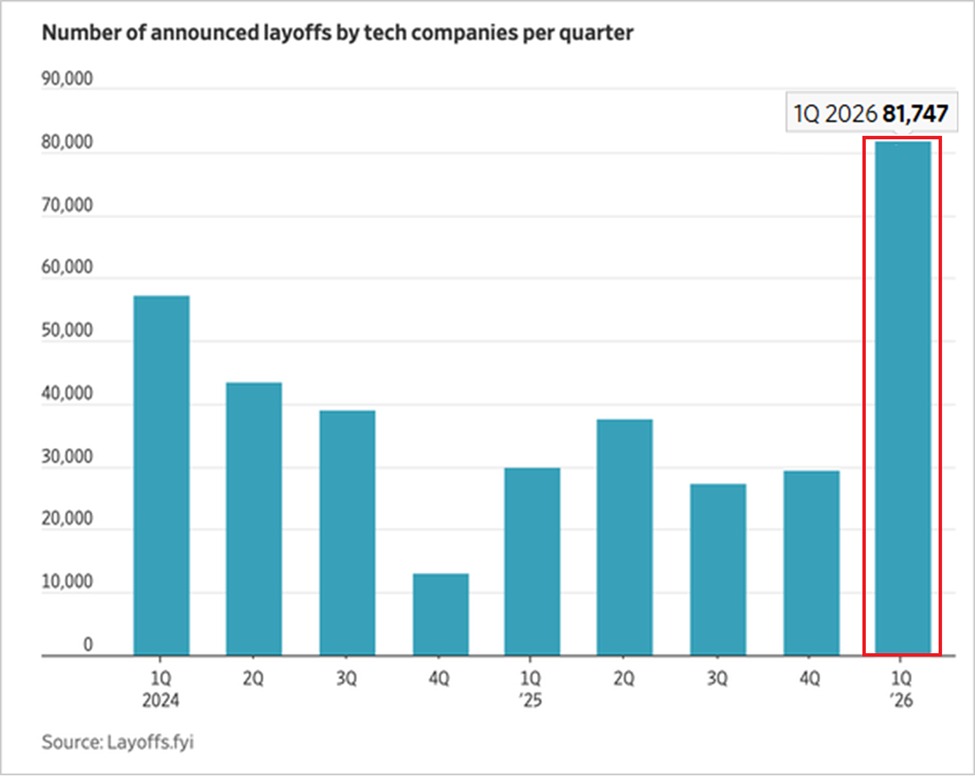
Tech Layoffs Surge in Q1 2026: A Turning Point in the Tech industry’s Reallocation to AI
The first quarter of 2026 marked a watershed moment for the technology sector as companies announced a staggering 81,747 layoffs, the highest quarterly total recorded since at least Q1 2024. This wave represents a sharp shift in corporate strategy, with many leaders reallocating capital from payroll toward investments in artificial intelligence infrastructure, including AI chips, data centers, and related support systems. The quarterly figure nearly doubled the previous quarter and surged by 580% from Q4 2025, signaling a pronounced reallocation of resources rather than a conventional cycle of hiring and firing.
A tale of a changing demand landscape and strategic emphasis
The data indicate a broader industry trend: the labor force in U.S. tech is shrinking as firms prioritize capital-intensive AI capabilities over expanding headcount. March alone accounted for 45,800 cuts, the largest single-month total for tech layoffs in at least two years. Analysts describe this period as a recalibration rather than a reset. While job reductions sting on local levels, they are accompanied by intensified investments in AI hardware, software platforms, and cloud infrastructure that are expected to underpin the next generation of digital products and services.
Historical context: cycles and structural shifts in tech employment
Historically, tech employment has swung with the dual forces of demand for new platforms and efficiency-driven cost management. The early 2020s featured rapid expansion in software services, cloud computing, and consumer tech, followed by tightening measures as market conditions shifted and macroeconomic pressures evolved. The current round of layoffs follows a pattern seen during prior major reconfigurations, where firms seek to hedge against volatility by building resilience around core AI capabilities. This cycle differs in that investment is increasingly front-loaded toward hardware acceleration, data center capacity, and high-performance computing, signaling a long-term structural shift rather than a short-term adjustment.
Economic impact: immediate and downstream effects
The immediate impact of the Q1 2026 layoff wave is bearable for thefigures but consequential for regional economies dependent on tech employment. Areas with dense tech ecosystems—including large metropolitan zones and university-rich corridors—are already feeling softer consumer spending, housing market adjustments, and shifts in service sector demand as former tech workers reallocate time and resources. In the short term, venture-backed startups and mid-market firms face tighter labor markets for specialized engineering roles, particularly those aligned with AI model development, data center operations, and AI safety and governance. However, the shift also brings longer-term economic implications:
- Capital reallocation toward AI infrastructure could spur growth in semiconductor manufacturing, hardware design, and cloud services, reinforcing a broader supply chain that underpins digital transformation across industries.
- Service and professional sectors may experience transitional demand as workers retrain, with surges in training programs, certification courses, and consulting focused on AI integration, compliance, and data privacy.
- Localized tax revenue fluctuations may occur as tech payrolls contract, underscoring the importance of state and municipal policy measures that support retraining, small business vitality, and regional innovation hubs.
Regional comparisons: where the impact is most felt
Different regions exhibit varying degrees of exposure to the current retrenchment. Tech hubs with heavy reliance on large employers may experience more pronounced near-term employment adjustments, while regions with diversified economies could buffer some effects. For example, coastal technology centers that combine engineering talent with venture ecosystems may observe quicker adaptation through re-skilling initiatives and proximity to AI research facilities. Inland regions, historically more dependent on manufacturing or other sectors, could see a slower but persistent realignment as tech roles become available in adjacent industries or as legacy IT roles migrate toward AI-enabled operations.
Corporate moves shaping the terrain
Two of the sector’s largest players have publicly outlined strategies reflecting the broader shift toward AI infrastructure:
- A major social media and technology company has announced an intention to reduce staff by approximately 8,000 positions as part of a broader plan to optimize operations and accelerate AI-driven initiatives. The move underscores a common pattern among large platform ecosystems, where user-scale operations increasingly hinge on AI-enabled content moderation, personalization, and system optimization.
- A diversified technology corporation is offering voluntary retirement packages to around 7% of its U.S. workforce, with the potential for additional reductions if participation remains below expectations. This approach illustrates how large incumbents balance workforce flexibility with workforce planning as they channel resources into data centers, AI accelerators, and software platforms that support next-generation products.
Industry-wide implications: capital allocation, skill demands, and resilience
As capital shifts from payroll to AI infrastructure, several enduring implications emerge:
- Capital intensity and productivity: AI-forward initiatives demand substantial investments in specialized hardware, including AI accelerators and high-speed networking. Firms believe these investments will yield longer-term productivity gains, even if they temporarily compress employment.
- Skill transformation: The demand for talent is evolving from traditional software development and IT operations toward roles focused on AI model development, data governance, systems integration, and AI ethics. This has intensified the need for retraining programs, certifications, and cross-disciplinary collaboration.
- Supply chain dynamics: The push toward domestic or regional AI capabilities could influence the supply chain for semiconductors, chips, and data-center components, potentially altering global trade flows and regional competitiveness.
- Innovation cycles: The current environment could accelerate consolidation among mid-sized tech firms as they scale AI offerings and partnerships, adding urgency to product repositioning and strategic acquisitions.
Public reaction and societal considerations
Public sentiment around tech layoffs is often shaped by the speed of change and the visibility of benefits that AI promises. Communities with strong tech footprints may experience anxiety over job security while also recognizing potential opportunities in reskilling and new enterprise formation. Education institutions, local governments, and industry associations are increasingly collaborating on retraining pathways that align with AI-centric job roles, aiming to cushion the social impact and maintain regional innovation momentum.
What to watch next: signals of stabilization or further shifts
Looking ahead, several indicators will signal whether the labor market has found a new equilibrium or if further adjustments are on the horizon:
- Hiring intentions in AI-related roles across sectors such as healthcare, finance, and manufacturing. A sustained demand for AI-enabled solutions could gradually offset some losses in traditional tech roles.
- Capacity expansions in AI chips, cloud regions, and data centers. If capital expenditure remains elevated, it could indicate confidence in long-term demand for AI-enabled services.
- Policy and workforce development initiatives at the state and national level. Programs that promote retraining and transitional employment can influence the speed and breadth of labor market adjustment.
Lessons for stakeholders: navigating a transition with clarity and purpose
For employees, the current environment underscores the importance of adaptability and continuous learning. Gaining expertise in AI fundamentals, data stewardship, and cross-functional collaboration can broaden career prospects across multiple industries. For employers, transparent communication about restructuring plans, timelines, and available retraining resources is essential to preserve trust and maintain morale during periods of change. For policymakers and economic developers, a focus on resilient workforce ecosystems—combining investment in infrastructure, skilling programs, and innovative hubs—can help absorb disruption while propelling broader economic growth.
Conclusion: a pivot point in the tech economy
The Q1 2026 layoff surge highlights a decisive pivot in the tech economy—from expanding headcount to turbocharging AI infrastructure. The magnitude and tempo of the cuts reflect strategic reallocation rather than a simple downturn, signaling that the next phase of technology adoption will hinge on the efficient deployment of AI systems, the availability of skilled workers to build and support them, and the creation of a resilient economic framework that can accommodate rapid change. As regions, industries, and workers adjust to this new normal, the broader question remains: how quickly can talent pipelines adapt, and how effectively can capital investments translate into durable, sustainable growth?