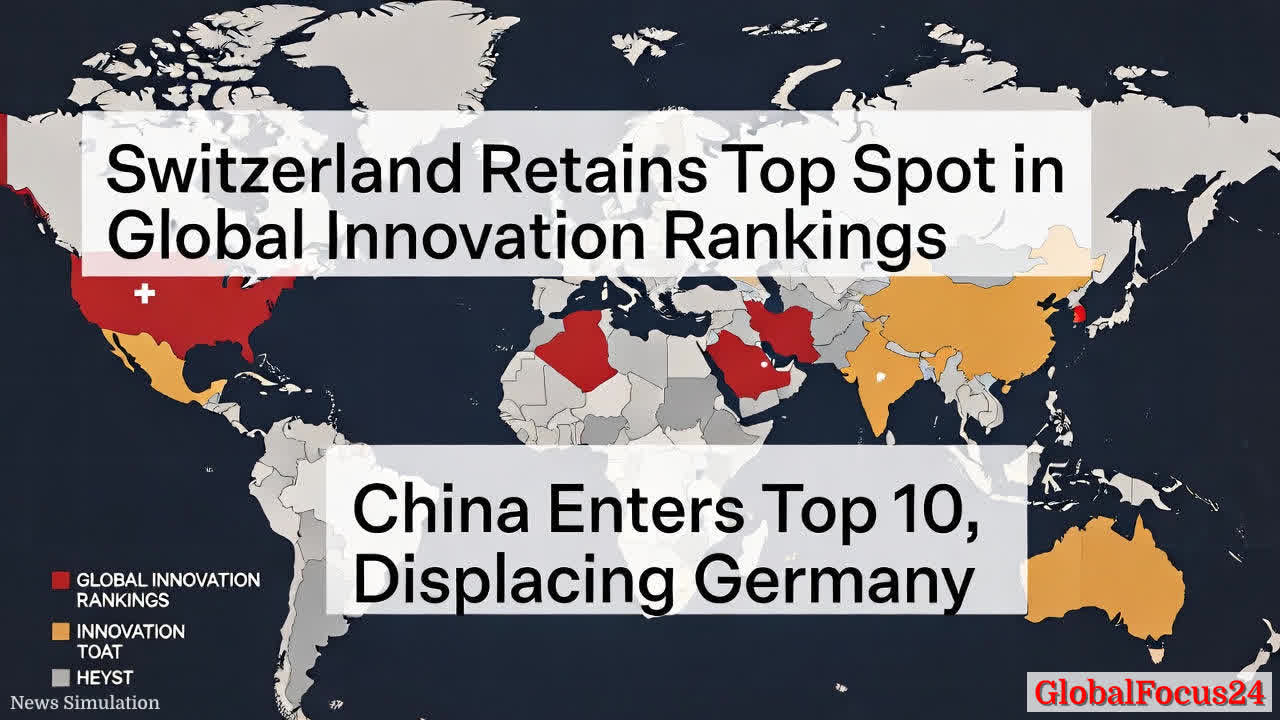
Global Innovation Rankings Signal Shifts as Switzerland Maintains Lead and China Enters Top 10
In a detailed, data-driven assessment of global innovation capacity, Switzerland has secured the top position for the fifteenth consecutive year, underscoring its enduring strength across knowledge creation, high-tech production, and intellectual property activity. The annual index, which spans roughly 140 economies and relies on about 80 indicators, presents a holistic view of how countries convert ideas into tangible economic and societal outcomes. While Switzerland’s sustained leadership anchors the list, the emergence of China into the top 10 marks a notable shift in the global innovation landscape, reflecting rapid advances in research intensity, patent activity, and the sophistication of business ecosystems in several large emerging economies.
Context and methodology
The index blends two core dimensions: innovation inputs and innovation outputs. Inputs measure the environment that supports invention—institutions, human capital and research, infrastructure, market sophistication, and business sophistication. Outputs capture the results of those inputs, including knowledge and technology production and the creation of creative goods and services. By averaging sub-indices, the methodology aims to balance capability with actual realization, offering a nuanced portrait of a country’s capacity to innovate and monetize new ideas.
Switzerland’s enduring edge
Switzerland’s lead is not accidental. The country consistently ranks highly in knowledge creation—backed by world-class universities, robust research funding, and collaboration across industry and academia. Its high-tech export profile remains a differentiator, reflecting a diversified, export-oriented economy with strong engineering, life sciences, and precision-manufacturing ecosystems. Intellectual property activity—patents and trademarks filed relative to economic size—also feeds into Switzerland’s sustained advantage, signaling a vibrant environment for firms to translate research into market-ready products.
Regional dynamics and comparisons
- Europe remains a powerful hub in the index, with six economies cracking the top 10. This concentration points to a mature innovation infrastructure across the continent, supported by strong regulatory frameworks, substantial public-private investment in R&D, and deep pools of technical talent.
- The United States and Sweden, consistently among the upper tier, illustrate the enduring benefits of large, dynamic innovation ecosystems, where capital, talent, and a culture of experimentation converge to sustain competitive advantages.
- Asia’s ascent is notable. China’s entry into the top 10—moving from just outside the threshold to position 10—reflects a multi-year push in research intensity, patent filings, and strengthening business sophistication. The shift highlights how large, rapidly developing economies can recalibrate their innovation models to achieve meaningful gains in global rankings.
- Germany’s retreat to just below the top tier signals a relative stagnation in areas such as venture funding and certain high-tech manufacturing facets when compared with faster-growing peers in other regions. This underscores how even advanced economies must continuously evolve to retain leadership in a rapidly changing global landscape.
- Other climbers include India, Türkiye, and Viet Nam, signaling a broader trend of rising innovation momentum in emerging and developing markets. These shifts reflect improvements in knowledge creation, startup ecosystems, and international collaboration that enable faster diffusion of new capabilities.
Economic impact and policy implications
A sustained lead in global innovation rankings translates into tangible economic advantages. Countries with high innovation performance typically experience higher productivity growth, more resilient export profiles, and the ability to attract skilled labor and investment. For policymakers, the index reinforces several crucial lessons:
- Invest in human capital and research infrastructure. Strong universities, research institutes, and R&D tax incentives correlate with higher knowledge outputs and more effective commercialization channels.
- Accelerate the commercialization pipeline. Bridging the gap between research findings and market-ready products—through enhanced venture financing, technology transfer offices, and supportive regulatory environments—can convert ideas into jobs and GDP growth.
- Foster inclusive and sustainable innovation. The index’s emphasis on broad-based inputs and outputs suggests that inclusive policy design—reaching small and medium-sized enterprises, regional hubs, and traditionally underserved communities—can amplify overall national innovation performance.
- Leverage regional collaboration. Cross-border research programs, standardized regulatory processes, and shared digital infrastructure can magnify the impact of national investments by unlocking larger markets and talent pools.
Regional comparisons aside, the broader narrative centers on the resilience and adaptability of innovation systems. Even as the global economy faces uncertain macro conditions, record-level investment in innovation underscores a persistent belief in long-term value creation through new technologies, processes, and business models. The evolving distribution of ideas across regions also hints at potential shifts in global value chains, with innovation hotspots potentially redefining where high-value manufacturing and advanced services take root.
Historical context
Over the past two decades, the global innovation landscape has shifted from a relatively concentrated set of advanced economies to a more distributed pattern of strength. While traditional leaders maintained momentum through steady investments in education, R&D, and institutional quality, several emerging economies demonstrated rapid progress by prioritizing science, technology, and talent development. The current year’s ranking captures that ongoing evolution: established power centers remain formidable, yet the ascension of major players from previously lower-ranked categories reflects the globalization of knowledge creation and the diffusion of best practices in policy design and private-sector development.
Sociopolitical and regional considerations
Public sentiment on innovation often intertwines with concerns about job security, wage growth, and regional investment disparities. When growth in high-tech sectors coexists with broader social stability and inclusive opportunity, innovation policy tends to receive broad public support. Conversely, policy backlash can arise if innovation-driven disruption disproportionately affects certain communities. The latest rankings invite policymakers to balance ambitious research agendas with targeted social programs, retraining initiatives, and regional development plans to maintain social cohesion while advancing technical progress.
Regional highlights in focus
- Europe: The region’s ongoing strength signals a commitment to long-run competitiveness. Policymakers continue to emphasize STEM education, digital infrastructure, and regulatory certainty to sustain high levels of innovation input and output.
- North America: The United States’ prominent position reflects a durable ecosystem of tech giants, startups, and world-class research institutions. Canadian innovation, while sometimes overshadowed by its larger neighbor, benefits from a favorable business climate and strong resource sectors that drive applied research and commercialization.
- Asia-Pacific: China’s ascent and the broader momentum in Southeast Asia and South Asia point to a shifting center of gravity. Investments in manufacturing automation, artificial intelligence, and biomedical research portend a more diversified regional innovation footprint.
- Middle East and Latin America: Emerging economies in these regions are accelerating investments in higher education and technology-driven industries, signaling a growing appetite for innovation-led growth and diversification.
Public reaction and societal tone
Public response to shifting innovation rankings often mirrors broader economic nerves. Communities watching job transitions in manufacturing or traditional sectors may interpret rising innovation activity as a signal of future opportunity, but they also seek assurances that gains will be widely shared. Media narratives frequently focus on the human element—the scientists translating research into products, the startups navigating early-stage funding, and the workers whose skills are updated through retraining programs. In this context, sustained policy support and transparent performance metrics are essential to preserving public trust in the innovation economy.
Conclusion
The global innovation index provides a comprehensive snapshot of how economies cultivate ideas and turn them into economic value and social benefits. Switzerland’s continued leadership reaffirms the potency of stable institutions, world-class education, and vibrant IP ecosystems. China’s rise into the top 10 reflects a broader, more dynamic picture of global competition driven by deliberate investments in R&D, manufacturing capabilities, and creative exports. As economies navigate uncertain macro conditions, the emphasis on inclusive, sustained, and scalable innovation remains critical to long-term growth, resilience, and shared prosperity across regions. The evolving rankings will likely continue to highlight a more interconnected, competitive, and inventive global economy in the years ahead.