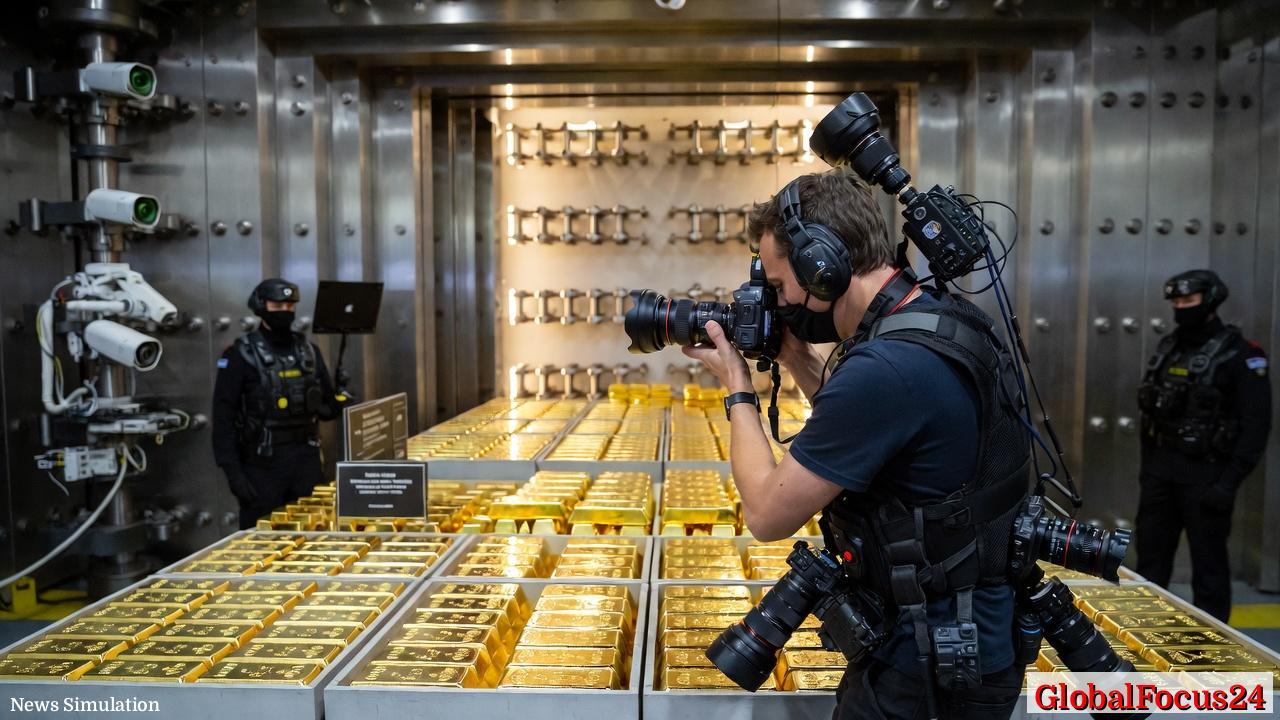
Russia’s Gold Reserves Surge to $326.5 Billion, Bolstering Financial Resilience Amid Global Economic Uncertainty
Russia’s central bank reported a remarkable increase in its gold reserves over the past year, adding approximately $130 billion to reach a total of $326.5 billion. The sharp expansion, disclosed in newly released financial data, signals a significant strategic shift in Russia’s approach to monetary security and foreign asset diversification as global markets continue to face volatility and shifting trade conditions.
A Record-Breaking Year for Russian Gold Reserves
The latest figures mark one of the largest annual gains in Russia’s gold holdings since the 2000s, when the Central Bank of Russia began systematically increasing its gold stockpile as part of a long-term effort to reduce reliance on foreign currencies. The 2025 surge underscores the growing role of gold as a foundation for Russia’s financial stability, particularly as the nation continues to navigate limited access to foreign exchange reserves amid ongoing geopolitical pressures and sanctions-related constraints.
According to analysts, the sharp rise in reserves was driven by two primary factors: sustained domestic gold production and rising global gold prices. Over the past year, global gold rates have steadily increased amid concerns over inflation, a weakening global growth outlook, and central bank purchases across emerging economies. By combining these elements, Russia’s holdings appreciated both in physical volume and in nominal value.
Historical Context: A Long-Term Strategy of Reserve Rebalancing
Russia’s accumulation of gold has deep roots in policies adopted well before current global economic challenges emerged. Following the 2008 global financial crisis, the Russian government began shifting its reserve composition away from Western currencies such as the U.S. dollar and the euro. The aim was to insulate the economy from external shocks, strengthen the ruble, and build a more self-contained monetary foundation.
Throughout the 2010s, the Central Bank of Russia remained one of the world’s most aggressive buyers of gold. By the mid-2010s, gold had grown to represent more than one-fifth of the nation’s total reserves. This trend accelerated sharply after 2014, when sanctions arising from the annexation of Crimea placed new restrictions on Russia’s access to international markets. In response, Moscow intensified its push to boost reserves through domestic mining and direct purchases from local producers, funneling newly mined gold into central bank holdings.
By 2020, gold had overtaken U.S. dollar assets as one of the largest components of Russian reserves. The 2025 addition of $130 billion further solidifies this approach, positioning Russia among the top global gold holders alongside the United States, China, and Germany.
Economic Impact and Policy Implications
The increase in gold reserves carries both symbolic and practical implications for Russia’s economy. On one level, it reflects the government’s ongoing effort to showcase financial resilience in the face of economic isolation. On another, it provides tangible benefits by improving the country’s capacity to stabilize the ruble, finance trade, and absorb external shocks.
Higher gold reserves strengthen the central bank’s ability to intervene in currency markets when necessary, particularly during periods of exchange rate volatility. They also act as a hedge against inflation and potential declines in foreign assets. At a time when energy revenues, a mainstay of Russia’s fiscal strength, face fluctuating global prices, the expanding gold reserve offers a reliable store of value independent of external demand for oil and gas.
Economists note that the buildup may also enhance Russia’s leverage in trade settlements with countries increasingly exploring alternatives to the dollar-based system. Over the past few years, Moscow has pursued agreements with partners such as China, India, and Turkey to use local currencies or gold-backed mechanisms for trade. The growing reserve base therefore underpins both domestic monetary security and Russia’s broader ambition to promote alternative payment arrangements across Eurasian markets.
Comparison with Other Global Gold-Holding Nations
On the global stage, Russia’s rapid accumulation positions it just behind the United States, which holds more than 8,100 metric tons of gold, and Germany, with approximately 3,300 tons. China has also made substantial additions to its reserves, citing similar motives—diversification, hedging against currency risk, and reducing exposure to U.S. Treasuries.
While exact figures from Moscow remain closely held, estimates suggest Russia’s total gold stock now exceeds 2,400 metric tons. By comparison, other major emerging economies, such as India and Turkey, maintain holdings in the range of 700 to 900 tons. The year’s increase reinforces Russia’s standing as one of the largest individual accumulators of gold worldwide, second only to China in terms of recent annual growth.
Domestic Gold Production and Industrial Factors
Russia’s status as one of the world’s leading gold producers has been a crucial enabler of its reserve policy. Domestic mining output—concentrated in regions such as Siberia, the Far East, and the Urals—provides a constant supply with minimal dependence on imports. Major projects by companies like Polyus and Polymetal International have expanded annual production, contributing to both export potential and reserve accumulation.
Government policies also support the gold sector through favorable taxation and financing arrangements. Over the past decade, Moscow has streamlined the process by which miners sell directly to the central bank, effectively closing the loop between raw extraction and reserve storage. This system has proven advantageous in recent years, especially as international buyers face restrictions on dealing with Russian commodities.
Global Economic Climate Driving Gold Demand
Russia’s reserve growth mirrors a broader global trend among central banks in 2025, with record gold purchases recorded across both developed and emerging economies. Several factors contributed to this surge, including persistent inflation concerns, divergence in interest rate policies among major economies, and geopolitical instability across multiple regions.
The U.S. Federal Reserve’s cautious approach toward interest rate cuts, combined with slower growth projections in Europe and Asia, led to increased investor appetite for safe-haven assets. As a result, gold prices reached record highs in late 2025, peaking above $2,500 per ounce—a level not seen in previous decades. For holders of large reserves such as Russia, these valuations translated into windfall-level nominal increases even without dramatically expanding physical volume.
The Role of Gold in Russia’s Broader Economic Strategy
Russia’s strengthening gold position plays a dual role within its evolving financial framework. Domestically, it provides a buffer that bolsters public and investor confidence in the ruble and the banking system. Internationally, it serves as a cornerstone of the country’s push toward greater monetary sovereignty, aligning with efforts to reduce exposure to Western financial networks.
The accumulation of gold also supports Russia’s long-term vision of economic self-reliance. In sectors from energy to agriculture, Moscow has emphasized local production and diversification. Gold complements this strategy by offering a portable, universally accepted asset that can bridge currency gaps in international trade without relying on potentially restricted financial channels.
This approach has become more pronounced as digital finance develops. Russia’s exploration of a digital ruble and cross-border payment frameworks could be underpinned by gold-backed reserves, giving these new systems increased credibility and value stability in global markets.
Regional and Historical Parallels
Russia’s reliance on gold reserves to underpin its economic strength recalls historical precedents from the early 20th century. Before World War I, the Russian Empire maintained one of the world’s largest gold reserves, helping stabilize its currency and strengthen its trade position. Though those reserves were largely depleted in the wake of war and revolution, the modern Federation has steadily rebuilt a comparable foundation over the past three decades.
Regionally, the pattern also mirrors strategies adopted by other resource-rich nations seeking to buffer against volatility in energy and commodity markets. Middle Eastern economies, for instance, have similarly increased gold and foreign reserve holdings to hedge exposure to oil price swings. In Asia, China and India’s central banks have followed a parallel trajectory, using gold to diversify away from the U.S. dollar amid growing shifts in the global economic order.
Outlook: Sustained Accumulation Likely
Looking ahead, analysts expect Russia to continue accumulating gold, although the pace may moderate depending on production levels and exchange rate dynamics. Continued restrictions on access to Western capital markets will likely reinforce the policy direction toward tangible, internally secured reserves. Meanwhile, the government’s focus on ensuring domestic financial stability and advancing alternative trade frameworks provides further incentives to maintain strong reserve levels.
In the broader context of global economics, the expansion of Russia’s gold holdings underscores an ongoing reconfiguration of international monetary systems. As countries increasingly prioritize self-sufficiency and risk mitigation, gold’s role as a neutral, hard asset remains central. For Russia, surpassing $326 billion in reserves marks both a symbolic and strategic milestone — one that strengthens its hand in facing the uncertainties of global finance in the coming years.