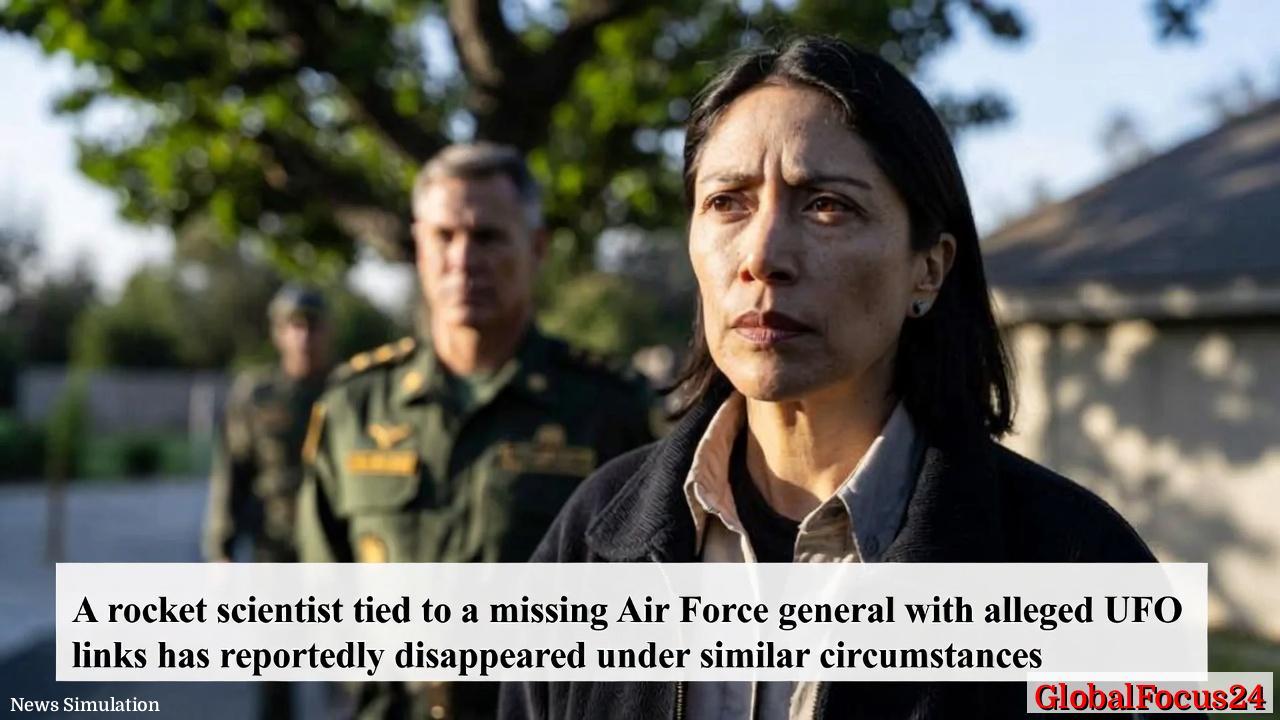
Rocket Scientist Vanishes After Air Force General’s Disappearance, Deepening Mystery Around Defense Research Network
A second disappearance tied to a U.S. defense research circle has intensified questions around a string of unexplained losses involving scientists, engineers, and former military officials. The latest case centers on aerospace engineer Monica Jacinto Reza, whose disappearance has been described as closely paralleling the earlier vanishing of retired Air Force Maj. Gen. William Neil McCasland, a figure long associated with aerospace and unidentified aerial phenomenon discussions. Together, the cases have drawn attention because they appear to connect advanced propulsion research, military laboratories, and a wider network of people now listed as dead or missing within a year.
A Pattern That Has Alarmed Observers
The newest disappearance has become part of a larger and unsettling list that includes at least six people linked to the same broader defense research ecosystem. The cases have circulated widely because of their overlap in profession, timing, and proximity to programs involving aerospace systems and next-generation propulsion. While no verified evidence points to a single cause, the clustering of events has prompted speculation about whether coincidence alone can explain so many unresolved outcomes in such a short span.
McCasland’s disappearance set the tone for the current wave of attention. According to publicly reported accounts, the retired general left his home on foot in Albuquerque and did not take his phone, a detail that added to the mystery from the start. Search efforts later expanded as family members, local authorities, and federal investigators tried to determine where he went and whether foul play was involved, but the case remains unresolved.
Who Monica Jacinto Reza Was
Monica Jacinto Reza has been identified in public discussions as an aerospace engineer associated with advanced rocket technology and work linked to the effort to replace Russian-made rocket engines in U.S. programs. Her name has also been tied to research networks involving defense funding and collaboration with major aerospace institutions. That background has made her disappearance especially notable, because it places a civilian engineer at the center of a story already shadowed by military connections and long-running speculation about classified aerospace work.
In technical circles, engineers working in propulsion and materials science often move between government labs, contractors, and university-linked research efforts. That mobility can make their professional histories difficult to summarize quickly, especially when projects are distributed across multiple institutions. In this case, the public narrative has focused less on one specific program than on the broader web of defense research relationships surrounding the missing individuals.
McCasland’s Background And Public Interest
McCasland’s earlier career helped explain why his disappearance drew immediate attention far beyond New Mexico. He previously commanded the Air Force Research Laboratory, one of the Air Force’s major science and technology organizations, which has long been central to work on propulsion, materials, avionics, and weapons-related research. His post-retirement involvement with a UFO research organization only amplified public interest, even though that connection does not by itself establish any link to his disappearance.
That history matters because the Air Force Research Laboratory sits within a broader national security and innovation ecosystem. The lab’s work touches areas that are also economically significant in the civilian world, including aerospace manufacturing, advanced materials, and high-performance computing. When a figure with that background vanishes, the case tends to attract attention from both investigators and people familiar with the defense sector’s long memory of secretive programs and unresolved controversies.
Why The Case Resonates In New Mexico
New Mexico has long occupied a distinctive place in the American aerospace story. The state is home to major defense and scientific facilities, including laboratories, test ranges, and military research sites that have shaped the region’s economy for decades. That background creates a setting in which stories involving generals, rocket scientists, and classified technology feel immediately plausible to local audiences, even when the evidence remains thin.
The state is also closely tied to the national mythology of UFO lore, partly because of decades-old stories around Roswell and partly because of the continuing presence of aerospace and intelligence-adjacent work. That has made recent disappearances easier to fold into a wider cultural narrative, especially on social media. But the practical side of the story is more grounded: these are missing-person cases involving educated professionals in a region where desert terrain, foothills, and wide search areas can complicate recovery efforts.
Economic Stakes In Aerospace And Defense
Beyond the intrigue, the underlying sector carries real economic weight. Aerospace and defense research supports high-wage employment, attracts federal funding, and sustains supply chains that run from advanced manufacturing to materials testing. In regions such as New Mexico, the sector also supports local businesses, contractors, and technical institutions that depend on the steady flow of defense-related work.
The overlap between military research and commercial aerospace is especially important in propulsion development. Efforts to reduce dependence on foreign engines and build domestic capability have broad implications for launch costs, procurement strategy, and industrial competitiveness. That is why any unexplained event involving personnel tied to such work draws notice: not because one disappearance changes the industry overnight, but because it reminds observers how concentrated specialized expertise can be.
Historical Context Of Aerospace Mysteries
The present fascination also reflects a longer American pattern in which aerospace research, secrecy, and public suspicion often travel together. During the Cold War, military laboratories and contractors frequently operated with limited transparency, helping fuel myths around black projects, hidden weapons, and unexplained incidents. Even as modern disclosure rules have increased, the perception that some aerospace work remains difficult to trace continues to shape public reactions to stories like this one.
That history matters because it affects how the public interprets silence. A missing engineer or retired general may be the subject of a conventional investigation, yet the surrounding context makes people search for deeper meaning. When a person with technical credentials and defense ties disappears, the mind naturally goes to the possibility of sensitive information, institutional secrecy, or dangerous professional entanglements, even when no facts yet support those theories.
Regional Comparisons And Search Challenges
Compared with coastal aerospace hubs such as Southern California or Washington state, New Mexico presents a different operational environment. The state has fewer dense urban corridors and more open land, which can help investigators in some situations but complicate searches in others because terrain, weather, and distance can all slow the process. In a case like McCasland’s, that combination of sparse visibility and rugged surroundings increases the difficulty of finding a person who leaves on foot.
The regional comparison also extends to the workforce. In places such as California’s aerospace corridor, specialists may be surrounded by a larger concentration of contractors, labs, and backup personnel. New Mexico’s ecosystem is smaller but deeply specialized, meaning individual researchers can be especially prominent within their professional circles. That can magnify the impact of any disappearance and make each new case feel more consequential than a single isolated incident.
What Remains Unclear
Despite the growing online speculation, key facts remain unresolved. Public reporting has not established a shared cause for the disappearances, and there is still no verified evidence that the cases are linked by anything beyond professional overlap. Investigators have not publicly identified a single pattern that explains the losses, and family statements in related cases have urged restraint as search efforts continue.
What is clear is that the story has tapped into a potent mix of real-world uncertainty and long-standing fascination with defense secrecy. The disappearance of a rocket scientist after a retired general vanished under similar circumstances has created a narrative that feels larger than any one individual case. For now, though, the facts point to a series of unresolved missing-person investigations with deep ties to aerospace research, a sector that remains as strategically important as it is difficult for the public to fully see.