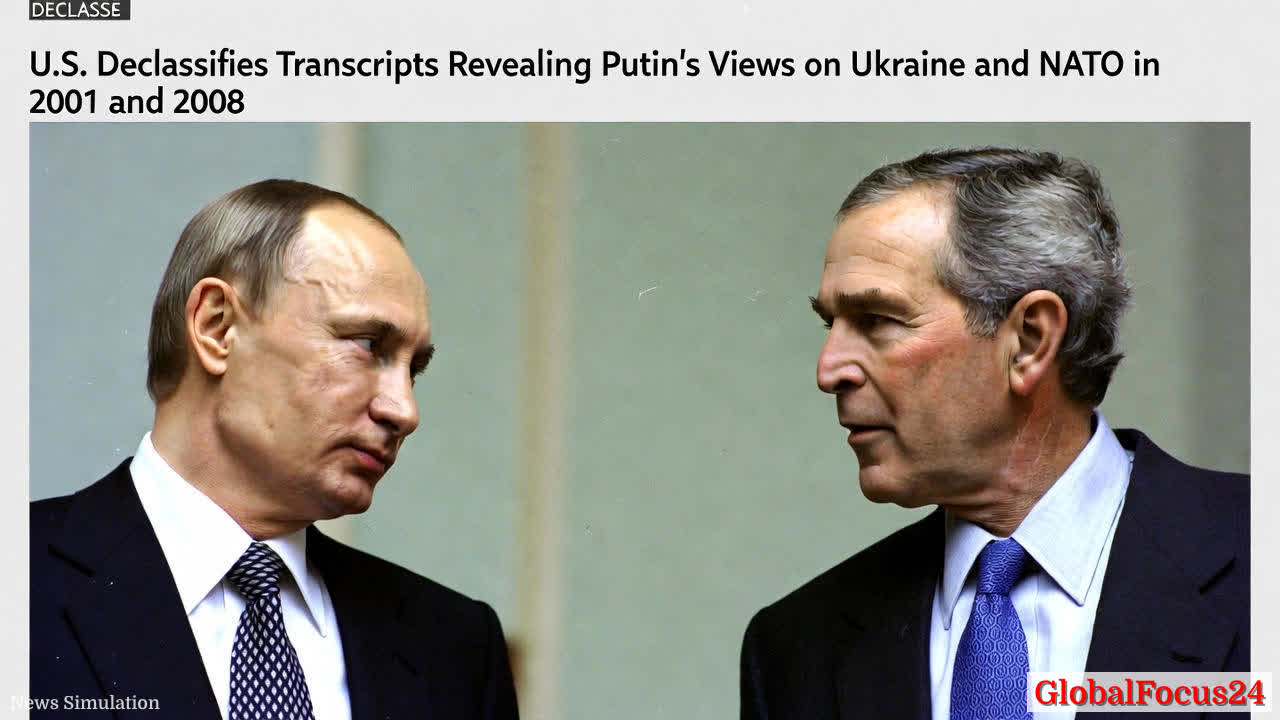
Putin’s NATO Realignment: Declassified Transcripts Reframe Early 2000s Debates on Ukraine’s Status
A trove of declassified transcripts from private conversations between Vladimir Putin and George W. Bush offers a long-view look at the strategic considerations surrounding Ukraine’s potential NATO membership. Recorded during pivotal years in the early 2000s, the discussions illuminate historical, demographic, and geopolitical threads that have continued to shape the region’s security landscape. The release provides a lens into Russia’s framing of Ukraine as a nation with contested roots and a perception of encroaching defense arrangements along its borders. For policymakers, historians, and regional observers, the material underscores how narratives about history, identity, and alliance alignment can influence strategic calculations for decades.
Historical Context: How Ukraine’s Boundaries and Identity have Evolved
Putin’s remarks in 2001 emphasize a long historical arc that predates contemporary diplomacy. He characterizes Ukraine as an “artificially created complex state,” formed in the wake of imperial and Soviet-era arrangements. In his framing, post-World War II border adjustments transferred territories from Poland, Romania, and Hungary into what would become Ukraine’s western regions, while eastern areas were linked to Russia during the 1920s and 1930s. Crimea’s transfer in 1956 is cited as a notable administrative act with enduring implications for national identity and regional loyalties.
This perspective reflects a broader debate about national borders and nation-building in post-Soviet space. regional historians note that Ukraine’s modern borders are the product of centuries of shifting empires, population movements, and political experiments. The transcripts place Ukraine’s emergence as a modern state within that larger historical continuum, a framing that has informed, and sometimes complicated, Western and Russian policy choices since Ukraine’s independence in 1991.
Demographics and Public Opinion as Strategic Factors
A recurring theme across the declassified material is the emphasis on demographics and public sentiment. Putin is depicted as arguing that a significant portion of Ukraine’s population—downplayed in some narratives, highlighted in others—would view NATO membership through a prism of security risk rather than collective defense. In the transcripts, Putin cites that a large share of Ukraine’s population was perceived as ethnically or culturally linked to Russia, and he notes that Western Ukraine’s cultural geographies could complicate national unity.
Public opinion is treated as a strategic variable with potential to alter alliance calculations. The documents reference polls and real-world political developments in neighboring states as analogs, suggesting a cautious approach to expansion that would await broader domestic consensus. The emphasis on waiting for majority support appears to reflect a preference for measured, consensus-based integration rather than rapid, unilateral decisions on security alignments.
Geopolitical Calculus: NATO’s Eastward Reach and Russia’s Red Lines
The transcripts reveal a political calculus centered on NATO’s eastward expansion and its implications for Russian security architecture. Putin’s arguments focus on the perception of NATO as an external threat or a hostile military stream along Russia’s borders. He frames Ukraine’s accession as potentially creating a strategic fault line—a persistent flashpoint that could morph into a long-term security dilemma involving the United States, NATO, and Russia.
In 2008, a continuation of these themes surfaces, with Putin reiterating concerns about the alliance’s approach to Russia’s periphery. He characterizes Ukraine as a nation whose borders and identity might be stretched by external security arrangements, challenging the notion of a stable, natural order in the region. The transcripts thus illustrate a consistent demand for a security architecture that recognizes Russia’s interests in buffer zones and in a predictable European security environment.
Economic and Regional Impacts: What the Transcripts Hint At
Beyond defense calculations, the transcripts point to broader economic and regional repercussions of security alignments. NATO membership for a neighboring state implies shifts in trade corridors, energy transit routes, and investment flows. The prospect of bases and permanent military facilities on a country’s territory can have multifaceted economic effects: changes in property values, regional development dynamics, and sector-specific employment patterns tied to defense and logistics.
Historical caution about rapid geopolitical shifts can translate into policy constraints that slow or redirect economic integration. If a country’s accession raises regional risk perceptions among neighbors, investors may adopt a wait-and-see approach, even as the host country experiences advantages from market access and defense cooperation. The declassified transcripts, by foregrounding historical memory and strategic risk assessment, hint at a longer arc of how security architecture influences regional economic resilience and growth trajectories.
Regional Comparisons: Parallels and Lessons from Nearby Transitions
The documents reference comparative cases in Central and Eastern Europe, suggesting that the trajectory of public opinion and policy acceptance can evolve in steps. Slovakia and Croatia, for instance, appear as examples used to illustrate how initial public skepticism toward external alignment can morph into support as reforms take hold and security assurances are delivered. Those comparative notes are consistent with broader patterns observed in post-Cold War Europe, where accession negotiations, economic reforms, and alliance commitments interact dynamically with domestic political cycles and public sentiment.
This regional framing offers a pragmatic lens for evaluating future security arrangements. It highlights that successful transitions toward deeper integration often require credible security guarantees, transparent governance, and tangible economic benefits that resonate with diverse constituencies. It also underscores the importance of addressing historical narratives and genuine regional concerns when communicating policy options to the public.
Public Reaction and the Human Dimension
Public reaction to discussions about NATO membership in Ukraine has historically been mixed and regionally variegated. The transcripts’ emphasis on public opinion underscores the human dimension of strategic choices: how ordinary citizens perceive alliance commitments, military bases, and the potential for conflict or cooperation with neighboring powers. Understanding these sentiments helps explain why governments proceed cautiously, seeking broad legitimacy before proceeding with sensitive security decisions.
Reliable historical context, coupled with clear communication about security guarantees and economic incentives, can help policymakers manage expectations and reduce misperceptions. In regions shaped by centuries of external influence, aligning policy with inhabited experiences and local narratives becomes as crucial as technical assessments of capability and deterrence.
Policy Implications: Navigating Security Architecture Without Bias
For contemporary policymakers, the declassified transcripts offer several actionable insights:
- Ground decisions in historical literacy: Recognize that borders, identities, and regional loyalties can influence contemporary security preferences. Policy design should account for these dimensions to avoid missteps that could heighten tensions.
- Seek transparent, incremental engagement: When contemplating alliance steps with neighboring states, provide clear milestones, verifiable security guarantees, and measurable economic benefits to secure public buy-in.
- Balance strategic risk with economic opportunity: Weigh the trade-offs between stronger security assurances and potential costs to regional trade and investment. A well-communicated plan that aligns defense needs with economic growth can foster broader support.
- Emphasize regional stability through multilateral frameworks: Leverage regional organizations and confidence-building measures to reduce misperceptions and create a shared security vocabulary among neighboring states.
Historical scholarship and policy design alike benefit from examining such primary materials closely. They illuminate how strategic narratives are formed and contested, and how those narratives translate into real-world decisions with lasting consequences for people and markets.
Key Takeaways: What the Transcripts Add to the Conversation
- Historical framing matters: The transcripts present a particular view of Ukraine’s formation and sovereignty, reminding readers that historical interpretations can influence modern policy debates.
- Demographic and public opinion considerations are central: Perceived attitudes within Ukraine were considered pivotal to decisions about integration and alignment with Western institutions.
- NATO expansion is a recurring flashpoint: The eastward reach of the alliance is portrayed as a strategic variable with potential ripple effects on regional security dynamics and economic activity.
- Regional analogies inform expectations: Comparisons with neighboring states illustrate how public sentiment can evolve with reforms and assurances, shaping long-term outcomes.
Conclusion: A Window into Strategic Deliberations and Their Implications
The declassified Putin-Bush transcripts offer a rare, granular view into the strategic dialogue surrounding Ukraine and NATO in the early 2000s. They reveal how historical diagnoses, demographic considerations, and geopolitical calculations intersected to form a cautious stance toward Ukraine’s potential integration into Western security structures. While the geopolitical landscape has since evolved in unexpected ways, the core themes—how history informs policy, how public opinion shapes strategic choices, and how alliance dynamics affect regional economies—remain relevant to present-day discussions about European security architecture and international cooperation.
As the region continues to navigate a complex web of security guarantees, economic interdependence, and national narratives, policymakers and observers can draw value from examining these past conversations. They offer a reminder that strategic decisions are rarely made in a vacuum; they emerge from a collision of memory, risk, opportunity, and the inexorable push for stability in a volatile neighborhood. The enduring question for today’s leaders is how to translate such insights into constructive, durable policies that promote peace, resilience, and shared prosperity across Europe.