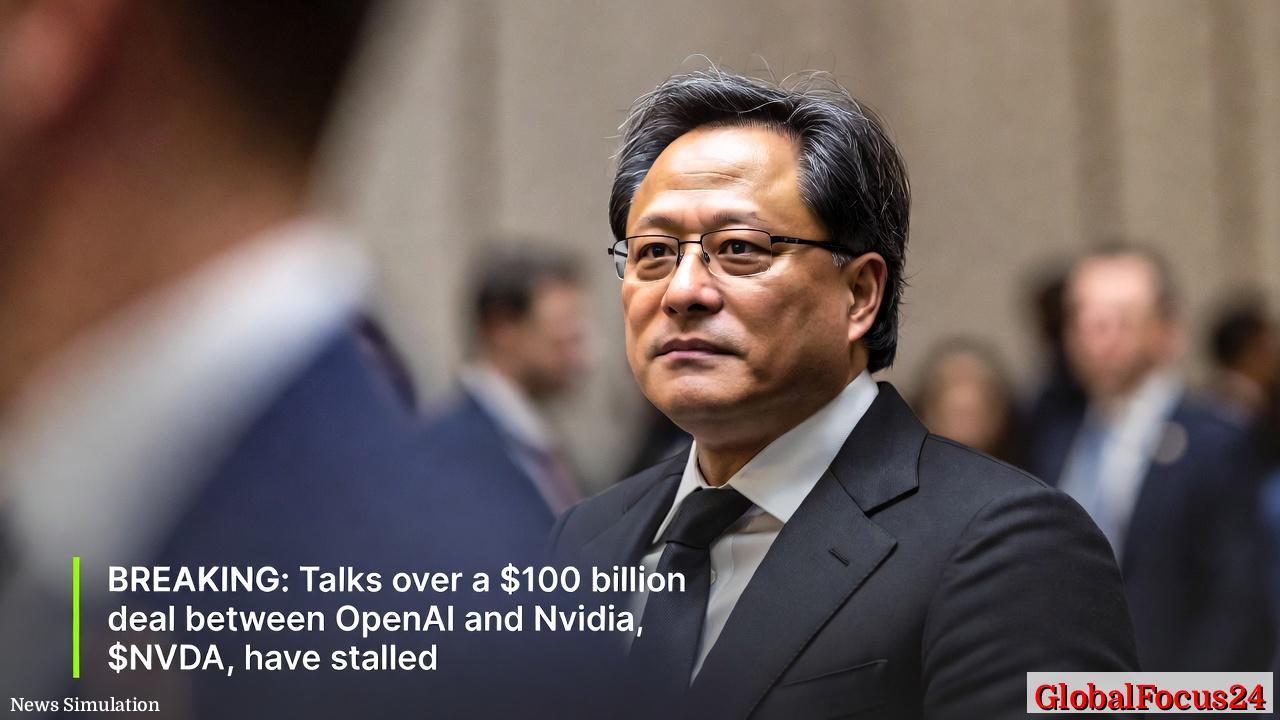
Nvidia-OpenAI Investment Talks Stall as AI Sector Navigates Gains and Risks
Nvidia’s ambitious plan to invest up to $100 billion in OpenAI has stalled, underscoring the fragility of high-stakes alliances in the fast-evolving artificial intelligence industry. The negotiations that began with broad fanfare last fall reveal the complex balancing act between liquidity, strategic control, and competitive dynamics amid a crowded field of rivals, including major cloud providers and other AI developers. While both companies have, in public statements, signaled a continued interest in collaboration, the latest pause highlights the delicate nature of large-scale tech investments and the practical challenges of aligning long-term incentives with immediate market pressures.
Historical context: a decade of AI funding and strategic partnerships
The AI funding landscape has evolved rapidly over the past decade. Early partnerships between semiconductor leaders and AI research outfits helped accelerate capabilities, but they often carried outsized expectations about unilateral dominance. Nvidia’s role as a silicon backbone for modern AI—providing the GPUs that train and run complex models—has grown from manufacturing chips to shaping strategic ecosystem partnerships. OpenAI, founded with a mission to democratize AI while pursuing safety and scalability, has attracted substantial investment from diverse sources, creating a competitive tension that extends beyond any single financier.
The proposed $100 billion investment would have represented an extraordinary scale in this ecosystem, signaling a long-horizon bet on OpenAI’s model architecture, data strategy, and deployment capabilities. In the broader historical arc, such large private capital commitments have sometimes accelerated technological adoption but also prompted scrutiny over governance, control, and the distribution of economic benefits. The current pause, therefore, sits at a crossroads: it may reflect prudent risk management in a volatile market or reveal deeper concerns about strategic alignment and competitive risk.
Economic impact: implications for funding ecosystems and regional tech clusters
If realized, the investment would have reverberated across multiple layers of the tech economy. For Nvidia, the deal could have reinforced its position as the undisputed backbone of AI infrastructure, potentially unlocking new revenue streams from licensing, tooling, and cloud integrations tied to OpenAI’s models. For OpenAI, the infusion would likely have accelerated model iteration, expansion of compute capacity, and faster deployment timelines across enterprise and consumer applications.
Beyond the direct participants, the financial and product implications would have influenced suppliers, data-center operators, and regional talent pools. The financing could have driven capex cycles for hyperscale data centers, including high-density power and cooling infrastructure, storage strategies, and advanced networking architectures. Regions with seasoned AI talent, robust university ecosystems, and favorable energy costs—such as parts of the United States and select international hubs—would likely experience amplified investments and job creation, even as automation and efficiency pressures reshape labor markets.
Regional comparisons illuminate different paths of AI investment and adoption. In North America, where Nvidia and OpenAI are deeply embedded in a dense ecosystem of software developers, cloud providers, and enterprise customers, the potential deal would have intensified competition for scarce compute resources and specialized talent. In Europe, regulatory scrutiny and data governance considerations have historically slowed rapid scaling but fostered strong public-private partnerships and investment in responsible AI programs. In Asia, governments and corporations have pursued a mix of state-backed funding and private capital to accelerate AI capabilities, with Singapore, Japan, and parts of China playing pivotal roles in hardware, software, and application development. The stalled talks underscore that regional policy environments can shape both the pace and structure of investment into AI capabilities, even as private sector collaboration remains a potent driver.
Operational and strategic considerations driving the pause
Several factors appear to be at the heart of the pause in negotiations:
- Non-binding nature of the agreement: Public statements have emphasized that any potential arrangement was not formalized. This ambiguity leaves room for renegotiation and reassessment as both sides calibrate expectations against evolving market conditions.
- Internal concerns about strategic fit: Reports and statements from Nvidia leadership suggest reservations about OpenAI’s business strategy, including questions about discipline in execution and clarity around monetization. Such concerns can slow progress when millions or billions of dollars hinge on shared strategic clarity.
- Competitive pressures: The AI landscape has grown more crowded and dynamic, with players like Google, Anthropic, and other cloud and tech firms expanding their AI capabilities. This intensified competition can sharpen concerns about how a large partnership would affect competitive positioning, access to compute, and bargaining power.
- Governance and control considerations: A deal of this magnitude inherently involves governance arrangements, equity or governance rights, and long-term control questions. Aligning these elements with both firms’ broader corporate objectives can be intricate and time-consuming.
- Regulatory and public-interest considerations: As AI capabilities scale, regulators and public-interest groups increasingly scrutinize who controls models, how data is used, and how sensitive outputs are managed. These factors can create additional friction in high-value negotiations.
Public reaction and market sentiment
Investors and industry watchers have followed the deliberations closely, interpreting the pause as a signal of healthy risk assessment rather than a collapse of collaboration. Market participants often see such pauses as windows to re-price risk, reassess exposure to computational bottlenecks, and consider alternative funding structures, such as staged investments, performance-based tranches, or joint ventures that preserve flexibility.
Public sentiment around AI investments tends to oscillate between optimism about breakthrough capabilities and concern about concentration of power. Large-scale capital commitments can accelerate innovation but may also concentrate decision-making in a few corporate hands, raising questions about governance, transparency, and the distribution of benefits across the broader tech ecosystem.
Technical and product outlook for OpenAI and Nvidia
From a technology perspective, Nvidia’s hardware prowess remains central to AI workloads. Its GPUs are widely used to train and run large-scale models, enabling researchers and developers to explore more ambitious architectures and training regimes. OpenAI’s research trajectory—focusing on safety, alignment, and practical deployment—depends on access to high-performance compute, as well as an ecosystem that supports rapid iteration and deployment at scale.
If the collaboration unfolds in a more incremental fashion, potential avenues could include:
- Joint development of specialized hardware accelerators or optimized software stacks to reduce training and inference costs while boosting performance.
- Hybrid funding models that mix core capital with project-based funding for specific model releases or safety initiatives.
- Structured governance arrangements, such as advisory boards or joint committees, to address concerns about strategic discipline and execution.
- Regional data-center partnerships or co-location agreements to alleviate latency and energy costs for global customers.
Historical parallels offer cautionary lessons. For example, partnerships that hinge on large, centralized governance structures can face friction when market dynamics shift or when a single party’s strategic priorities diverge. Conversely, collaborations that retain flexible funding, clear milestones, and shared incentives can weather turbulence and deliver sustained value.
Implications for customers and developers
For customers who rely on OpenAI’s models and Nvidia’s infrastructure, the pause introduces a period of cautious planning. Enterprises may revisit budgeting for AI workloads, factoring in potential cost changes, compute availability, and deployment schedules. Developers and startups could see shifts in access to optimized toolchains, model pricing, and early-release features contingent on the outcome of the negotiations.
In the near term, cloud providers and AI tooling ecosystems may adjust pricing, capacity commitments, or early-access programs in anticipation of how the partnership might evolve. This environment can create volatility in benchmarks and project timelines, underscoring the importance of resilience and contingency planning for teams building AI-powered solutions.
Conclusion: a watershed moment or a temporary detour?
The stalled Nvidia-OpenAI negotiations represent a pivotal moment that signals both the maturity and fragility of AI’s commercial frontier. On one hand, the sheer scale of a potential $100 billion investment demonstrates the confidence investors and industry leaders place in AI capabilities to reshape multiple sectors. On the other hand, the pause reflects a disciplined approach to evaluating risk, governance, and strategic fit in a field where competition is intense and technical barriers are high.
If the partnership resumes with a clarified blueprint, it could catalyze a new era of AI deployment, data-center efficiency, and enterprise-grade capabilities. If it remains unresolved or evolves into a more nuanced arrangement, the broader AI ecosystem will likely adapt by accelerating alternative collaborations, refining pricing and access models, and pursuing regional partnerships to sustain momentum.
Regardless of the outcome, the episode underscores a fundamental truth about AI development: while hardware, software, and data capabilities drive progress, the success of transformative technology ultimately hinges on how well organizations align strategy, governance, and execution in a rapidly shifting landscape. The next chapters will reveal whether this alliance becomes a defining milestone in AI history or a cautionary tale about the challenges of aligning ambitions at scale.