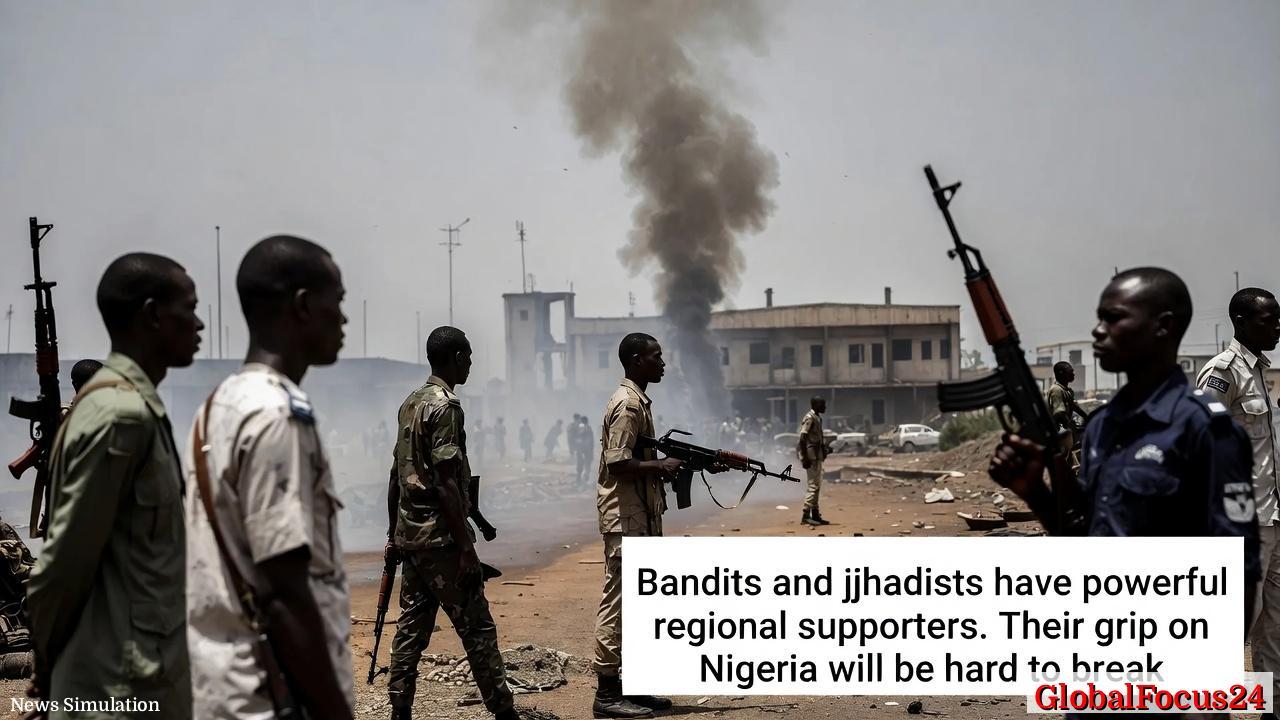
Bandits and Jihadists Tighten Grip as Nigeria Confronts a Deepening Security Crisis
A National Security Challenge Reaching New Heights
Nigeria, Africa’s most populous nation, is confronting one of the gravest security crises in its modern history. A deadly attack in the northwestern state of Zamfara last week left more than 100 civilians dead and underscored the growing convergence of banditry, jihadism, and political instability. Despite years of military offensives and billions spent on internal security, armed groups continue to expand their territorial control, displacing thousands and threatening the very fabric of the Nigerian state.
Witnesses described the assault as swift and brutal—gunmen on motorcycles descended on several villages, setting fire to homes, stealing cattle, and abducting residents. The army’s response came hours later, offering little comfort to communities already traumatized by a decade of violence. The attack was one of dozens that have struck the northwest since the beginning of 2026, signaling that the government’s efforts to contain the crisis remain far from successful.
A Decade of Escalating Violence
The roots of Nigeria’s current insecurity stretch back more than a decade, to the early rise of Boko Haram in the country’s northeast. Initially confined to Borno and Yobe states, jihadist groups have since splintered and metastasized, giving rise to multiple factions such as the Islamic State West Africa Province (ISWAP). Meanwhile, opportunistic criminal gangs—locally known as “bandits”—have flourished in the northwest, capitalizing on weak governance, porous borders, and widespread poverty.
By the early 2020s, these groups began to interact and cooperate in new ways. Bandit leaders forged tactical alliances with jihadists, sharing weapons, intelligence, and smuggling routes. Some analysts argue that without this nexus, the northwestern crisis might have remained a localized phenomenon. Instead, it has evolved into a hybrid insurgency combining ideological extremism with profit-driven criminality.
This blending of motives has made the situation especially difficult to address. While jihadist groups pursue religious and political goals, bandits are motivated by money and survival. Their collaboration has produced a fluid network capable of adjusting to military pressure and spreading across borders into Niger, Chad, and Mali.
Regional Dynamics and External Support
The security picture in Nigeria cannot be understood in isolation. Across the Sahel, extremist groups have capitalized on political instability and faltering governance. Militant networks based in Mali and Burkina Faso maintain ties with affiliates in Nigeria, facilitating the exchange of fighters and weapons. Intelligence officials warn that foreign funding and training have strengthened some of Nigeria’s armed groups, allowing them to launch more coordinated and deadly operations.
Regional powers have struggled to contain the spillover. The dissolution of the G5 Sahel joint task force in 2024 left a vacuum in counterterrorism cooperation. Though Nigeria remains an active member of the Multinational Joint Task Force (MNJTF) alongside Chad, Cameroon, and Niger, limited resources and differing national priorities have diminished its effectiveness. The result is a patchwork of uncoordinated operations that seldom deliver lasting results.
Smuggling routes connecting the Sahel to Nigeria’s northern states have also become lifelines for armed groups. Gold, fuel, arms, and human trafficking sustain their operations, generating millions of dollars annually. This financial strength has allowed them to recruit young men disillusioned by unemployment and corruption, further entrenching their influence in rural communities.
The Human Cost and Humanitarian Strain
The consequences for ordinary Nigerians are devastating. According to humanitarian agencies, nearly 3 million people have been displaced across northern Nigeria, many living in overcrowded camps with limited access to food, water, and medical care. Entire farming communities have been driven from their lands, exacerbating food insecurity in a region already vulnerable to drought and poor infrastructure.
Children are among the hardest hit. Attackers frequently target schools for ransom kidnappings, a tactic that gained international attention after the 2014 abduction of schoolgirls in Chibok. Yet similar incidents continue to occur, each deepening public anger and despair. In Zamfara, Sokoto, and Katsina states, families now hesitate to send their children to school, fearing fresh assaults.
The economic toll is equally severe. Agriculture, which employs the majority of the northern population, has been crippled by insecurity. Markets have closed, transport routes have become perilous, and investment in rural development has evaporated. Analysts estimate that Nigeria loses billions annually to lost productivity and security expenditures. The indirect costs—stunted education, social fragmentation, and trauma—are harder to quantify but arguably more damaging over the long term.
Government Efforts and Public Skepticism
Successive administrations have promised decisive action to restore peace, yet the results remain elusive. Military operations such as “Hadarin Daji” and “Safe Haven” have yielded mixed outcomes—temporarily dispersing militants without dismantling their networks. Security forces face the dual challenge of overextension and inadequate equipment. Many rural communities complain that soldiers arrive only after attacks and leave soon afterward, offering little protection.
The government has also attempted negotiation and amnesty programs, particularly with bandit groups. These initiatives have occasionally reduced violence in the short term but often collapse due to mutual distrust and poor implementation. Critics argue that paying ransoms or granting amnesty to armed actors risks legitimizing criminality and undermining the rule of law.
Meanwhile, corruption continues to erode confidence. Reports of soldiers selling weapons or leaking operational plans have surfaced repeatedly. Transparency advocates contend that without real accountability and reform, military spending will continue to yield disappointing results.
Comparing Nigeria’s Experience with Its Neighbors
Nigeria’s struggle mirrors broader patterns across West Africa. In Burkina Faso and Mali, jihadist movements have overwhelmed state forces despite international backing. Niger, once a relative bastion of stability, has faced its own surge in attacks since the 2023 coup. These developments reveal how fragile governance and socioeconomic inequality create fertile ground for insurgency.
Yet Nigeria’s situation stands out in scale and complexity. With a population exceeding 220 million and a vast, diverse territory, the country must manage not only Islamist insurgency but also ethnic rivalries, separatist movements, and organized crime. The combination magnifies the difficulty of achieving lasting peace.
Some observers draw parallels with Colombia’s decades-long battle against guerrilla groups and drug cartels. There, sustained investments in intelligence, regional alliances, and development eventually weakened armed networks. Similar approaches—integrating counterinsurgency with economic and community-based initiatives—may offer lessons for Nigeria.
Economic Implications for Africa’s Largest Economy
Nigeria’s security breakdown reverberates far beyond its conflict zones. As Africa’s largest economy and a key energy exporter, instability in Nigeria poses risks to regional trade and investment confidence. The World Bank has repeatedly warned that persistent insecurity could drag down GDP growth by more than one percentage point annually.
The oil-rich Niger Delta, though less affected by jihadist threats, faces its own security challenges from piracy and pipeline vandalism. Combined with northern unrest, these factors deter foreign direct investment and strain government revenues. In 2025, Nigeria’s inflation reached double digits, partly due to disrupted agricultural supply chains and elevated transport costs linked to insecurity.
International partners—particularly the United States, United Kingdom, and European Union—have pledged support in intelligence and counterterrorism training. However, analysts stress that military assistance alone will not solve what is increasingly a socioeconomic crisis. Sustainable progress will depend on governance reform, rural development, and education—areas where Nigeria’s performance remains uneven.
A Fragile Hope for Reform
Despite the bleak outlook, there are signs that awareness is growing among policymakers and civil society. Grassroots organizations across the north have begun mediating between communities and local authorities, working to rebuild trust and promote dialogue. Religious leaders are also playing a quiet but vital role in countering extremist narratives.
Security experts emphasize that solutions must combine force with opportunity. Where young people have access to education, jobs, and justice, recruitment by armed groups drops significantly. Some pilot programs in Kaduna and Kano states have shown promise by integrating ex-fighters into farming or vocational training schemes.
The Nigerian government faces immense pressure to replicate and expand these initiatives nationally. As bandits and jihadists entrench their positions, time is running out to reverse the tide. Without comprehensive action, Nigeria risks sliding further into protracted instability that could reshape West Africa’s political and economic landscape for years to come.
The Road Ahead
The deadly attack in Zamfara is not an isolated incident but part of a troubling trajectory that has transformed vast swaths of Nigeria into zones of lawlessness. While external support may bolster counterterrorism capabilities, the country’s salvation will ultimately depend on its ability to rebuild institutions, invest in people, and restore the public’s faith in government.
Nigeria stands at a crossroads between resilience and regression. The road ahead demands political will, strategic coordination, and a recognition that the fight is as much about governance and opportunity as it is about firepower. Until the state reasserts authority across its territory and addresses the grievances that fuel rebellion, bandits and jihadists will continue to hold a deadly sway over the nation’s heartland.