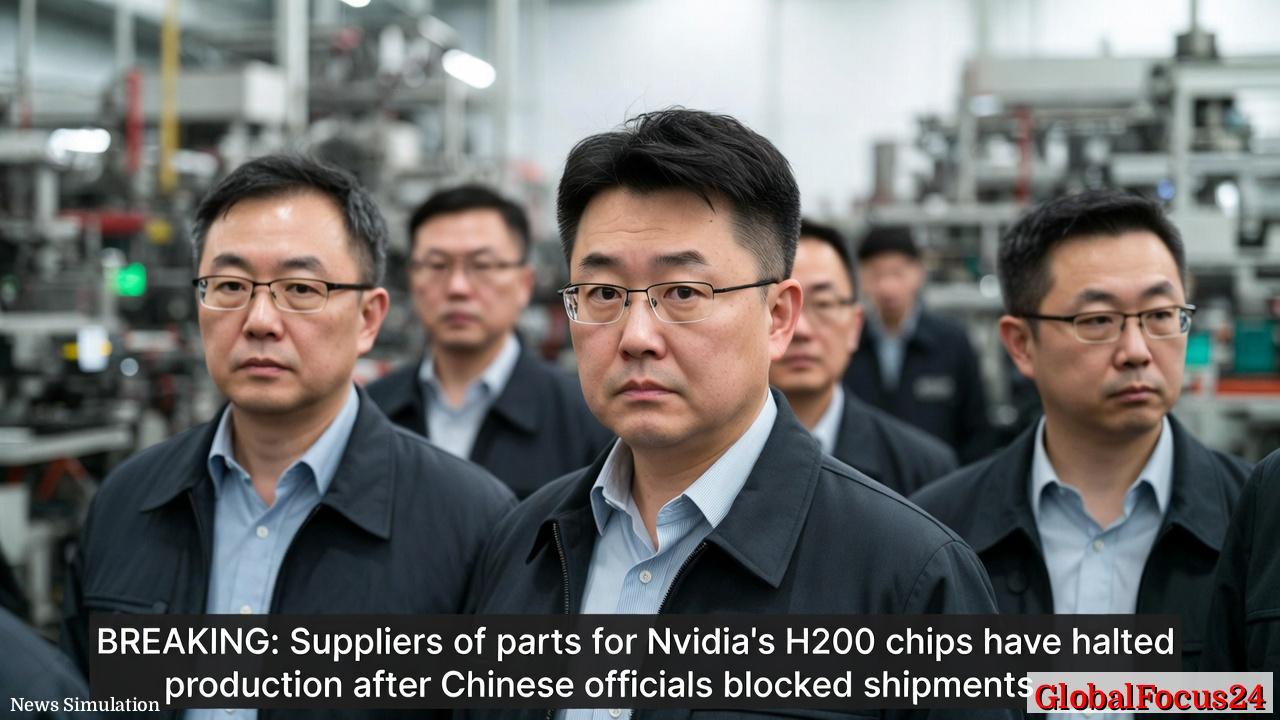
NVIDIA Suppliers Halt Production of H200 Chip Parts Amid Chinese Blockade
Production of components for NVIDIA’s H200 artificial intelligence chips has ground to a halt after Chinese authorities reportedly blocked export shipments of critical semiconductor materials. The stoppage adds to mounting tensions between the global semiconductor industry and China’s tightened trade controls, threatening to delay one of the most anticipated hardware launches in the AI sector.
Strategic Setback for NVIDIA’s AI Expansion
The H200 chip, a next-generation graphics processing unit (GPU) designed for data centers and artificial intelligence workloads, has been central to NVIDIA’s global growth strategy. Built on advanced architecture and refined for efficiency in massive-scale computing, the H200 has been slated to power servers for leading tech firms, cloud operators, and research institutions throughout 2026.
Suppliers now face an indefinite suspension after Chinese customs cited new compliance reviews targeting high-performance semiconductor exports. Multiple contracted manufacturers in Asia have confirmed to industry sources that shipments of essential components — including memory modules and printed circuit board assemblies — were seized or delayed pending additional government scrutiny.
These actions have effectively frozen the supply chain for one of NVIDIA’s most valuable product lines, a development that could ripple across the global AI ecosystem. Analysts expect the disruption to delay overall production timelines by several months, depending on whether negotiations between trade officials and corporate intermediaries can restore movement of goods.
The Broader Semiconductor Context
The blockade underscores deepening friction in the semiconductor sector, which has increasingly come under geopolitical and regulatory strain. Over the past decade, microchip production and distribution have been shaped by a complex web of export controls, investment restrictions, and national security measures — a landscape made more volatile by the global race for artificial intelligence supremacy.
China remains both a critical market and supplier in the semiconductor ecosystem. While the U.S. and allied nations provide much of the cutting-edge design and fabrication technology, Chinese firms contribute key materials, assembly, and packaging capacity. Any disruption within this network tends to cascade throughout global hardware production lines.
The H200 halt highlights the fragility of that balance. Semiconductor supply chains are notoriously interdependent, and NVIDIA’s reliance on cross-border collaboration makes the company particularly vulnerable to policy shifts. Even a temporary stop in one region can trigger delays across testing, certification, and deployment phases worldwide.
Historical Parallels in Chip Supply Disruptions
This is not the first time semiconductor production has faltered due to political or regulatory obstacles. Similar slowdowns occurred in 2020 and 2022 during pandemic-era logistics breakdowns and during previous rounds of U.S.-China technology export restrictions. Each episode exposed how a small number of highly specialized inputs — such as advanced lithography machines, raw wafer materials, or high-bandwidth memory — can act as single points of failure in a globalized tech industry.
In the late 1980s, Japan’s semiconductor dominance faced comparable blockades when trade disputes led to heavy tariffs and restricted sales to the U.S. Those events reshaped global chip supply for decades, paving the way for Taiwan, South Korea, and later China to expand their market positions. Analysts now warn that the current H200 impasse could spur a similar realignment, as NVIDIA and its partners look to relocate or diversify component production outside regions vulnerable to new restrictions.
Economic Impact and Market Reaction
The immediate financial fallout for NVIDIA and its suppliers could be substantial. Industry observers estimate that the H200 line represents billions in projected sales for 2026, especially amid skyrocketing demand for AI infrastructure from companies racing to deploy large language models and automation platforms.
News of the production halt has prompted fluctuations across semiconductor markets. Shares of component suppliers in Taiwan and South Korea fell modestly, while logistics providers serving NVIDIA have reported increased scrutiny from clients seeking alternative routing solutions. Meanwhile, investors are assessing whether the disruption will materially affect NVIDIA’s quarterly targets or simply delay revenue recognition into later quarters.
For China, the blockade demonstrates its ability to influence global technology production — but it comes with economic costs of its own. Domestic assembly partners and packaging firms that had positioned themselves for high-value export contracts with NVIDIA and other chipmakers now face operational standstills. Several industry insiders have already reported workforce idling and halted procurement, signaling that the ripple effects may extend beyond the primary suppliers involved.
Comparisons Across Key Semiconductor Regions
Globally, other chip-producing regions are responding to these events with heightened caution. Taiwan and South Korea, both leading centers for AI-related chip manufacturing, have reinforced their export compliance documentation and sought clearer diplomatic channels for high-tech shipments. European semiconductor groups have also accelerated plans to insulate local fabs from disruptions tied to Asian trade conflicts.
By contrast, U.S.-based chip manufacturers have ramped up lobbying efforts for additional government subsidies to offset potential disruptions in critical component imports. The CHIPS and Science Act established a framework for such funding, but recent developments suggest it may not fully shield American tech giants from non-domestic regulatory risks.
In Japan, which remains a vital supplier of semiconductor materials, officials have reportedly begun reviewing export relationships with both Chinese and U.S. entities, seeking to balance economic stability with participation in multilateral security frameworks. The goal, according to industry analysts, is to remain a reliable supplier without falling prey to punitive responses from major trading partners.
The Global Race for AI Infrastructure
The H200 blockade comes amid unprecedented demand for AI-ready hardware. Data centers worldwide are competing to secure high-performance GPUs capable of training larger and more energy-efficient models. NVIDIA’s unique architecture has positioned it at the center of this surge, and its ability to deliver the H200 on time is considered crucial for sustaining industry momentum.
Any delay could create room for competitors such as AMD and Intel to capture a greater share of forthcoming AI contracts. At the same time, emerging suppliers in regions less exposed to geopolitical friction — including Singapore, Malaysia, and India — are vying to attract manufacturing and logistics operations from Western companies wary of future blockades.
The longer the Chinese hold persists, the more these secondary markets stand to benefit. But industry experts caution that replicating NVIDIA’s tightly integrated supplier structure elsewhere could take years, given the high specialization required for the H200’s advanced packaging and thermal management systems.
Technical and Logistical Challenges Ahead
Restarting production will not be as simple as rerouting shipments. Many H200 components require precision calibration and controlled environmental storage. If parts remain stranded in transit for extended periods, manufacturers may need to requalify materials or restart testing from scratch. Such procedural resets could further delay NVIDIA’s production pipeline and reduce yield efficiency once manufacturing resumes.
The company has reportedly begun reallocating engineering resources to optimize production schedules in unaffected regions. Several insiders familiar with the matter indicate that backup facilities in Taiwan and the United States are preparing to handle limited short-run prototypes while awaiting resolution of the blockade. Nonetheless, the scale of the disruption means that NVIDIA may not achieve full production capacity before mid-2026.
Outlook for Trade Negotiations and Supply Chain Adaptation
Observers are closely watching diplomatic developments that may influence this standoff. While no official resolution timeline has been announced, trade envoys and industry associations have urged both governments to prioritize semiconductor cooperation as a matter of global economic stability. Historically, supply chain freezes of this magnitude tend to be temporary, but even a short-term disruption can have disproportionate knock-on effects in a sector so tightly calibrated for just-in-time delivery.
In the long term, companies like NVIDIA may intensify efforts to localize or regionalize production, mitigating exposure to export controls or customs bottlenecks. The shift toward “friend-shoring” — locating critical infrastructure within politically aligned countries — has already begun among Western semiconductor firms, and the H200 episode is likely to accelerate that trend.
A Critical Juncture for the Semiconductor Industry
For the global technology community, the halt of NVIDIA’s H200 chip production signals more than a temporary supply snag. It reflects a structural transformation underway in the way complex electronic systems are designed, built, and distributed. As artificial intelligence becomes the backbone of virtually every sector — from automation and healthcare to finance and national defense — ensuring the stability of semiconductor flows will remain both an economic and geopolitical imperative.
Whether this blockade lasts weeks or months, it has already exposed the intricate vulnerabilities of the modern tech economy. Each phase of the semiconductor supply chain, from raw materials to finished chips, lies entangled within networks that no single nation or company can fully control. In that sense, NVIDIA’s struggle to resume H200 operations may mark not just a corporate challenge, but a defining test of how resilient — and cooperative — the global technology ecosystem can be in an era of mounting trade fragmentation.