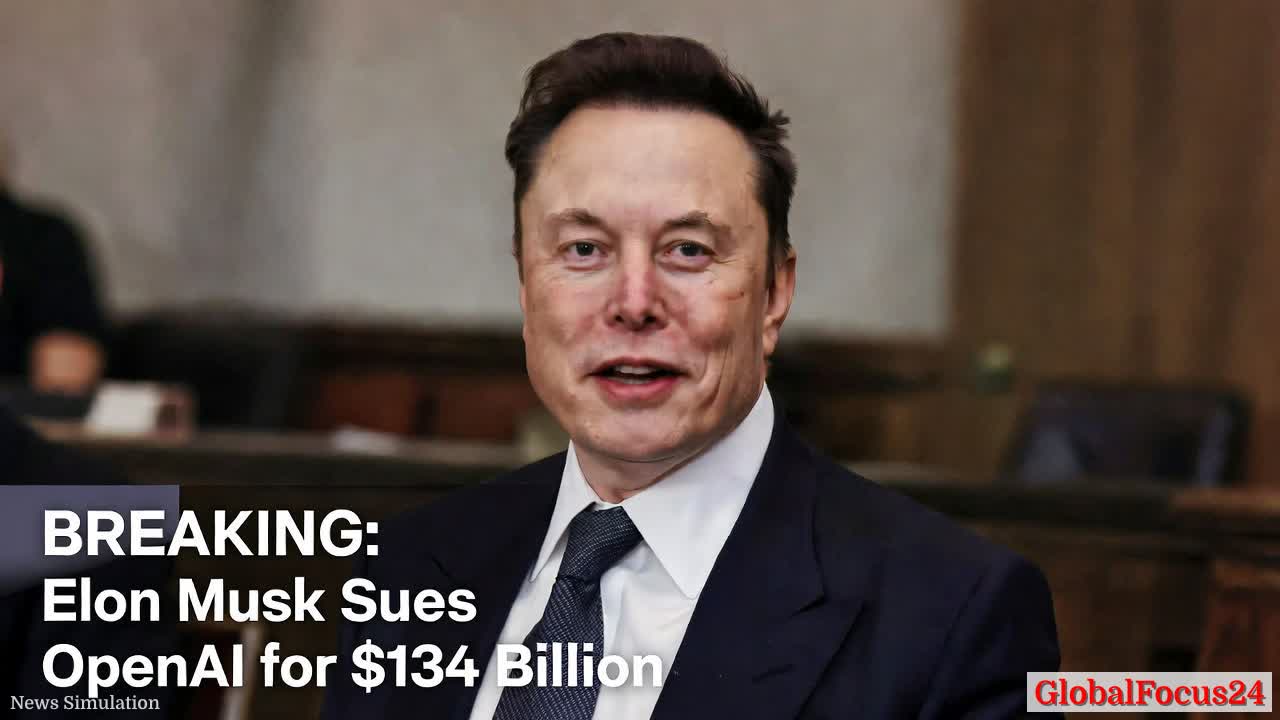
Elon Musk Sues OpenAI for $134 Billion, Alleging Breach of Founding Agreement
A Record-Shattering Lawsuit in Silicon Valley
Elon Musk has filed a sweeping lawsuit against OpenAI, seeking up to $134 billion in damages, in what could become one of the largest private legal claims in U.S. corporate history. The suit, filed in California state court, alleges that OpenAI’s transformation from a nonprofit research lab into a multi-billion-dollar technology powerhouse violated the principles under which Musk initially funded and helped establish the company.
Musk’s legal team claims his early donations—approximately $38 million, starting in 2015—played a decisive role in propelling OpenAI from an idealistic research collective into an artificial intelligence leader now valued at more than $500 billion. The case asserts that Musk is entitled to compensation proportional to that value, arguing that the organization’s current for-profit structure constitutes a breach of its original noncommercial mission.
The battle marks a remarkable turn in the relationship between one of the world’s most prominent entrepreneurs and a company he helped create to “benefit humanity.” It also raises deeper questions about how founding contributions—monetary, intellectual, and visionary—translate into equity or ownership in firms that shift from nonprofit to commercial dominance.
Origins of a Nonprofit Vision
OpenAI was founded in December 2015 as a nonprofit coalition to ensure artificial intelligence would advance in ways that were safe and beneficial. Alongside Musk, early backers included technology leaders such as Sam Altman, Greg Brockman, Ilya Sutskever, and several major venture figures from Silicon Valley.
At the time, the organization positioned itself as a humanitarian counterweight to the profit-driven development of AI by major corporations like Google and Facebook. The founders pledged over $1 billion in combined commitments, though only a portion of that was immediately funded. Musk’s share, estimated near $38 million, made him one of the top contributors.
The group’s stated mission—to ensure the benefits of AI were shared widely—was central to its early branding. Musk frequently warned that unregulated AI posed an existential threat to humanity, emphasizing collaboration over competition. That ethos helped OpenAI attract talent and credibility during its formative years.
But as AI breakthroughs accelerated, so too did the need for massive computing resources and investment. The costs of training models like GPT and its successors ran into the hundreds of millions of dollars, prompting a structural shift that would soon blur the line between nonprofit ideals and private enterprise.
The Shift to For-Profit Structure
In 2019, OpenAI transitioned from a purely nonprofit entity to an unusual “capped-profit” structure, establishing OpenAI LP, a for-profit subsidiary controlled by the nonprofit board. The change aimed to attract large-scale capital while ensuring that profits would be limited to 100 times investors’ returns.
That compromise, however, drew scrutiny from former members and donors. Musk, who had stepped away from OpenAI’s board the year prior, has since expressed disapproval over the company’s alignment with major corporate partners—most prominently Microsoft, which has invested billions into the firm.
According to the lawsuit, Musk’s team contends that this restructuring effectively converted his early philanthropic contributions into seed capital for what is now one of the world’s most valuable AI enterprises. The complaint argues that, had the company wished to pivot toward profit-making, it should have formalized Musk’s financial interest or refunded his contributions rather than unilaterally repurposing them for a commercial venture.
The Legal Foundations of the Claim
Musk’s lawyers are expected to argue that OpenAI’s transformation constitutes unjust enrichment and breach of contract, asserting that a de facto agreement existed among founders to keep the organization nonprofit. While critics note the absence of formal profit-sharing arrangements, Musk’s camp points to internal communications and policy documents referencing OpenAI’s mission “to benefit humanity, not shareholders.”
The damages figure—up to $134 billion—appears to have been derived from an estimated stake in the company’s current valuation had Musk maintained an equivalent investment position. If successful, the claim would rank among the largest individual awards ever seen in a corporate case, surpassing many high-profile technology settlements of the past decade.
Legal experts say the challenge for Musk’s team will be to prove that the founders had a binding contractual understanding that prevented future leadership from adopting a profit-driven model. Most charitable organizations have broad discretion to change their structure, provided they maintain regulatory compliance and update their charters.
Still, the case’s sheer scale and the prominence of its central figures ensure it will draw intense scrutiny—both from legal analysts and from an industry increasingly grappling with questions about ownership in a world dominated by AI-driven intellectual property.
Economic and Industry Implications
The lawsuit’s financial scope has startled investors and boardrooms across the technology sector. A $134 billion judgment—though unlikely to be realized in full—could have significant ripple effects on venture markets and AI valuations globally.
In recent years, AI has become a central driver of corporate value creation, with companies such as Microsoft, Google, and Anthropic competing for dominance in generative language models, autonomous systems, and applied machine learning. Analysts suggest that if Musk’s legal theory gains traction, it could encourage other early contributors or former collaborators to seek compensation from AI firms that began as open or nonprofit collectives.
Such outcomes could complicate future funding arrangements, as investors demand clearer agreements defining equity rights, licensing terms, and intellectual contributions. Some economists warn that uncertainty around pre-commercial phases of AI research could deter long-term collaboration—a hallmark of early AI innovation efforts.
However, others see potential benefits. Formalizing founder agreements could bring transparency and stability to relationships that have often blurred philanthropic intent with entrepreneurial ambition. As one analyst noted, “Musk’s lawsuit might force the industry to clean up its governance models before AI reaches its next stage of global influence.”
A Collision Between Vision and Enterprise
For Musk, the dispute represents more than a financial claim—it is a contest over narrative control in the rapidly evolving field of artificial intelligence. In public remarks following the suit’s filing, he stated, “I’ve lost a few battles over the years, but I’ve never lost a war.” The comment underscores not only his personal stake but also his broader philosophical divisions with OpenAI’s current direction.
Musk has continued to pursue AI development through his own venture, xAI, which focuses on building “truth-seeking” systems intended to combat bias in machine learning models. Industry observers note that the lawsuit arrives as xAI begins expanding its talent base and partnerships, suggesting the legal action could also serve as a strategic move to reaffirm Musk’s leadership in the AI race.
For OpenAI, the timing is equally delicate. The company remains under intense public and governmental scrutiny over safety protocols, licensing transparency, and the economic disruption caused by generative tools like ChatGPT and DALL·E. It is also navigating renewed competition from academic institutions and corporate labs aiming to replicate or surpass its models.
Regional Comparisons and Global Perspective
The Musk-OpenAI clash is not occurring in isolation. Across Asia and Europe, policymakers are closely watching how American courts interpret disputes involving AI ownership and governance. Countries like China, South Korea, and Germany have taken varied approaches to balancing research freedom with commercial accountability.
In China, state-backed AI labs operate under strict national oversight, ensuring that intellectual contributions and funding align with government strategy. In contrast, European regulators—guided by frameworks such as the EU AI Act—have focused on transparency, risk assessment, and ethical compliance rather than direct ownership structures.
If Musk’s claim forces OpenAI to reclassify its early contributions or restructure its profit model, it could inspire similar calls for accountability abroad. Startups that began as open-source collaborations, particularly in the UK and Canada, might face questions about whether their original donors or researchers hold residual rights to the intellectual property now driving billion-dollar valuations.
Historical Echoes in Tech Disputes
Technology history is filled with legal battles where intellectual vision collided with corporate control. From the disputes surrounding Apple’s founding contracts in the late 1970s to ownership conflicts in biotechnology startups during the 2000s, the recurring theme has been how early innovation translates into long-term equity.
Musk’s case recalls similar tensions from the Internet’s early era, when volunteer projects and open-source initiatives evolved into multibillion-dollar corporations. The fundamental challenge remains: how to balance the altruistic origins of collaborative research with the profit imperatives required to sustain global technological infrastructure.
Whether courts side with Musk or with OpenAI, the decision could redefine how founders, donors, and institutions draft mission-based charters for advanced research in artificial intelligence and beyond.
What Comes Next
The legal proceedings are expected to unfold over months, possibly years, given the complexity and unprecedented scale of the claim. OpenAI has yet to release a detailed response, though industry insiders suggest the company will argue that Musk’s contributions were charitable donations with no attached ownership rights or promises of return.
Meanwhile, the lawsuit has reignited public debate over the future of AI governance. Can technology truly serve humanity’s broader interests while generating vast private wealth? And what obligations do pioneers like Musk hold—or forfeit—when the institutions they create outgrow their original ideals?
One thing is clear: the outcome of Elon Musk v. OpenAI will shape not only the trajectory of two of the most powerful figures in modern technology but also the moral and financial frameworks guiding the next era of artificial intelligence.