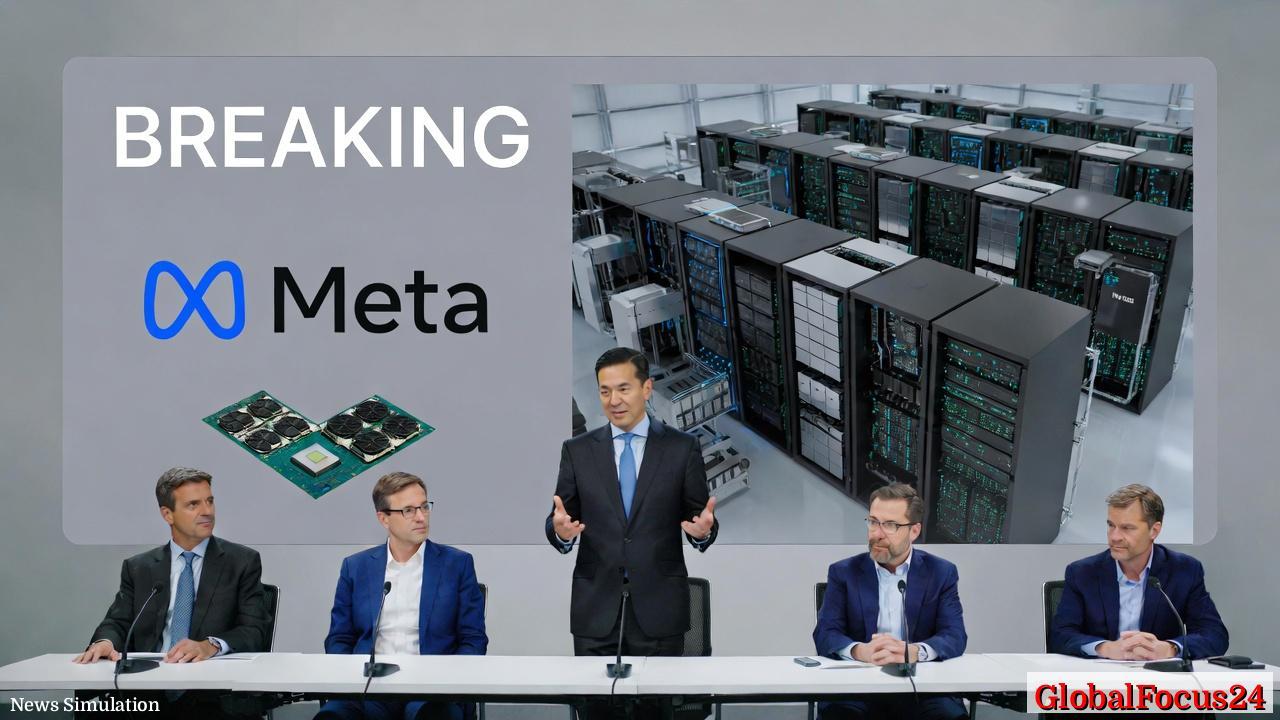
Meta and Nvidia unveil multiyear, multigenerational AI infrastructure partnership reshaping the cloud and data center landscape
In a landmark collaboration announced to accelerate artificial intelligence capabilities across on-premises and cloud environments, Meta Platforms and Nvidia introduced a multiyear, multigenerational strategic partnership designed to expand AI infrastructure at scale. The agreement encompasses a broad spectrum of deployment—from hyperscale data centers optimized for both training and inference workloads to standalone Nvidia Grace CPUs complemented by millions of Nvidia Blackwell and Rubin GPUs across multiple generations. The initiative also integrates Nvidia Spectrum-X Ethernet switches with Meta’s Facebook Open Switching System (FBOSS) platform and leverages Nvidia Confidential Computing technology to safeguard user data in AI-powered features across WhatsApp, while supporting Meta’s long-term AI roadmap, including Vera Rubin platform clusters.
Historical context: the rise of hyperscale AI and the shift to orchestration at scale
The collaboration sits at a pivotal point in the evolution of modern AI infrastructure. Over the past decade, hyperscale data centers have moved from monolithic, device-centric configurations to highly heterogeneous, software-defined ecosystems that blend specialized accelerators with general-purpose compute. Nvidia’s GPUs have become the backbone of large-language model training and inference, while CPU architectures designed for AI workflows have evolved to reduce latency, increase throughput, and improve energy efficiency. Meta—long a pioneer in building vast, globally distributed social platforms—has invested heavily in in-house data center design, software stacks, and AI tooling to process billions of user interactions and generate real-time recommendations. The new agreement crystallizes a strategic vision: unify hardware and software ecosystems across on-premises data centers and cloud environments to accelerate AI innovation while maintaining robust data security and privacy controls.
Economic impact: accelerating investment, efficiency, and regional competitiveness
The economic implications of the partnership are broad and multi-faceted. First, the scale of deployment signals a significant capital expenditure footprint intended to advance Meta’s AI capabilities and accelerate product improvements across its social platforms and messaging services. By adopting Nvidia Grace CPUs and continuing to deploy Blackwell and Rubin GPUs, Meta aims to optimize performance per watt, reduce operational costs through streamlined orchestration, and shorten time-to-value for AI-powered features. The integration of Nvidia Spectrum-X switches is expected to enhance data center interconnect, reducing bottlenecks in data movement between compute nodes and storage, which translates into lower latency and higher throughput for live chat moderation, content understanding, and real-time recommendations.
Second, the multigenerational aspect supports a long-term cost optimization curve. As AI models grow in size and complexity, the ability to scale hardware in generations allows Meta to balance performance gains with depreciation cycles, supply chain resilience, and maintenance costs. This approach reduces the risk of rapid obsolescence and aligns with the broader trend of enterprises transitioning to modular, upgradeable architectures that can be refreshed incrementally without wholesale system overhauls.
Third, the partnership bolsters regional competitiveness by expanding capacity for AI workloads near major user bases. As data sovereignty and localization become increasingly important, the capacity to deploy hyperscale data centers across strategic geographies enables faster service delivery, lower cross-continental latency, and improved reliability. This can support regional AI use cases—from language understanding for varied dialects to customer support automation—while maintaining compliance with data protection laws and industry regulations.
Fourth, the collaboration has potential ripple effects on the broader AI ecosystem. The combination of advanced GPUs, next-generation CPUs, high-speed interconnects, and confidential computing creates a compelling blueprint for other technology companies, data center operators, and cloud service providers. Suppliers and integrators aligned with Nvidia’s hardware ecosystem may experience heightened demand for compute, storage, and networking components, while software developers could benefit from standardized acceleration stacks and optimized runtimes that facilitate model training and inference at scale.
Technological specifics: a multi-faceted hardware and software strategy
- NVIDIA Grace CPUs: The deployment marks Nvidia’s first major use of standalone Grace CPUs in Meta’s AI infrastructure, signaling a shift toward specialized processing for large-scale AI workloads. Grace CPUs are designed to handle memory-intensive tasks and to complement GPUs by offloading orchestration, data preprocessing, and certain model execution phases, enabling more efficient resource utilization and lower latency for complex inference tasks.
- NVIDIA Blackwell and Rubin GPUs: Across multiple generations, Meta plans to deploy millions of these accelerators to support training, fine-tuning, and real-time inference. Blackwell GPUs are built to deliver high computational throughput for transformer-based models and other dense neural networks, while Rubin GPUs are expected to contribute to inference efficiency and energy savings through advanced architecture and optimized software stacks.
- FBOSS with Spectrum-X: Integrating Nvidia Spectrum-X Ethernet switches into Meta’s Facebook Open Switching System strengthens data center networking. This combination promises higher bandwidth, lower latency, and better quality of service for AI workloads, enabling faster synchronization of distributed model training and quicker delivery of personalized experiences across platforms.
- Confidential Computing: Nvidia’s Confidential Computing technology is set to safeguard sensitive data as it moves through AI pipelines. Integrating this technology with WhatsApp-powered features aims to protect user data confidentiality and integrity during processing, a critical consideration given the scale and privacy expectations surrounding messaging services.
- Vera Rubin platform clusters: The long-term AI roadmap includes next-generation Vera Rubin platform clusters, signaling continued investment in scalable, maintainable AI infrastructure. This focus points to a strategic plan for deploying and managing ever-larger models, sophisticated inference pipelines, and advanced data analytics across Meta’s suite of applications.
Regional and industry comparisons: how this partnership stacks up against peers
- Cloud giants and hyperscalers: The Meta-Nvidia alliance aligns with moves by major cloud and AI-first players to standardize accelerated computing across data center fleets. Similar partnerships have surfaced in the sector, emphasizing the importance of integrated GPUs, high-speed networking, and confidential computing in delivering enterprise-grade AI services. Meta’s approach mirrors a broader trend toward multi-architecture stacks that leverage CPUs, GPUs, and specialized accelerators in a cohesive, software-driven environment.
- Data center operators in the region: For technology hubs in North America, Europe, and Asia-Pacific, the partnership underscores the ongoing race to densify AI capacity while balancing operational efficiency, energy usage, and cooling requirements. Regional comparisons reveal differences in energy pricing, grid reliability, and regulatory landscapes, all of which influence decisions about where to place large-scale AI infrastructure.
- Messaging and social platforms: Within the context of social networking and messaging, the collaboration highlights a growing emphasis on AI-driven features such as content understanding, safety moderation, predictive text, and user experience enhancements. The Confidential Computing component addresses rising concerns about data privacy in conversational AI and data-intensive features.
Public reaction and user experience implications
Public reaction to the news reflects a mix of optimism and cautious scrutiny. Users and observers anticipate more responsive services, improved content moderation, and enhanced privacy protections for AI-powered features. However, as with any large-scale deployment of AI infrastructure, questions arise about transparency, control, and the safeguards around data handling, especially in messaging platforms where personal data is central to service functionality. Industry analysts emphasize the importance of robust governance, clear user disclosures, and ongoing performance monitoring to ensure that the benefits of accelerated AI come without compromising user trust.
Operational considerations: scalability, reliability, and supply chain resilience
- Scalability: The planned deployment across multiple generations enables a staged, scalable approach to expanding AI capabilities. This strategy helps Meta manage capacity to meet rising demand while maintaining performance targets as models become more complex.
- Reliability: High-performance interconnects and advanced cooling are critical for maintaining reliability in dense AI environments. The Spectrum-X networking solution paired with optimized software stacks should help minimize latency and maximize uptime for essential services.
- Supply chain resilience: A multigenerational plan supports resilience against component shortages and price fluctuations. By diversifying hardware configurations and planning for ongoing refresh cycles, Meta can better weather market volatility and geopolitical risks that affect semiconductor availability.
What this means for developers and the AI ecosystem
- Developer productivity: With more capable infrastructure, developers can experiment with larger models, faster iteration cycles, and more sophisticated inference pipelines. This can shorten time-to-market for new features and improve the quality of AI-driven user experiences.
- Innovation cadence: The partnership creates a robust platform for researchers and engineers to push the boundaries of AI. As Vera Rubin clusters come online, expectations rise for breakthroughs in multi-modal AI, real-time understanding, and personalized engagement.
- Ecosystem alignment: The collaboration reinforces the importance of coordinated hardware-software ecosystems. Toolchains, libraries, and runtimes optimized for Grace CPUs, Blackwell and Rubin GPUs, and confidential computing are likely to gain traction, making it easier for other players to adopt similar architectures.
Conclusion: a forward-looking milestone in scalable AI infrastructure
The Meta-Nvidia multiyear, multigenerational partnership marks a watershed moment in the deployment of AI at scale. By integrating next-generation CPUs, GPUs, high-speed networking, and confidential computing across on-premises and cloud environments, the collaboration aims to accelerate AI research and product development while safeguarding user privacy and data integrity. The strategic emphasis on scalable, modular hardware generations positions Meta to adapt to rapid advances in model size and complexity, enabling faster deployment of AI-powered features across Facebook, Instagram, WhatsApp, and other platforms.
In a broader sense, the alliance illustrates how industry leaders are converging on a shared blueprint for enabling responsible, high-performance AI at scale. As Meta’s infrastructure evolves, the global tech ecosystem can anticipate a wave of new capabilities—from more capable content understanding to more personalized user interactions—paired with a continued emphasis on security and privacy. The coming years will reveal how these investments translate into tangible improvements in user experience, platform resilience, and the pace of AI-driven innovation across industries.
Follow-up note: If you’d like, I can tailor this article to emphasize a particular regional comparison (for example, North America versus Europe, or Asia-Pacific) or adjust the focus toward a specific AI use case such as messaging, content moderation, or e-commerce recommendations.