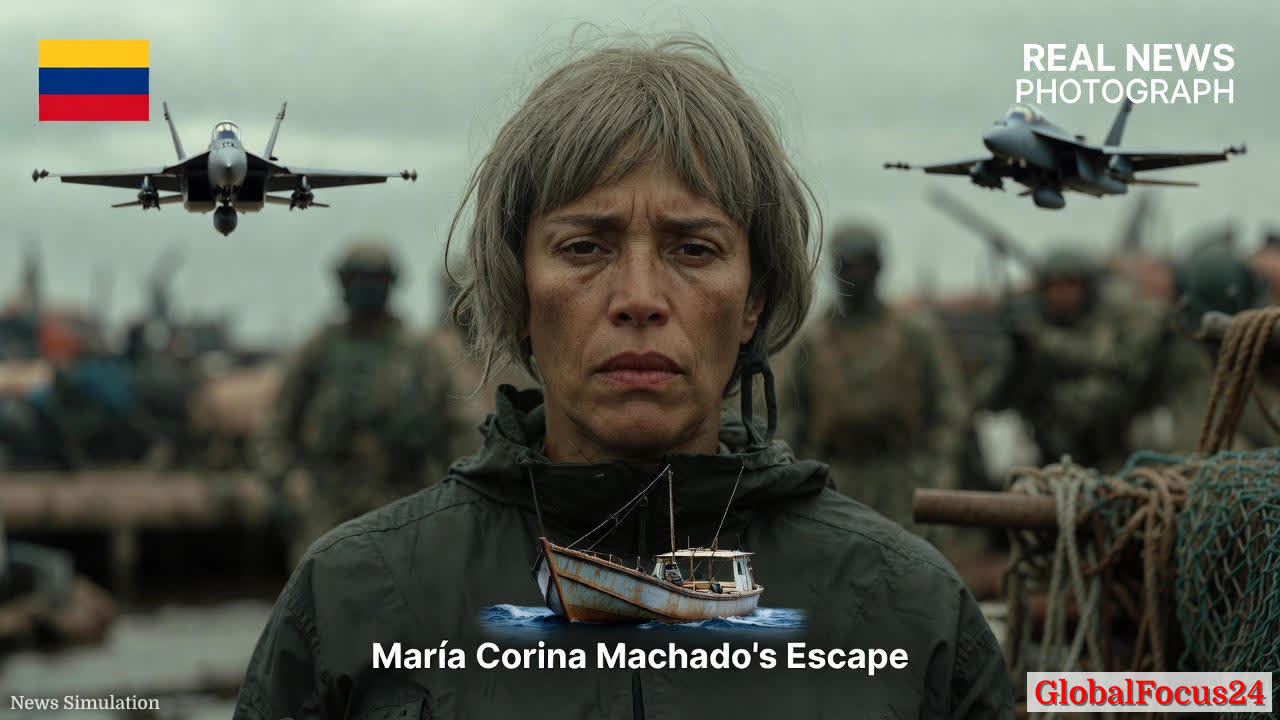
Disguised Escape: A Nobel Laureate’s Flight from Venezuela and Its Regional Ripples
A dramatic, carefully planned escape under disguise and deep concealment has highlighted the fragile state of political safety for opposition figures in Venezuela, while underscoring how international attention and regional dynamics intersect with human-rights concerns, diplomacy, and energy security. This account outlines the sequence of events, places the actions within historical and economic contexts, and compares the situation to broader regional patterns without veering into commentary on policy preferences or partisan outcomes.
Historical backdrop: Venezuela’s political volatility and the draw of international recognition In recent years, Venezuela has endured a protracted crisis characterized by polarized leadership, economic contraction, and persistent protests. The Nobel Peace Prize, awarded to a figure who challenged the governing regime, magnified the tension between domestic political actors and the international community. The award itself has long been a symbol of nonviolent resistance and democratic accountability, yet it also places recipients in difficult positions at home, where authorities may view recognition as an extension of external influence.
The historical arc of opposition leadership in Venezuela reveals a pattern: organizers and public figures frequently maneuver through periods of hiding, exile, and footwork across regional borders to preserve safety and pursue strategic objectives. This pattern is not unique to Venezuela; neighboring countries with porous borders and shared economic dependencies have long provided both refuge and risk for political actors seeking to sustain influence from abroad. The recent escape sequence—winding through multiple checkpoints, seas, and international transit—fits within this broader historical frame while amplifying the stakes linked to the awards and international support networks surrounding dissent.
Operational context: The escape route, the checkpoints, and the sea crossing The escape began in a Caracas suburb, where the subject had spent an extended period in hiding. From there, the plan moved toward a coastal fishing village, where a skiff awaited. The involvement of a network with experience in assisting others to depart the country indicates a leveraging of established routes and informal support structures that operate at the intersection of humanitarian need and political risk.
Passing through more than ten military checkpoints over an approximately ten-hour span underscores the severity and precision required for such a maneuver. Each checkpoint presented a potential impediment to progress or a risk of capture, demanding careful timing, deception, and the ability to adapt to changing security conditions. Reaching the coast by midnight set the stage for the next leg: a voyage across the open Caribbean to Curaçao.
Sea passage on a wooden skiff amid challenging weather conditions illustrates the hazards of irregular movement. Wind and sea states can dramatically influence speed and safety, and the choice of a wooden craft for this leg emphasizes the improvisational nature of the operation. The decision to undertake the crossing despite formidable natural elements highlights the perceived necessity of international refuge and the urgency attributed to entering a secure corridor operated by external actors.
An intermediate coordination step involved an alert to U.S. military forces in the region prior to the sea crossing. The intent was to prevent airstrikes against the vessel, a tactic that has tragically occurred in similar contexts and has broader implications for regional civilian safety and international law. This precaution reflects the evolving calculus of risk management when civilian actors seek safe passage in volatile theaters.
Regional security dynamics: Airspace incursions, deterrence, and the role of the U.S. military presence The late-2025 regional security environment features an intensified U.S. military posture in the Caribbean and northern South America, with airspace activity designed to deter, monitor, and, when necessary, respond to threats against soft targets and noncombatant evacuations. The appearance of U.S. Navy aircraft near Gulf routes during critical transit windows signals a deterrent capability that intersects with humanitarian evacuation needs and political signaling.
This period has seen a broader discussion about the strategic balance between maintaining regional stability and addressing concerns about humanitarian protections for political refugees, opposition leaders, and activists. The close approach by allied forces does not necessarily imply endorsement or direct involvement in the escape, but it does reflect a transnational dimension to the risk calculus faced by individuals seeking asylum and protection.
Arrival in Curaçao and onward travel to Europe Curaçao’s role as a transshipment point in this narrative is notable for its geographic position and its function as a transit hub in the wider network of international relocation. The decisive moment in Curaçao involved a private contractor specializing in extrication, underscoring the privatized, professionalized nature of modern extraction operations. The private sector’s involvement in facilitating movement for high-profile political figures mirrors a broader trend in which specialized services intersect with human mobility, security, and international norms governing asylum and protection.
From Curaçao, an executive jet—stopping in Bangor, Maine, and continuing to Oslo—enabled the arrival in Europe within a compressed timeline that highlighted the rapid cross-continental mobility enabled by global aviation networks. Upon arrival in Oslo, the Nobel ceremony schedule proceeded, and the recipient’s absence during proceedings and the subsequent public acknowledgment by the Nobel staff illustrated the complexity of international recognition in real time.
Public reception and the ceremonial context in Oslo The Oslo ceremony context highlighted a tension between international admiration for nonviolent resistance and the practical realities faced by dissidents who seek refuge during critical moments. The moment of arrival—on a balcony overlooking celebrants, with songs and chants of support—etched a vivid image of global solidarity for those advocating political change. The personal dimensions of the event—such as the recipient’s gratitude and the emotional release expressed in public spaces—demonstrate how international platforms can galvanize supporters across borders, even as the recipients’ futures remain uncertain at home.
Impact on domestic politics and international perceptions Within Venezuela, the response to the escape is multifaceted. Officials have labeled the pathway as a risk to state sovereignty and a potential conduit for external influence aimed at shaping domestic outcomes. Critics of the regime argue that such episodes reveal the fragility of the country’s political system and the vulnerabilities of governance structures under pressure from domestic dissent and international attention.
From an international perspective, the escape highlights the interplay between human rights advocacy, diaspora mobilization, and diplomatic signaling. While the Nobel recognition tends to elevate the profile of the recipient and the broader cause, it also raises questions about the practicality and consequences of exile as a strategic instrument in political advocacy. The event prompts foreign policymakers to consider how to balance principled support for human rights with the potential consequences for regional stability and energy-sector considerations.
Economic impact: A regional lens on energy, investment, and risk Venezuela’s economy remains deeply intertwined with global energy markets, and political instability can reverberate across a network of trading partners, suppliers, and financial institutions. The international spotlight on dissent and the peripatetic movement of political actors can influence investor sentiment, decision-making in state-led energy projects, and the pace of economic reforms. In neighboring countries, regional energy trade and the management of shared resources amplify the stakes of political events in Venezuela, shaping response patterns from markets and policymakers alike.
The optics of exile in such cases often intersect with questions about investment risk, talent retention, and the resilience of supply chains tied to crude oil, natural gas, and mineral resources. For regional economies, the ability of opposition figures to maintain influence from abroad—through advocacy, diplomacy, or public persuasion—has implications for how governments position themselves in international forums and how they negotiate with private sector stakeholders who watch for signals about stability and policy predictability.
Regional comparisons: Echoes of similar episodes in other countries Across Latin America and the Caribbean, history offers a spectrum of episodes in which political actors depart, seek asylum, or rally international support while maintaining influence from abroad. In some cases, exiles have leveraged international platforms to advocate for change and to exert pressure on home governments. In other scenarios, exiles face restrictions on return and legal jeopardy that complicate their ability to contribute to domestic outcomes. Comparative analysis suggests that the effectiveness of exile as a strategy depends on a combination of international legitimacy, diaspora engagement, and the receptivity of foreign governments to bipartisan dialogue on human rights and democratic governance.
Public reaction: Voices from society, supporters, and detractors Public sentiment surrounding such escapes often encompasses a mix of admiration for courage and concern about the consequences of destabilization. Supporters emphasize the importance of international oversight, human rights protections, and the moral imperative to protect political dissidents facing repression. Detractors warn against external interference and the risks associated with high-profile exiles using global platforms to shape domestic policy debates. In transitional moments like these, opinion often crystallizes around questions of accountability, the prospects for a peaceful path forward, and the extent to which international engagement can contribute to durable political reform.
What comes next: Plans, risks, and potential trajectories The individual at the center of this narrative has indicated an intention to rest briefly before embarking on a broader European itinerary to build international advocacy for Venezuela. The plan to visit Washington, among other capitals, reflects a calculated approach to enriching the discourse around Venezuela’s political and humanitarian context. The potential return to Venezuela remains a point of considerable risk, given legal and political pressures that could accompany travel back to the country. The outcome will hinge on how domestic authorities balance lawful process, political considerations, and the practical realities of enforcing travel restrictions against prominent opposition figures.
Conclusion: A moment of historical significance with enduring questions The escape of a Nobel Peace Prize recipient from Venezuela encapsulates a moment where personal risk intersects with international diplomacy, regional security concerns, and global attention to human rights. It surfaces critical questions about how political leadership, civil society, and foreign allies shape pathways for accountability, reform, and resilience in environments marked by volatility. While the immediate narrative focuses on one dramatic journey, the broader implications touch on energy markets, regional stability, and the ongoing struggle for a political order that can sustain dialogue, legitimacy, and hope for ordinary citizens facing economic and social pressures.
Notes on verifiability, ethics, and ongoing developments As with any rapidly evolving story involving political actors, security operations, and international diplomacy, developments are subject to change. Fact-checking from multiple, independent sources helps maintain accuracy, while careful attention to privacy and safety guidelines is essential when discussing sensitive operational details. Readers seeking a deeper grasp of the surrounding regional dynamics may explore historical trajectories of dissent in Venezuela, regional migration patterns, and the role of international institutions in safeguarding human rights during political transitions.