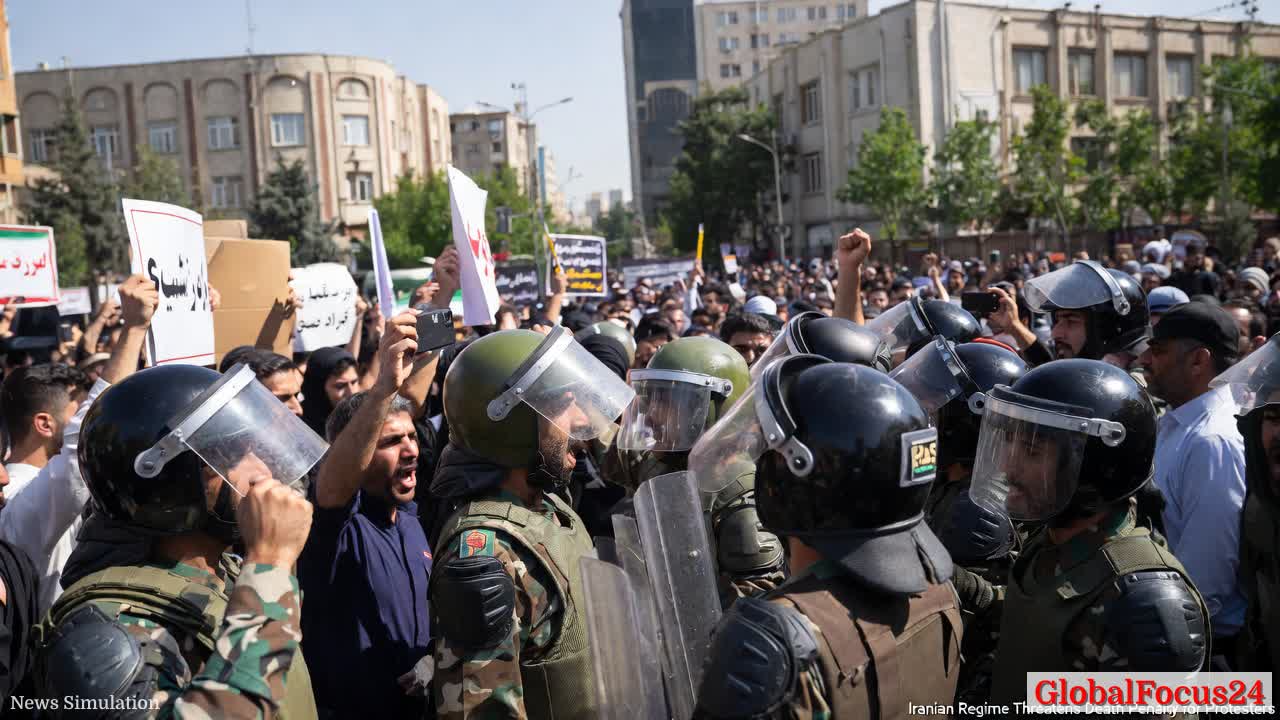
Iran’s AG Declares Protesters “Enemy of God” Amid Escalating Crackdown and Global Tensions
The decision by Iran’s attorney general to label protesters as an “enemy of God” marks a sharp escalation in the Islamic Republic’s handling of widespread demonstrations that began in late December and have since spread across major cities. The announcement, delivered on state television, signals to the public and to observers abroad that the regime intends to treat dissent as an existential threat rather than a security challenge. The development arrives at a moment when Iran’s economy remains fragile, international pressures persist, and regional dynamics continue to shift in ways that could influence the trajectory of protests and the government’s response.
Historical context: a long arc of public dissent and managerial responses Iran’s encounter with mass street demonstrations is rooted in a complex history of political contestation, economic hardship, and social mobilization. Since the 1979 revolution, the government has repeatedly faced episodes of large-scale protest, often spurred by a combination of economic grievances, perceived limits on personal freedoms, and skepticism toward elite governance. The current protests, initially sparked by concerns over economic stagnation, inflation, and currency devaluation, have evolved into a broad-based demand for political reform and greater civil liberties. The government’s historical playbook has typically combined denials of legitimacy, selective concessions, and, in some periods, intensified security measures to deter collective action. The latest decree aligns with a longstanding pattern where authorities frame dissent as a violation of national security and religious orthodoxy, thereby justifying stern legal and institutional responses.
Economic impact: ripple effects on energy, investment, and consumer sentiment Iran’s economy has faced persistent headwinds, including sanctions-based constraints, inflationary pressures, and currency volatility. Prolonged unrest compounds these challenges in several ways:
- Investor confidence and capital flight: heightened political risk can deter both domestic investment and foreign capital participation in key sectors, including energy, manufacturing, and infrastructure projects.
- Trade and sanctions dynamics: ongoing tensions with external actors influence Iran’s access to international markets and disrupt supply chains, which, in turn, can affect inflation, import costs, and the cost of living for ordinary citizens.
- Domestic consumption and employment: when confidence erodes, consumer spending typically slows, impacting small businesses and regional markets that rely on steady demand.
- Government funding and social programs: reputational risk and potential sanctions pressure may constrain fiscal space for social subsidies and subsidy reforms, affecting households and small enterprises.
Regional comparison: Iran’s approach versus peers facing protests Across the Middle East and parts of Asia, governments have employed a spectrum of strategies to address large-scale demonstrations. In some cases, authorities have pursued dialogue, limited reforms, and targeted reforms to ease public grievances. In others, security-first approaches, including curfews, restricted internet access, and a heavy security presence, have prevailed. Iran’s recent framing of protesters as “enemy of God” places it closer to the latter end of the spectrum, reflecting a readiness to use criminal charges tied to religious orthodoxy as a tool to deter participation and justify harsher penalties. By contrast, several neighboring economies with substantial civil society engagement have experimented with more incremental policy adjustments and safer channels for political expression, though all face balancing acts between stability, legitimacy, and reform.
Public reaction: uncertainty, resilience, and information gaps As authorities tightened information channels and imposed communications blackouts, public reaction has been shaped by uncertainty and fear, but social resilience remains evident. Protests have drawn participation from diverse demographic groups, including students, labor activists, and ordinary citizens dissatisfied with economic conditions. In urban centers, residents have described a sense of urgency around sustaining livelihoods while navigating the risks associated with participation in demonstrations. International observers and humanitarian organizations continue to monitor the situation closely, underscoring the potential for escalation should the state pursue a harsher crackdown or, alternatively, seek negotiation and visible concessions to quell unrest.
Legal framework and human rights considerations The use of the “enemy of God” charge underscores the intersection of religion, law, and politics in Iran’s governance model. Within the Islamic Republic’s legal framework, charges tied to national security and public order can carry severe penalties, including the death penalty in extreme cases. This development raises robust questions for international human rights observers about due process, fair trial guarantees, and proportionality in the application of punishment. The public international response typically centers on calls for restraint, protection of demonstrators, and adherence to due process norms, balanced against concerns about regional stability and diplomatic relationships.
Security apparatus and operational implications The government’s redoubling of punitive language aligns with expectations of increased security operations designed to prevent escalation and limit the influence of protest networks. Security dynamics in such contexts often include:
- Expanded police and security presence in urban centers to deter large gatherings.
- Monitoring and control of communications to disrupt organization and dissemination of protest materials.
- Legal actions aimed at prosecuting participants on charges framed as national security or religious offenses. These operational choices can have broad social and economic repercussions, including further disruptions to daily life, business activity, and public trust in institutions.
International reactions and potential trajectories The international response to Iran’s crackdown is likely to be a mix of sanctions pressure, diplomatic messaging, and, in some cases, appeals to humanitarian considerations. While some global actors press for de-escalation and dialogue, others emphasize the importance of protecting human rights and civil liberties. The risk of miscalculation remains high in such environments, where external interventions—whether military, economic, or cyber—could produce unintended consequences for regional stability and global energy markets. Analysts continue to weigh the likelihood of intensified sanctions, mediation efforts, or renewed negotiations on broader economic and political reform.
Infrastructure and internet access: a critical bottleneck Internet blackouts and communications restrictions can complicate both protest coordination and the spread of verified information. While such measures may temporarily hinder organizing efforts, they also impede economic activity, limit emergency communications, and prevent timely reporting on conditions on the ground. The resilience of affected communities often reflects adaptive strategies—relying on alternative networks, word-of-mouth dissemination, and local organizing structures—to sustain civic engagement under restricted conditions.
Historical resonance and the calendar of protests Past waves of dissent in Iran have followed patterns of initial economic grievance that broaden into national political demands. Observers note that the persistence and scale of the current protests have created a challenging coordinate for the regime, as domestic economic pressures remain intertwined with questions about governance, legitimacy, and personal freedoms. The unfolding events thus carry substantial historical resonance in terms of how the state negotiates its social contract with citizens and how long-lived reformability remains within the political system.
Implications for the broader region The situation in Iran has implications for neighboring markets and security calculations. Neighboring economies that interface with Iran through trade, energy transit, and cross-border commerce could experience indirect effects from capital flows, sanctions dynamics, and regional stability concerns. For regional policymakers, the episode reinforces the importance of crafting responses that balance stability with humane considerations, while encouraging channels for peaceful dialogue and gradual reform.
Public communications and media coverage Accurate, timely reporting remains essential in environments where information is tightly controlled. Independent verification of casualty figures, detentions, and access to healthcare is critical for maintaining public accountability and informed civic participation. Media audiences worldwide consume updates through a mix of domestic outlets and international organizations, underscoring the global audience’s demand for transparency and consistency in reporting.
Looking ahead: potential paths to resolution Several plausible trajectories could unfold in the coming weeks and months:
- Escalation and crackdown: a continuation of the current approach, with further prosecutions and increased security operations, potentially intensifying domestic hardship and public risk.
- Limited concessions: targeted reforms aimed at addressing specific economic grievances while preserving core political structures, potentially cooling tensions without yielding broader political changes.
- Dialogue and reform: renewed negotiations and confidence-building measures that open space for civil society engagement, electoral considerations, or governance reforms that could tilt the balance toward a more inclusive political process. Each path carries trade-offs between stability, legitimacy, and social cohesion, and the choice will largely reflect the regime’s assessment of its staying power, external pressure, and the perceived costs of continued unrest.
Conclusion The designation of protesters as an “enemy of God” represents a decisive moment in the current cycle of Iran’s domestic upheaval. It underscores the regime’s willingness to deploy the full weight of its legal and security apparatus in response to dissent, while economic fragility and regional dynamics continue to shape the broader context. As the situation evolves, observers will be watching not only for the immediate security outcomes but also for signs of whether economic pressures and civil society demands can converge toward a pathway that maintains social order while safeguarding fundamental rights. The coming weeks are pivotal in defining Iran’s trajectory—economically, politically, and socially—while informing regional assessments of risk, investment climates, and the global conversation about governance, human rights, and stability in one of the region’s most consequential theaters.