Breakthrough in Integrated Photonics Paves the Way for Scalable Quantum Communication Networks
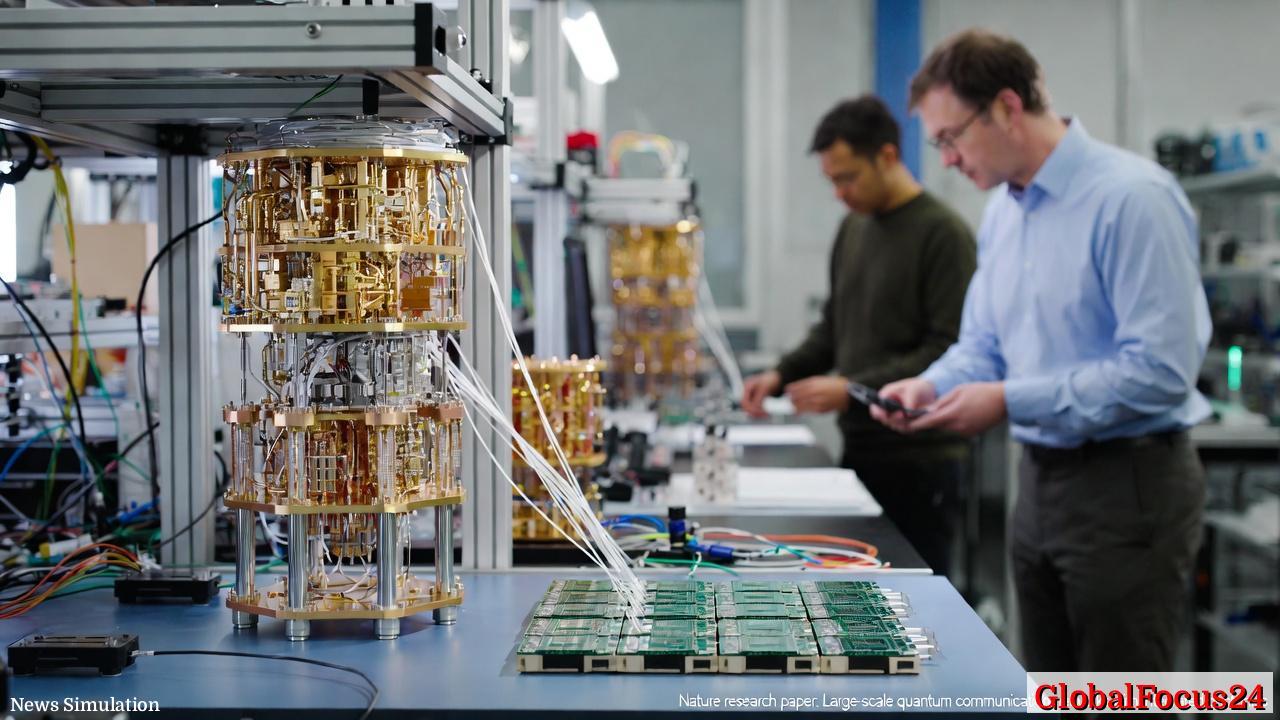
In a major milestone for the future of secure global communication, researchers have achieved large-scale quantum communication networks powered by integrated photonics. The breakthrough demonstrates how chip-based photonic circuits can transmit quantum information efficiently across multiple network nodes, marking a significant step toward practical quantum internet infrastructure.
From Laboratory Concept to Scalable Quantum Networks
Quantum communication has long promised ultra-secure data transfer based on the principles of quantum mechanics. Unlike classical communication systems that rely on electrical signals, quantum networks transmit information through quantum states of photons — particles of light — enabling fundamentally secure channels that cannot be intercepted without detection.
Until now, most demonstrations of quantum networks operated on a limited scale, often linking two or three nodes using bulky optical setups that required precise alignment and stabilization. The new research, however, overcomes these limitations by harnessing integrated photonics — a technology that embeds optical components such as waveguides, modulators, and detectors directly onto semiconductor chips.
This integration allows for the miniaturization and mass production of quantum network elements using methods similar to those in the semiconductor industry. The result is a more scalable, stable, and energy-efficient architecture capable of supporting quantum communication across extensive distances and complex network structures.
How Integrated Photonics Enhances Quantum Information Transfer
Integrated photonics offers several advantages crucial for the realization of a quantum internet. First, the technology enables the generation, manipulation, and detection of quantum states on a compact platform. Photonic chips can also be precisely engineered to minimize signal loss and environmental interference, two major challenges in maintaining quantum coherence — the fragile state that preserves quantum information.
In the latest experiments, researchers demonstrated the creation of entangled photons — light particles whose quantum states are intrinsically linked — across multiple on-chip nodes. By routing entangled photons through integrated photonic circuits and fiber-optic channels, the team successfully established quantum links capable of supporting secure information transfer over extended distances.
Such demonstrations are critical stepping stones toward distributed quantum computing systems, where quantum processors in different locations could communicate seamlessly through photonic networks. Integrated photonics provides the physical basis for scaling this model while keeping construction and maintenance costs low.
Historical Progress Toward the Quantum Internet
The concept of the quantum internet dates back to the early 2000s when physicists first proposed harnessing quantum entanglement for long-distance communication. Early proof-of-principle experiments, including satellite-based quantum key distribution and fiber-based quantum teleportation, established that quantum states could be transmitted securely over tens or even hundreds of kilometers.
However, extending quantum networks beyond these limits faced significant technical barriers. Traditional optical setups were too bulky and unstable to operate at the scale of existing digital communication networks. Integrated photonics changed that trajectory by enabling quantum functionalities on chips smaller than a human fingernail.
Over the past decade, the convergence of quantum optics and silicon photonics has accelerated rapid advancements. Novel fabrication techniques now support hybrid integration, combining quantum emitters such as color centers or quantum dots with silicon and silicon nitride photonic circuitry. This approach allows direct generation of quantum states within scalable, low-loss chips — a crucial step toward a practical, global quantum communication framework.
The Economic and Technological Impact
The economic implications of scalable quantum communication networks extend across multiple sectors, from cybersecurity and finance to healthcare and defense. Quantum-secure communication could protect sensitive information from potential attacks by quantum computers, which are predicted to eventually render current encryption standards obsolete.
Major technology firms and research institutions are already investing in integrated photonics as a foundation for commercial quantum infrastructure. Analysts forecast that the quantum communication market could surpass several billion dollars in value over the next decade as demand for secure information transfer and networked quantum devices grows.
The integration of photonic components onto chips also aligns with global sustainability goals. Compact, energy-efficient quantum photonic devices consume significantly less power than traditional laser-based systems, reducing operational costs for large-scale deployments. As manufacturing scales, economies of production could make quantum communication technology widely accessible.
Regional Developments and Global Competition
North America, Europe, and Asia are all racing to dominate quantum communication and integrated photonics. The United States has launched national quantum initiatives combining federal funding with private-sector partnerships to accelerate domestic innovation. Multiple national laboratories and universities in California, Illinois, and New York are developing prototype quantum network testbeds based on photonic integration.
In Europe, large-scale projects like the Quantum Internet Alliance are connecting research institutions across the continent with experimental quantum links using integrated photonic nodes. The European Union’s Quantum Flagship program continues to support development of quantum hardware, communication protocols, and industry partnerships under a unified strategic roadmap.
Meanwhile, China has made significant progress in combining quantum communication infrastructure with satellite-based entanglement distribution, extending quantum links to intercity networks and beyond. These efforts underscore the global strategic importance of quantum communication technologies in securing data and establishing technological leadership in the emerging quantum economy.
The Role of Hybrid Quantum Systems
A crucial factor in the evolution of quantum networks lies in the ability to link different types of quantum systems. Photonic quantum systems, while excellent at transmitting information, are not ideal for storage. To create practical networks, photons must interface with quantum memories and processors based on atoms, ions, or solid-state qubits.
Integrated photonics facilitates these hybrid connections by providing a bridge between stationary qubits — which store quantum information — and traveling photonic qubits that transmit it. Recent demonstrations have shown efficient coupling between photonic circuits and quantum memories using optically active defects in diamond and rare-earth-doped crystals. Such integrations could ultimately enable quantum repeaters, vital components needed to extend quantum networks over continental scales.
Barriers and Next Steps
Despite the remarkable progress, challenges remain. Maintaining quantum coherence over long distances still requires advanced error correction and noise-resistant materials. Integrating quantum light sources directly on photonic chips remains a complex engineering task, as does scaling networks while preserving synchronization between multiple quantum nodes.
Researchers are also exploring new materials, such as lithium niobate and indium phosphide, that promise improved efficiency and tunability for on-chip quantum components. Advances in nanofabrication, combined with machine-learning-based optimization of circuit design, are expected to accelerate the performance and yield of quantum photonic chips in the near future.
Another frontier involves standardizing quantum network protocols and interfaces. Just as classical internet protocols enabled global connectivity, quantum networks will require universally compatible standards to interlink different systems securely and reliably.
A Vision for the Quantum Internet Era
The successful demonstration of large-scale quantum communication networks using integrated photonics represents more than a technological milestone — it signals the beginning of a new communication paradigm. Future quantum networks could enable applications far beyond secure messaging, including distributed quantum computing, ultra-precise sensing, and advanced scientific simulations.
In this emerging landscape, integrated photonics acts as both the backbone and catalyst. Its scalability, reliability, and synergy with existing semiconductor manufacturing processes make it the natural platform for building universal quantum infrastructure. What was once confined to laboratory experiments is now evolving into a foundation for globally networked quantum systems.
As researchers continue linking photonic quantum nodes across larger distances and refining chip-based architectures, the dream of a fully functional quantum internet moves steadily closer to realization. The latest achievements show that the components of this network — once theoretical — are now taking tangible, integrated form on silicon chips, laying the groundwork for the next revolution in information technology.