Nigeria and Global Births in 2025: A Population Surge Reframing Economic and Geopolitical Outlook
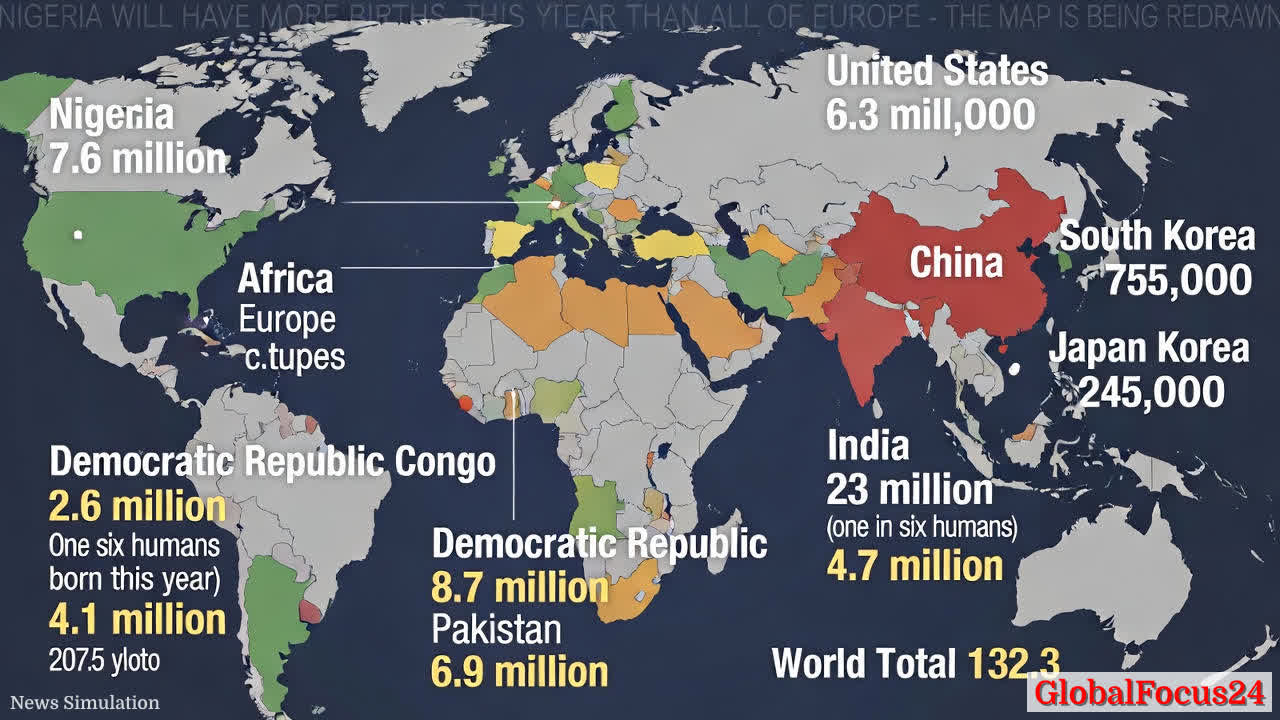
In 2025, the world faces a striking demographic pivot: the number of births across several oil-rich and developing regions reshapes future labor markets, consumer demand, and regional power dynamics. New projections indicate Nigeria will lead global birth totals with approximately 7.6 million births this year, eclipsing the entire European continent’s combined births of about 6.3 million. India remains the globe’s most prolific source of newborns, with an estimated 23 million births—roughly one in six babies born worldwide. China follows with 8.7 million births, while Pakistan records 6.9 million. The Democratic Republic of Congo is expected to contribute 4.6 million births, surpassing the United States in that metric. Africa as a regional bloc is projected to account for 47.1 million births in 2025, driven by eight countries among the world’s top 30 birth totals. In stark contrast, Japan and South Korea report sharply slowing fertility, each with fewer than 750,000 and 245,000 births respectively, underscoring divergent fertility trajectories across Asia. The global total is projected at 132.3 million births, a figure poised to influence economic growth models, education systems, and geopolitical alignments for decades.
Historical context: fertility trajectories and development phases Demographic patterns in the 21st century have followed a familiar arc: high birth rates in many low- and middle-income countries transitioning toward stabilization as economies grow, healthcare improves, and urbanization accelerates. Yet in 2025, several regions defy a simple narrative. Nigeria’s birth projection sits at the center of a larger West African demographic expansion that has persisted through the late 2010s and early 2020s. Nigeria’s population growth has been propelled by a youthful age structure, improving life expectancy, and sustained improvements in maternal health, even as urban migration intensifies the demand for education, housing, and infrastructure.
India’s continued population growth is a reminder of its status as a young nation with a large birth cohort. While literacy and female labor-force participation have risen in many states, cultural, socioeconomic, and regional disparities shape fertility choices. China’s birth figures reflect a gradual revival after decades of policy-driven low fertility, combined with rising parental aspirations and urban living challenges. Pakistan’s birth numbers align with persistent fertility rates in parts of South Asia, where early marriages and evolving family norms interact with healthcare access and economic pressures.
The Democratic Republic of Congo’s expected 4.6 million births highlight a persistent pattern in Central Africa: countries with high young- population shares but variable access to healthcare and education still experience rapid population momentum. Africa overall remains the fastest-growing continental population, a trend with profound implications for labor markets, urban planning, and regional integration initiatives across the continent.
Economic impact: labor, consumption, and development financing The 2025 birth totals have immediate macroeconomic implications. A larger cohort of young people translates into a swelling labor supply over the medium term, potentially lifting growth if accompanied by job creation, skill development, and durable infrastructure. Countries with strong educational systems and scalable vocational training are better positioned to convert demographic dividends into sustained economic expansion. Conversely, regions grappling with unemployment or underemployment may confront heightened competition for jobs, pressure on public services, and the need for policy reforms to harness youthful energy productively.
Household consumption will also be reshaped. A growing youth population tends to push demand for education, housing, mobile technology, and consumer durables. Retail sectors and financial services providers may recalibrate offerings toward younger demographics, including microfinance, digital payment platforms, and affordable credit products for first-time buyers. Governments may respond with targeted investments in schools, apprenticeships, health services, and public transport to accommodate population growth and productivity goals.
Education and skills dynamics Education systems face heightened demand as millions of young people enter or move through schooling and training. Countries with expanding cohorts must manage resource constraints, including classroom capacity, teacher recruitment, and infrastructure adequacy. The quality and relevance of education—emphasizing science, technology, engineering, and mathematics (STEM), as well as vocational training—will determine whether increased birth rates translate into a more productive workforce.
Digital education tools and public-private partnerships offer pathways to scale. In regions with high birth rates and limited public funding, blended learning models, mobile-based training, and community schools can expand access. Equally important is aligning curricula with labor market needs, fostering entrepreneurship, and supporting higher education pathways that connect graduates to local and regional employers.
Regional comparisons: Africa, Asia, and beyond
- Africa registers a pronounced birth momentum, with the region contributing a substantial share of global births. This pattern underscores both opportunity and challenge: while Africa’s young population holds promise for long-term growth, it also requires accelerated investments in health, education, electricity, and transportation to convert potential into realized outcomes.
- South Asia continues to be a demographic engine, driven by India and Pakistan. The interaction of population growth with rapid urbanization, climate resilience concerns, and economic reform agendas will influence regional stability and supply-chain dynamics.
- East Asia faces a different trajectory. Japan and South Korea illustrate aging societies with shrinking youth cohorts, which necessitate policies to sustain productivity, maintain social welfare systems, and manage labor shortages through automation and immigration pathways where appropriate.
- Europe’s relatively lower birth totals in 2025 reflect sustained or slowing population growth that intersects with migration flows, labor-market reform, and funding for aging populations. The contrast with Africa and South Asia highlights how regional demographics shape economic strategy and political priorities.
Public reaction and policy responses Public sentiment around rapid population changes often centers on education opportunities, job prospects, and social services. In countries experiencing strong birth momentum, communities may advocate for greater investment in early-childhood development, maternal health programs, and inclusive education to ensure that every child has a path to economic participation. Policymakers face the task of building resilient infrastructure—transport, power, water, and digital networks—that can accommodate larger numbers of students, workers, and families.
Policy responses across regions typically emphasize three pillars: expanding human capital, enabling female participation in the workforce, and creating an enabling business environment. Investments in primary and secondary education, vocational training, and apprenticeships help to translate a rising youth population into a productive future workforce. Women’s empowerment initiatives, including access to reproductive health services and equitable job opportunities, have proven effective in aligning fertility trends with broader development goals. Finally, macroeconomic stability, credible governance, and transparent institutions create the confidence needed for private investment and long-term planning.
Geopolitical considerations: population as soft power Population dynamics influence geopolitical influence in multiple ways. Large, youthful populations can bolster a nation’s human capital base, driving innovations and domestic market size that attract foreign investment. Countries with diversified economies and high-quality institutions may leverage demographic momentum to achieve greater regional leadership. Conversely, rapid population growth without commensurate job creation or regional integration can fuel social tensions, migration pressures, and regional disparities.
Comparative regional strategies that calibrate immigration, education, and economic reform may determine how nations ride demographic shifts toward greater influence. As global economies recalibrate post-pandemic and amid technological change, demographic profiles become more salient in assessing long-term growth potential and resilience.
Environmental and health considerations The environmental footprint of population growth and the health of birth cohorts are intertwined with development trajectories. Infrastructure planning must consider water and energy demands, waste management, and climate resilience. Public health systems that prevent and manage communicable diseases, maternal health care, and adolescent health programs contribute to sustainable growth. Efficient, scalable health services reduce the burden on families and governments while supporting a healthier, more productive workforce.
Conclusion: a 2025 snapshot with decades to come The 2025 birth projections present a nuanced portrait of a world where demographic forces intersect with economic ambitions, regional realities, and global strategic considerations. Nigeria’s projected 7.6 million births, closely followed by India’s 23 million, China’s 8.7 million, and Pakistan’s 6.9 million, illustrate a world where population momentum remains a central driver of development policy. Africa’s overarching birth totals and the presence of eight top-30 birth countries on the continent emphasize the urgency for sustained investment in health, education, and infrastructure to convert potential into durable prosperity.
As policymakers, businesses, and communities navigate this demographic moment, the emphasis remains on inclusive growth, job creation, and resilient systems that can adapt to both rapid change and long-term uncertainty. The year 2025 thus stands as a pivotal reference point in the ongoing narrative of how humanity’s population dynamics shape economies, trajectories, and the contours of global power for years to come.