)
Elon Musk’s Mars Milestone: A Pay Package Tied to a Permanent Colony
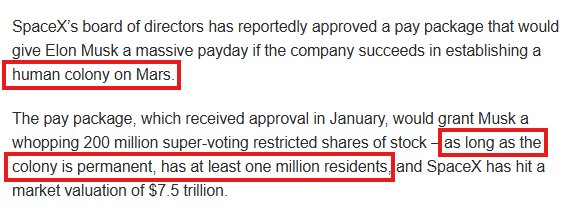
A high-stakes incentive program linked to SpaceX’s long-term ambitions has attracted attention from investors, policymakers, and space enthusiasts alike. The centerpiece is a proposed compensation arrangement that would grant Elon Musk 200 million Super-Voting Shares only if SpaceX establishes a permanent Mars colony housing at least one million residents. The concept, while bold, prompts a broader conversation about the economics, feasibility, and regional implications of humanity’s next great frontier.
Historical context: ambitions that shape modern space ventures
Space exploration has always blended science, engineering, and audacious long-term planning. From the early days of orbital missions to the establishment of the International Space Station, the arc of human spaceflight has repeatedly hinged on durable visions that extend beyond quarterly results. The current proposal echoes a tradition of incentive structures designed to align leadership incentives with horizon-year milestones. In practice, such arrangements aim to convert a founder’s strategic patience into measurable, auditable outcomes that can sustain heavy capital expenditure and complex governance across decades.
The idea of colonizing Mars sits at the intersection of technology readiness, risk tolerance, and societal ambition. Technologists point to incremental steps—robotic precursor missions, in-situ resource utilization, life-support innovations, and habitat design—that could eventually render a permanent presence feasible. Economists weigh the enormous upfront cost against the potential long-run benefits: new markets for space-derived materials, scientific breakthroughs, and the ultimate diversification of human civilization. Yet the path remains uncertain, with challenges ranging from radiation protection and sustainable food systems to political authorization and global cooperation on off-Earth infrastructure.
Economic impact: from ignition of investment to regional ripple effects
A Mars colony program of this scale would reverberate across multiple layers of the economy. First, the funding architecture would likely involve a mix of private capital, strategic partnerships, and public-sector support, given the infrastructure, research, and regulatory groundwork required. The direct investment—funds allocated toward propulsion systems, habitat modules, life-support technologies, and closed-loop resource cycles—could spur a cascade of supplier activity, job creation in specialized engineering disciplines, and demand for high-technology manufacturing. In addition, the development of a Mars-focused ecosystem would create demand for software platforms, data analytics, autonomous systems, and resilient communication networks capable of operating across interplanetary distances.
Second, regional economies would feel spillovers beyond the immediate space hardware supply chain. For example, regions with strengths in aerospace manufacturing, robotics, advanced materials, and propulsion research could experience elevated demand for talent, infrastructure upgrades, and accelerated research collaborations. Conversely, communities not currently embedded in high-tech ecosystems could face transitional pressures as labor markets reallocate toward more specialized, capital-intensive activities. Such shifts underscore the importance of workforce development, retraining programs, and investment in STEM education to ensure broad-based benefits.
Third, the societal and financial implications of a one-million-person Mars settlement would hinge on governance, sustainability, and resilience. The economics of a space colony hinge on the ability to establish reliable life-support systems, energy generation, and closed-loop ecosystems that minimize dependency on Earth for essentials. The capital intensity of establishing a self-sustaining habitat—capable of producing air, water, food, and energy at scale—raises questions about cost curves, risk sharing, and timelines. Investors and policymakers would likely look for milestones that illuminate progress, such as autonomous habitat maintenance, scalable food production, and redundant life-support architectures, before committing to broader funding rounds.
Regional comparisons: how Earth-based milestones inform interplanetary bets
Comparing the Mars colony concept to other large-scale, long-horizon ventures helps illuminate potential trajectories. For instance, offshore oil and gas mega-projects, though operating in a different domain, illustrate how capital-intensive, multi-year projects require staged financing, logistical coordination, and robust risk management. In the realm of renewable energy, grid-scale storage and reliability challenges mirror some of the systemic risks anticipated in a Mars settlement, offering lessons about supply chain resilience and the value of modular, scalable solutions.
Within the aerospace sector, nations and regions with mature aerospace clusters—such as parts of the United States, Europe, and East Asia—stand to benefit from technology spillovers even if the Mars project remains decades away. Military and civilian space programs already drive intense research in radiation shielding, life support, and autonomous systems, which could feed directly into planetary habitation initiatives. The regional comparison highlights how steady demand for high-precision components, testing facilities, and collaboration networks can cushion economies against cyclic downturns and accelerate knowledge transfer.
Public reaction: optimism, caution, and policy considerations
Public sentiment toward ambitious space endeavors is often a mix of wonder and pragmatism. Enthusiasm tends to rise when milestones are clearly defined and when the strategic value is presented in terms of scientific discovery, national prestige, or new economic opportunities. Yet skepticism persists about timelines, cost control, and the feasibility of sustaining human life on Mars over long durations. Public interest in the mission’s governance structure, safety protocols, and return-on-investment models underscores the importance of transparent reporting, independent oversight, and well-communicated risk management strategies.
Policy frameworks would play a critical role in shaping the feasibility of a Martian settlement. International collaboration would be essential to address cross-border concerns related to space traffic management, resource utilization rights, and environmental stewardship of celestial bodies. National programs could explore space-policy alignments that encourage private-sector leadership while ensuring compliance with planetary protection guidelines and equitable access to emerging space capabilities. The balance between encouraging innovation and safeguarding public interests would likely be a focal point for lawmakers and industry analysts.
Historical precedent for long-horizon compensation
Executive incentive structures tied to distant milestones have appeared in other sectors, albeit rarely at such a planetary scale. The concept of granting large equity-based rewards contingent on achieving audacious outcomes is designed to synchronize executive ambition with shareholder value and long-term strategic goals. In industries with multi-decade product cycles and heavy upfront risk, such arrangements can attract talent and retain leadership during periods of significant uncertainty. However, they also place a premium on accurately defining, measuring, and validating milestones to prevent disputes and misalignment with stakeholder expectations.
The practical design of a Mars-centric pay package would need to address several critical elements: clear, auditable milestones; transparent valuation of the equity grant; protective provisions in case of broader existential risks; and governance mechanisms to ensure that progress toward Mars colonization remains scientifically sound and economically justified. In any such framework, the balance between encouraging bold exploration and maintaining fiduciary responsibility to investors becomes a central theme.
Technological bets that underpin interplanetary habitation
The technical challenges of establishing a one-million-person Mars colony are immense. Key areas of focus would include:
- Life-support systems: development of robust, closed-loop bioregenerative life support to recycle air, water, and nutrients efficiently.
- Habitats and radiation protection: lightweight, durable modules plus shielding strategies to mitigate cosmic radiation and solar particle events.
- In-situ resource utilization: converting Martian resources into usable materials, water, and fuel to reduce Earth-to-Mars supply needs.
- Energy infrastructure: reliable, scalable power generation, potentially combining solar, nuclear, and energy storage solutions to cope with dust storms and long nights.
- Food production: hydroponic or soil-based agriculture adapted to Martian conditions to ensure a stable food supply.
- Transportation and logistics: reliable ascent/descent systems, surface mobility, and autonomous maintenance capabilities to support a growing population.
- Health care and emergency response: medical technologies capable of functioning with limited Earth-based support and communication delays.
Each of these domains represents a potential bottleneck and a potential source of innovation. Progress in any one area can unlock parallel advances in others, accelerating the pathway from experimental demonstrations to scalable, real-world applications.
What success might look like in the near term
While a permanent Martian city of one million residents remains a distant objective, progress can be tracked through a series of intermediate milestones that demonstrate technical mastery, economic viability, and governance maturity. Examples of plausible near-term indicators include:
- Demonstrations of reliable autonomous habitat maintenance and repair workflows in Earth-based or lunar/Martian-analog environments.
- Successful testing of scalable life-support loops in closed environments with minimal resupply failures.
- Early commercial activity on Mars-related infrastructure, such as construction of modular habitats using local resources, or the establishment of ISRU pilot facilities.
- International collaboration agreements that harmonize space resource utilization, safety standards, and research sharing.
- Incremental population targets, such as growing a permanent base workforce that surpasses hundreds or thousands of residents while maintaining high standards of safety and quality of life.
These milestones would help de-risk the broader vision, clarify funding pathways, and provide tangible metrics for evaluating progress against the ambitious target.
Conclusion: balancing bold vision with disciplined execution
The proposed 200 million Super-Voting Shares contingent on a permanent Mars colony is more than a compensation curiosity. It embodies a collective bet on humanity’s ability to extend life-supporting infrastructure beyond Earth and to sustain a large, self-governing settlement in another planet. If realized, the arrangement would mark a profound shift in how long-term ventures are financed and how exceptional goals are tied to leadership incentives. The broader implications for investors, regional economies, and international cooperation include heightened attention to risk management, resource allocation, and the governance architectures required to shepherd a multi-decade, multi-trillion-dollar enterprise from blueprint to reality.
As space technology advances and the economics of space intensify, the conversation about Mars colonization moves from speculative theory to strategic planning. The outcome will depend on a convergence of scientific breakthroughs, disciplined capital deployment, thoughtful policy design, and an enduring collective will to pursue a frontier that has long captivated humanity. The world watches as this ambitious blueprint unfolds, balancing aspiration with the rigorous demands of feasibility, safety, and sustainable growth.