Electric Vehicle Prices Hit Record Lows as Gas Costs Climb Amid Middle East Conflict
Electric Cars Become Bargain Buys in 2026
As global tensions escalate following the U.S.-Israeli war with Iran, American consumers are feeling the economic effects most acutely at the gas pump. Fuel prices have surged to their highest levels since 2022, reigniting national interest in electric vehicles (EVs). Yet, in a twist of timing, EV prices are now among the lowest in years—presenting an unexpected opportunity for car buyers seeking relief from rising fuel costs.
Dealerships nationwide report that practically every electric model on their lots is heavily discounted. Automakers, grappling with excess inventory after a year of weakened demand, are offering unprecedented deals to clear stock. What began as a sluggish start for the EV sector in 2025 has turned into a buyer’s market heading into the spring of 2026.
How the Market Got Here
The decline in EV prices can be traced to one decisive policy change: the end of the federal $7,500 electric-vehicle tax credit last year. The credit had served as a major incentive for consumers to make the leap to battery-powered vehicles. Its expiration left automakers reeling, as sales cooled dramatically across nearly all major brands.
By late 2025, inventories swelled to levels not seen since the early pandemic years. Dealers, faced with mounting financing costs for unsold inventory, began slashing prices and layering on incentive programs. Combined with direct manufacturer discounts, total savings in some cases now exceed $20,000 per vehicle.
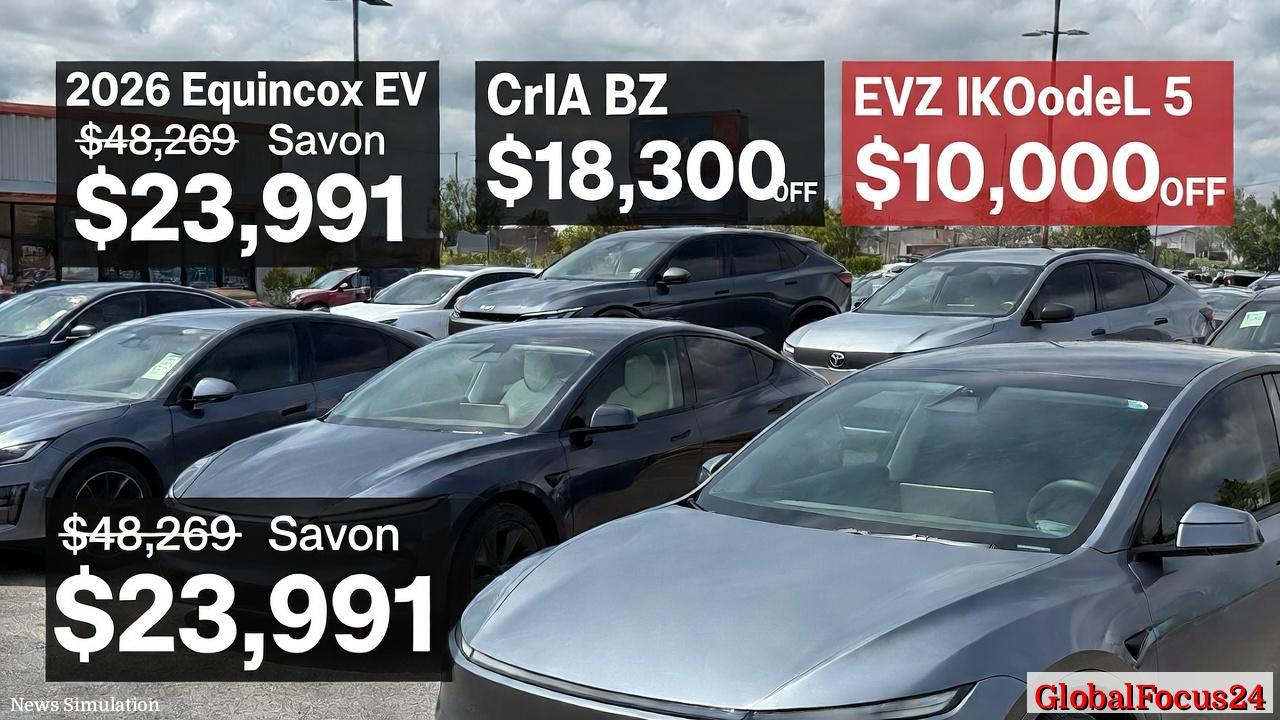
In California, for example, one buyer reportedly paid just $23,991 for a 2026 Chevrolet Equinox EV originally listed at $48,269. After nearly $10,000 in manufacturer cash and multiple dealer incentives—including optional equipment valued at $5,000—the buyer drove away with a well-equipped, 300-mile-range electric SUV for less than the cost of many gasoline crossovers.
Major Automakers Slash Prices
Across the industry, automakers are aggressively courting buyers.
Tesla, still the leader in U.S. EV sales, has cut prices by roughly $1,400 on the Model 3 sedan and $940 on the Model Y SUV, while launching lower-cost versions to maintain its competitive edge. Korean automakers Kia and Hyundai are going even further: Kia’s lease incentives on the EV6 now reach as high as $18,300, while Hyundai’s Ioniq 5 sees discounts up to $10,000 through its in-house finance arm. One Colorado buyer secured a 2026 Ioniq 5 Limited for $38,500—a steep markdown from the $51,300 list price.
Toyota, long cautious in its transition to full-electric vehicles, recently joined the fray, trimming $5,000 off its bZ series models. Ford and General Motors, meanwhile, are running special spring promotions, offering interest-free financing on select EVs and hybrid models. Together, these manufacturer-led strategies have pushed EV affordability to levels not seen since the first-generation Nissan Leaf launched over a decade ago.
Rising Gas Prices Renew Consumer Attention
While discounts alone might not have sparked a surge in EV demand, rising gas prices are changing the equation. The U.S.-Israeli conflict with Iran has disrupted crude supply lines, sending oil prices soaring above $120 a barrel for the first time since 2014. Average retail gasoline prices have now passed $5.10 per gallon nationwide, with California drivers paying closer to $6.20.
Consumers are responding in real time. Google search data shows a sharp uptick in EV and hybrid-related queries since early March, mirroring previous periods of fuel price volatility. Automotive market analytics firm Edmunds notes that dealer traffic for plug-in models has doubled in some metro areas over the past month.
“I wasn’t really considering an EV until gas hit six dollars again,” said a San Jose engineer who recently purchased a discounted Hyundai Kona Electric. “Now the math is too obvious to ignore.”
Historical Parallels to Earlier Energy Shocks
The current surge in EV interest follows a historical pattern seen during past energy crises. In the 1970s, fuel shortages prompted widespread interest in smaller, more efficient cars. A similar shift occurred in 2008, when gas prices above $4 per gallon led to a brief but significant migration toward hybrids like the Toyota Prius. Yet, each time fuel prices fell, American buyers returned to larger SUVs and trucks.
Industry analysts suggest this cycle may be harder to reverse now. Unlike earlier transitions, today’s electric vehicles offer longer ranges, faster charging, and broader model variety. More than 50 all-electric models are now available in the U.S., compared with fewer than 25 just three years ago. With charging infrastructure expanding rapidly and resale values stabilizing, many economists expect that this wave of adoption could be more lasting.
Economic Ripple Effects Across the Auto Industry
For automakers, the price war brings both opportunity and risk. Discounting can help move vehicles off lots and generate short-term cash flow, but at the expense of profit margins. Analysts warn that sustained incentives could delay future investments in battery technology and production.
Still, economists argue that lower prices might be just what the industry needs to achieve scale. “Excess supply has a way of accelerating market normalization,” said Lydia Klein, an automotive economist based in Chicago. “Discounting now helps build a larger base of EV owners, which in turn encourages more investment in infrastructure and battery recycling. It’s part of the long game.”
Regional comparisons highlight the impact even more clearly. States like California, New York, and Massachusetts—where electricity is relatively cheaper and charging networks more mature—are seeing faster EV uptake than central and southern regions. In Texas and Florida, where both electricity and gas prices remain volatile, hybrid models are gaining stronger traction than full electrics.
Dealers Adjust to the New Landscape
Dealerships, the front line of the pricing battle, are adjusting quickly. Some have transformed their marketing strategies, offering “power transition” trade-in programs that give additional rebates to customers switching from large SUVs or trucks to EVs. Others are bundling free charging credits or home charger installations as part of the sale.
“These incentives are unlike anything we’ve seen,” said a sales manager at a Los Angeles Chevrolet dealership. “For some models, customers are walking in expecting to negotiate—and leaving realizing the deal’s already done for them.”
According to Cox Automotive, national EV inventory levels remain about 35 percent higher than the industry average for gasoline vehicles. However, turnover has accelerated steadily since mid-February, coinciding with fuel price spikes. Most forecasters expect market balance to return by late summer if the current pace continues.
The Future of Electrification Amid Economic Uncertainty
Despite the current slowdown in EV profits, the industry’s long-term outlook remains positive. Federal and state governments continue to invest heavily in charging infrastructure, battery manufacturing, and renewable power grids. Even without the consumer tax credit, subsidies for domestic production aim to keep EVs cost-competitive with internal combustion vehicles.
International market trends also favor continued electrification. European and Chinese automakers are cutting costs through high-volume battery production, and U.S.-based firms are racing to catch up. The resulting global competition is likely to keep downward pressure on prices well beyond 2026.
At the same time, much depends on how long elevated oil prices last. If the conflict-induced energy disruption persists, Americans may finally begin shifting toward electric mobility on a scale not seen before. Historically, it has taken months of sustained high fuel prices to create durable changes in consumer behavior—but conditions now appear ripe for exactly that.
Changing Consumer Psychology
Beyond economics, the emotional appeal of energy independence resonates more strongly today. Many buyers cite a desire for stability and self-reliance amid rising geopolitical uncertainty. Driving electric, they say, offers some control over household expenses in an unpredictable world.
Automakers are tapping into this sentiment with targeted advertising emphasizing freedom from fuel volatility. Billboards in major metro markets spotlight slogans like “Charge Forward” and “Never Pay at the Pump Again,” linking economic anxiety with the promise of technological liberation.
As interest grows, automakers are also revisiting hybrid offerings as a bridge for nervous buyers. Models such as the Toyota Prius, Honda CR-V Hybrid, and Ford Maverick continue to post strong sales gains, serving as practical alternatives between familiar gas power and full electric conversion.
A Market in Motion
The U.S. auto industry is entering a rare period of alignment: high fuel prices, falling electric-vehicle costs, and improving technology are converging to push mass adoption closer than ever. Whether this marks a temporary price anomaly or the beginning of a long-term market shift remains to be seen.
For consumers, however, the equation is simpler. As gas prices climb and electric vehicles reach unprecedented affordability, the economic case for switching to electric power has rarely been stronger. In a year defined by uncertainty, the open road may belong to those willing to plug in rather than fill up.